
Breaking
Latest tech news from South Africa and around the world•Stay updated with breaking technology developments•Innovation and digital transformation news•AI, gaming, and gadget updates daily•Crypto and fintech news from Africa•
 Tech Team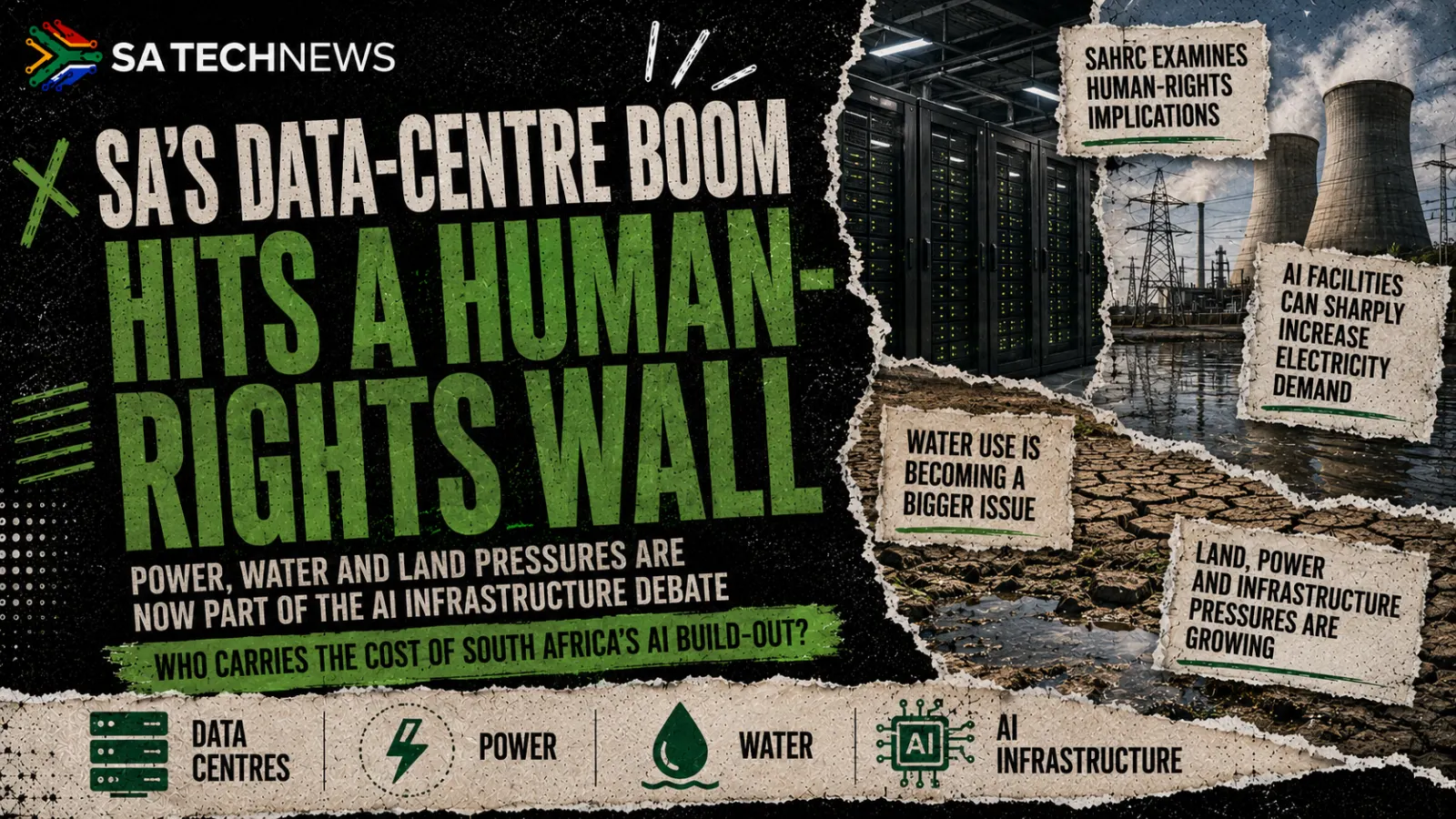
The Human Rights Commission is examining power, water, land and governance costs as civil society pushes for tougher national rules.
South Africa wants more data centres. It also wants more AI investment, more cloud infrastructure and more of the global digital economy running through local soil.
Now comes the uncomfortable part: deciding what those facilities are allowed to consume, where they can be built and what communities should get in return.
The South African Human Rights Commission has opened a high-level process examining the human-rights implications of the country's rapid data-centre expansion. The Commission is looking at electricity demand, water use, land, environmental impacts, privacy, cybersecurity, community participation, transparency and whether existing regulation is good enough for infrastructure that can consume resources at industrial scale.
That inquiry has now become a sharper political fight.
A coalition including Housing Assembly, Foxglove, Open Secrets, Research + Action and the Planetary AI Collective has asked the SAHRC to consider a national public inquiry, mandatory disclosure rules and even a temporary pause on new hyperscale approvals while a regulatory framework is developed.
The industry will strongly contest parts of that case. It should. Some of the most dramatic resource-use estimates being circulated have already been disputed.
But the underlying governance question is getting harder to avoid.
South Africa is already the continent's most mature data-centre market and has attracted major investment from global cloud and colocation companies.
That position matters. Local data centres reduce latency, help companies keep workloads in-country, support cloud services and create the compute base required for AI.
Government has been openly courting that investment as part of a broader push into cloud and artificial intelligence infrastructure.
The problem is that a hyperscale data centre is not just a warehouse full of servers.
It is a large electricity customer. Depending on its cooling design, it can also be a significant water user. It needs land, fibre, backup systems and grid capacity. It creates construction work and specialised operational jobs, but far fewer permanent jobs than a labour-intensive factory of comparable capital value.
Those trade-offs become politically sensitive in a country where households and businesses have spent years dealing with electricity constraints, water failures and expensive infrastructure.
The Commission's process is unusually broad for a technology-infrastructure issue.
It has asked stakeholders to address electricity demand and tariffs, water and cooling, climate impacts, e-waste, land use, privacy, cybersecurity, community consultation, transparency, business responsibilities and equitable access to digital infrastructure.
That list points to the real weakness in the current system: South Africa does not have one dedicated national regulatory regime for data centres.
Developments move through existing planning, environmental, electricity, water and corporate-law processes. Different authorities see different pieces.
Civil-society groups argue that nobody sees the complete national footprint and that operators are not subject to a single mandatory disclosure standard for water and electricity consumption.
Their submission estimates that South Africa already has more than 60 known facilities with roughly 500MW of disclosed capacity and says the pipeline could more than triple sector electricity demand. Those figures come from the coalition's submission and should be treated as its assessment rather than an official national register, because no such comprehensive register currently exists.
That absence is itself part of the argument.
The fight around Equinix's planned Cape Town facilities is a useful warning about how quickly this debate can become distorted.
Opponents have circulated estimates suggesting the development could consume billions of litres of water a year if conventional evaporative cooling were used.
Equinix's planned facilities, however, are not expected to use that kind of water-based cooling, making those estimates a poor description of the actual proposal.
That does not make the water question irrelevant. It makes accurate, project-specific disclosure more important.
If a facility uses closed-loop or air-based cooling, publish that. If it requires a large municipal water allocation, publish that too. If a new data centre is supported by additional renewable generation rather than drawing from existing grid headroom, make the energy plan visible.
Good regulation should make it harder for both industry marketing and activist modelling to fill an information vacuum with assumptions.
Traditional enterprise computing is not what is driving the next wave of data-centre investment globally. AI is.
Training and serving large models requires dense clusters of power-hungry accelerators. That pushes rack densities and electricity requirements far beyond conventional office IT.
South Africa therefore faces a genuine strategic choice.
It can reject large digital infrastructure and watch investment move elsewhere. That would carry its own economic cost.
Or it can treat data centres as strategic industrial infrastructure and set clear rules before the build-out becomes too large to govern coherently.
The second option is harder but more useful.
That could mean a national register, standardised reporting of electricity and water use, clearer grid-connection requirements, enforceable community-participation rules and stronger disclosure around the source of new power demand.
None of those measures requires South Africa to be anti-data-centre or anti-AI.
They require the country to stop pretending that digital infrastructure is weightless.
The cloud still lands somewhere. In South Africa, the argument is now about what that landing should cost, and who gets to decide.
Source: SA Tech News