
Breaking
Latest tech news from South Africa and around the world•Stay updated with breaking technology developments•Innovation and digital transformation news•AI, gaming, and gadget updates daily•Crypto and fintech news from Africa•
 Tech Team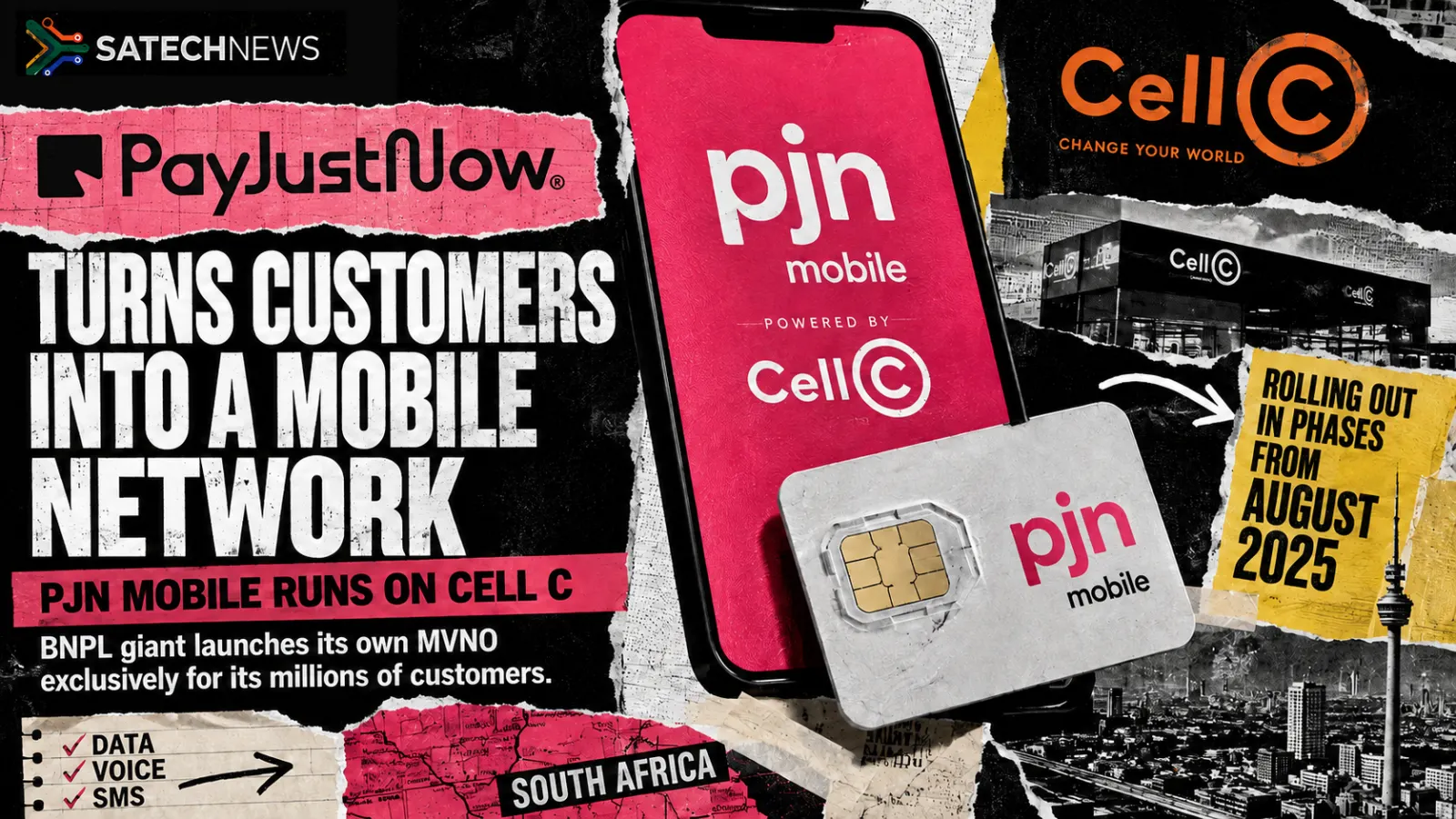
PayJustNow is launching an MVNO on Cell C, aiming to turn its buy-now-pay-later customers into mobile subscribers with credit-linked offers.
The BNPL brand is moving beyond checkout finance and into mobile connectivity, rolling out a new virtual network that runs on Cell C and plugs directly into the company's broader fintech ecosystem.
The service, called PJN Mobile, began rolling out on 27 August 2026 and is initially being opened to selected groups of existing customers rather than the whole market at once. Weaver Fintech, PayJustNow's parent company, says the phased launch is intended to test reward behaviour and the economics of the service before a wider release.
That matters because this is not just another low-cost SIM play. It is trying to use mobile connectivity as another layer in the same customer relationship that already spans buy-now-pay-later, lending and insurance.
The company is best known for its Pay-in-3 product, which lets customers split a purchase into three equal instalments, with no interest if payments are made on time. Weaver Fintech said in its latest annual reporting that the brand had 3.7 million registered customers at the end of 2025, while the group's broader BNPL base had reached 4.3 million.
That gives PJN Mobile something most new MVNOs do not have: a large, already-engaged customer base from day one.
Weaver had already signalled earlier in 2026 that it planned to launch a mobile virtual network operator. The company said the service would be designed around affordable airtime and data while using rewards to encourage customer loyalty and positive behaviour across its wider ecosystem.
The first live version is now appearing inside PayJustNow's app.
PayJustNow's own support material confirms that PJN Mobile runs on the Cell C network. Customers can order either a physical SIM or an eSIM through the app, complete RICA requirements, port an existing number and manage activation from within the PayJustNow experience.
An eSIM carries a once-off cost of R2, according to PayJustNow's support documentation. The company also says SIM activation itself is free.
PJN Mobile is being positioned around the idea that normal activity elsewhere in the Weaver ecosystem can feed back into mobile rewards.
PayJustNow's onboarding material advertises R20 of free airtime on activation, 500MB of WhatsApp data per month for six months, and the ability to earn up to R200 of airtime each month for certain on-time payments.
The company says those rewards can be linked to actions such as paying a funeral policy premium, loan instalment or BNPL payment on time.
That is a much more deliberate strategy than simply selling cheap bundles.
Weaver Ventures managing executive Andre Hugo told MyBroadband that the service was built to increase engagement across Weaver's wider customer base. Purchase behaviour, repayment behaviour and connectivity behaviour can all form part of the same customer picture.
There is a clear commercial logic to that. Weaver has spent years acquiring millions of customers through the BNPL product. Mobile gives it another frequent-use product that can keep those customers inside the ecosystem every day, rather than only when they are shopping or repaying credit.
It also creates another data point around customer activity, although that is where privacy, consent and responsible data use will become increasingly important as the ecosystem grows.
For Cell C, the launch fits neatly into the strategy it has been pursuing for years.
The operator has increasingly positioned itself as a wholesale platform for virtual networks while using national roaming and network partnerships to extend coverage. Its MVNO business has become an important part of its customer and revenue base.
PJN Mobile joins a South African market where banks, retailers, insurers and other consumer brands increasingly want their own mobile products without building physical radio networks.
The advantage for those brands is obvious: the mobile network becomes another loyalty and retention tool.
The challenge is that the market is getting crowded. A branded SIM is no longer unusual, and users already have offers from financial institutions and retail groups that bundle data, rewards and banking relationships together.
PayJustNow's differentiator is the size and activity of its BNPL base.
At the end of 2025, the brand had recorded 9.4 million cumulative transactions across more than 3,450 active merchants and 12,324 active points of presence. Weaver has since said the merchant network is expanding further.
That gives the company repeated opportunities to put PJN Mobile in front of users who are already inside its app and already understand the brand.
The launch is still controlled.
Hugo said the first cohort consisted of internal staff. The next phase is being extended to selected BNPL customers, followed by insurance and lending customers during September.
The intention is to open PJN Mobile to all new users after feedback from those groups, potentially within the next month or two.
That means South Africans should not assume the service is immediately available to every existing account.
There are also still important commercial details missing. At the time of writing, management had not publicly listed a complete set of voice and data bundle prices or its out-of-bundle rates on its main website.
The company's support pages show a bundle-builder model and confirm that out-of-bundle data can be controlled through USSD settings, but the full pricing proposition will matter once PJN Mobile moves beyond the pilot-style rollout.
The most interesting part of PJN Mobile is what it says about the direction of South African fintech.
The line between payments, credit, insurance, rewards and connectivity is becoming thinner. A company that started by helping customers split retail purchases can now use the same app and customer relationship to sell a mobile service.
If Weaver can make the rewards genuinely useful and keep pricing competitive, PJN Mobile could become an unusually effective retention layer for the BNPL firm rather than a standalone telecom business.
If it cannot, it risks becoming just another branded SIM in an increasingly busy MVNO market.
The next test is straightforward: what the bundles cost, how broad the rollout becomes, and whether millions of PayJustNow customers see enough value to move their mobile spending across.
Source: SA Tech News