
Breaking
Latest tech news from South Africa and around the world•Stay updated with breaking technology developments•Innovation and digital transformation news•AI, gaming, and gadget updates daily•Crypto and fintech news from Africa•
 Tech Team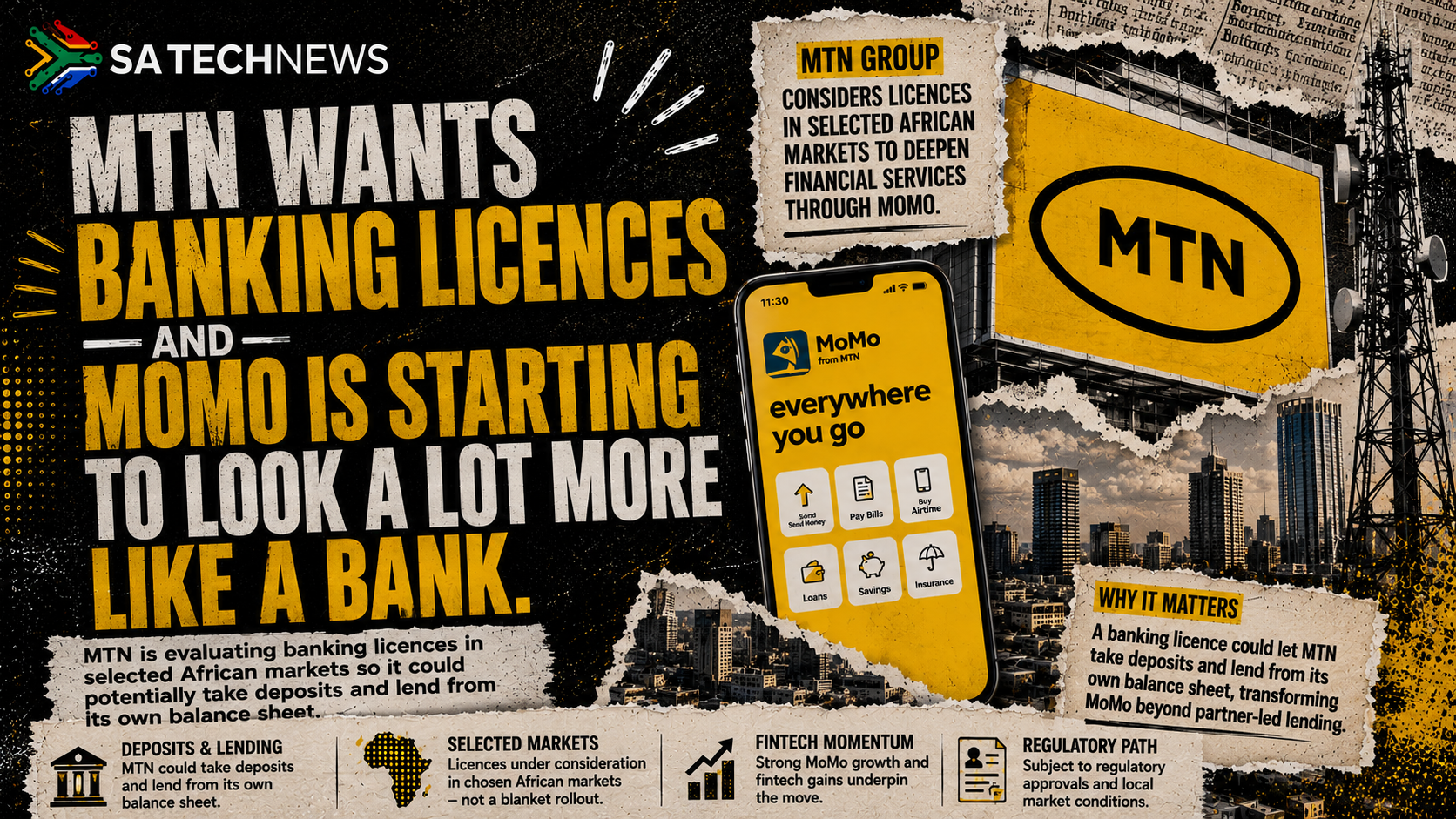
MTN is evaluating banking licences in selected African markets as it pushes MoMo deeper into lending — a move that could let the telecom group take deposits and lend from its own balance sheet.
MTN has spent years insisting that its fintech business is more than a side project attached to a mobile network. Now the group is considering a move that would make that argument much harder to dismiss: obtaining banking licences in selected African markets.
Group CEO Ralph Mupita told Reuters that MTN is evaluating licences that could allow it to take deposits and lend from its own balance sheet in markets where its Mobile Money operation has enough customers and wallet activity to justify the added complexity.
That is a meaningful shift. MTN already offers lending products through partnerships with banks and other financial institutions, but those arrangements keep much of the credit risk — and part of the economics — outside MTN itself. A banking licence could change that equation.
It would also move MoMo closer to the territory occupied by conventional banks, even if MTN does not intend to become a full-service bank everywhere it operates.
Mobile money in Africa was initially built around a simple problem: moving cash digitally where traditional banking infrastructure was thin. The model then expanded into merchant payments, remittances, insurance and other financial services.
Credit is the next obvious prize.
MTN already has the data, distribution and customer relationships needed to assess millions of users who may have limited traditional credit histories. Its developer platform lists a customer loan API across a broad set of African markets, including South Africa, Ghana, Nigeria, Uganda and Rwanda. In South Africa, MTN’s Mobile Money collection service is offered in conjunction with African Bank, illustrating the partner-led model the group currently uses.
The attraction of doing more itself is straightforward. If MTN can accept deposits and lend from its own balance sheet in carefully selected markets, it gains more control over the product, customer relationship and economics.
The risk is equally straightforward: lending money is much harder than moving it.
Credit losses, capital requirements, liquidity management and banking supervision would introduce a different level of regulatory and balance-sheet responsibility. Mupita indicated that any move towards direct lending would therefore be gradual rather than a wholesale conversion of MoMo into a bank.
That caution matters. Telecom operators have enormous customer bases, but scale does not automatically make them good lenders.
The banking discussion is part of a wider transformation inside MTN.
Its latest half-year results show a group increasingly trying to extract value from infrastructure and platforms beyond conventional voice and data. Service revenue rose 17.5% to R115.3 billion in the six months to June 2026, while adjusted headline earnings per share increased 21.3% to 793 cents. MTN also approved a R6 billion share buyback after stronger cash generation.
At the same time, the company is pushing further into digital infrastructure. MTN has established Africa Data Hub Holding through a strategic partnership with a UAE-backed data-centre investment platform. The plan includes AI-enabled data-centre capacity in South Africa and Nigeria, with an initial development ambition of about 150MW and room to expand as demand develops.
Put those pieces together and MTN increasingly looks less like a company whose future depends only on selling airtime and mobile data.
It owns connectivity. It has tens of millions of customer relationships. It operates a financial platform. It is building data-centre infrastructure. And it is now asking whether, in selected markets, it should own more of the banking layer too.
None of this means MTN is about to launch an MTN Bank in South Africa.
The group has not identified which markets it is considering for banking licences, and South Africa already has a sophisticated, heavily regulated banking sector with strong incumbent digital offerings. MTN’s local MoMo proposition also operates alongside banking partners rather than replacing them.
Markets where mobile money is more deeply embedded in everyday commerce could offer a more natural starting point. MTN has particularly strong fintech operations across several African countries where mobile wallets play a larger role in the financial system.
The important development is therefore not a hypothetical South African bank launch. It is the strategic direction.
Mobile operators have spent years watching messaging apps erode SMS, internet calling weaken voice revenue and over-the-top services capture more of the value created by their networks. Fintech gives operators a chance to move in the opposite direction: upwards into a service layer where the network, identity, payments history and distribution footprint become competitive advantages.
Banking licences would take that strategy one step further.
MTN does not need to turn every MoMo wallet into a bank account for this to matter. It only needs to prove that in the right markets, a telecom operator can use its mobile-money scale to become a credible deposit-taker and lender.
If that works, the old distinction between an African mobile network and a financial institution gets considerably harder to draw.
Source: SA Tech News