
Breaking
Latest tech news from South Africa and around the world•Stay updated with breaking technology developments•Innovation and digital transformation news•AI, gaming, and gadget updates daily•Crypto and fintech news from Africa•
 Tech Team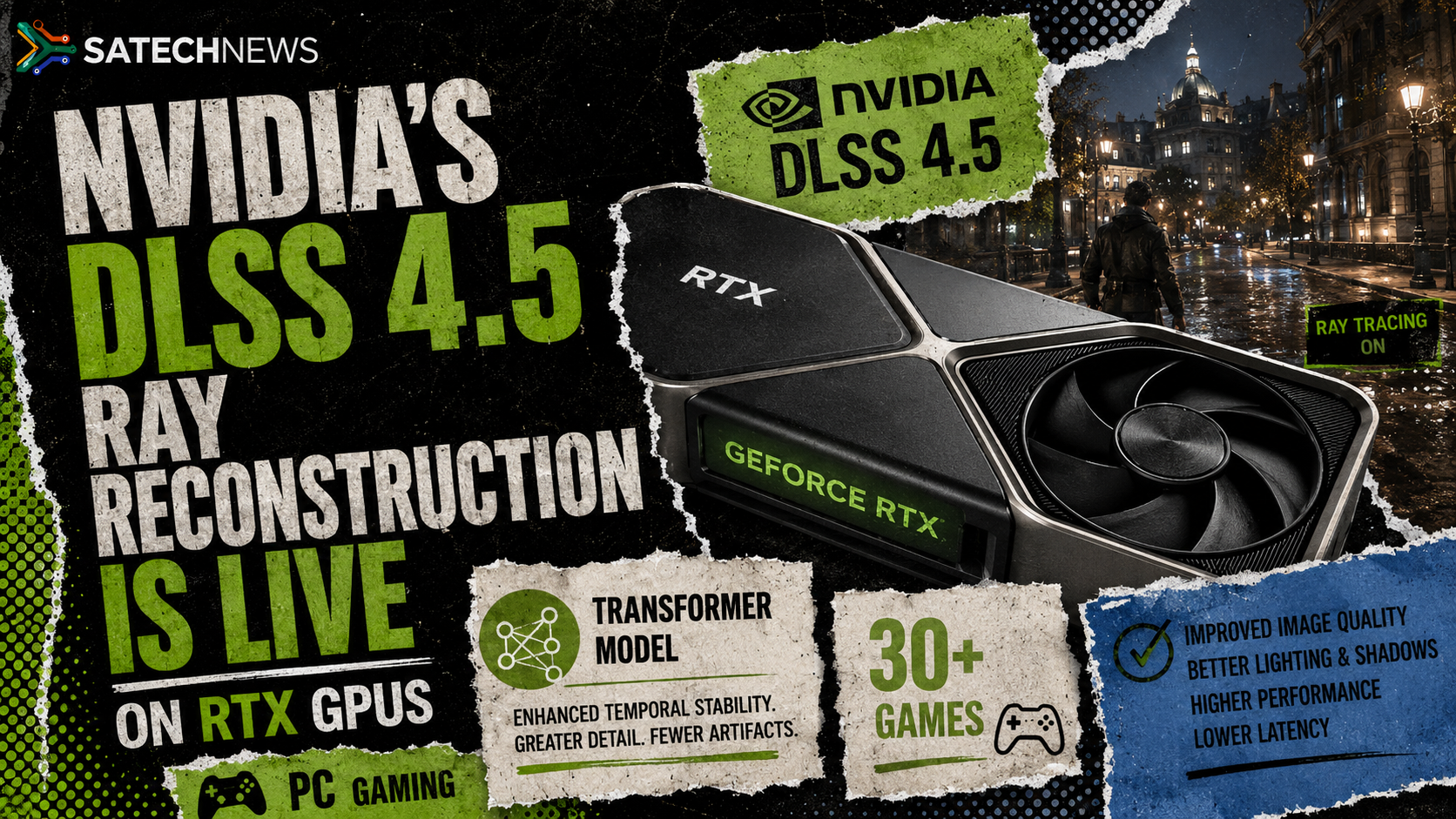
Nvidia has released the second-generation transformer model behind DLSS 4.5 Ray Reconstruction, bringing it to supported ray-traced games through the Nvidia app.
Nvidia has switched on the Ray Reconstruction part of DLSS 4.5, bringing its latest neural rendering model to supported ray-traced and path-traced PC games.
The update was released around Gamescom 2026 and is available through a new version of the Nvidia app.
Unlike Multi Frame Generation, which creates additional frames to raise displayed frame rates, Ray Reconstruction is primarily about image quality.
It replaces traditional hand-tuned denoisers with a neural network trained to reconstruct the parts of a ray-traced image that were not fully sampled by the renderer.
Nvidia says the new DLSS 4.5 model uses a second-generation transformer architecture with 35% more compute capability and 20% more parameters while maintaining similar performance to the previous model.
Those are Nvidia’s own figures, but the technical direction is important even without the percentages: the company is continuing to move more of the real-time rendering pipeline from fixed graphics algorithms into learned models.
Ray tracing works by firing rays into a scene to calculate lighting, reflections and shadows.
The problem is that tracing enough rays for a perfectly clean image is extremely expensive.
Games therefore work with limited samples and use denoising techniques to infer what the final image should look like.
Traditional denoisers are usually tuned for specific lighting effects and can introduce problems such as ghosting, unstable details or blurred textures.
DLSS Ray Reconstruction attempts to replace several of those hand-built denoisers with one AI model that analyses temporal information, motion data and samples from the game engine.
The goal is a more stable high-resolution image with cleaner lighting and fewer artefacts.
DLSS 4.5 uses a new transformer model that Nvidia says has deeper spatial awareness and has been trained on a larger dataset.
One useful detail is that Ray Reconstruction is not limited to the newest GeForce cards.
Nvidia says the feature works across GeForce RTX GPUs, although performance and access to other parts of the DLSS 4.5 stack still vary by hardware generation.
The newest RTX cards get the widest set of features, including the more aggressive Multi Frame Generation options, while older RTX hardware can still benefit from technologies such as Super Resolution and Ray Reconstruction where supported.
That matters in South Africa because GPU upgrade cycles tend to be longer than Nvidia’s product cycles.
A software image-quality improvement that extends to existing RTX owners is more useful locally than a feature that requires an immediate jump to the newest high-end card.
The updated Nvidia app lets users apply the new Ray Reconstruction model to supported games through driver settings.
Nvidia says the model can currently be overridden into around 30 compatible titles, with developers also rolling it into games through official updates.
Supported examples include Cyberpunk 2077, Alan Wake 2, Indiana Jones and the Great Circle, Doom: The Dark Ages and several other ray-traced or path-traced titles.
The company is also bringing the technology into RTX Remix, its modding platform for adding modern rendering features to older PC games.
That means DLSS 4.5 is not only aimed at new releases. It is becoming part of Nvidia’s wider attempt to make AI reconstruction a standard layer between game engines and the final image.
Nvidia’s DLSS technology has improved substantially across generations, but neural rendering is not automatically better in every scene.
Reconstruction models can still produce temporal instability, strange detail recovery or artefacts around thin geometry, particles and rapidly moving objects.
The quality can also vary depending on how well a game exposes motion vectors and other engine data.
That is why side-by-side testing matters more than a feature list.
The interesting question for DLSS 4.5 is whether the new transformer model improves the difficult cases without adding enough processing cost to erase the performance benefit.
Nvidia says the model maintains performance similar to the previous Ray Reconstruction version despite being larger.
Independent testing will show how consistently that holds across different RTX cards.
The bigger story is that DLSS no longer looks like an optional upscaler bolted onto a game.
Nvidia now uses learned models for resolution reconstruction, frame generation and ray-traced image reconstruction, while game developers increasingly design their rendering pipelines around those capabilities.
AMD and Intel are pursuing their own versions of the same broader idea.
For PC gamers, that changes what a GPU upgrade means. Raw shader and ray-tracing performance still matter, but software models are increasingly responsible for how the final image is assembled.
DLSS 4.5 Ray Reconstruction is another step in that shift.
It is available now, and because it reaches existing RTX hardware, a large number of South African PC gamers can test whether the new model produces a visible improvement before spending anything on a new graphics card.
Source: SA Tech News