Breaking
Latest tech news from South Africa and around the world•Stay updated with breaking technology developments•Innovation and digital transformation news•AI, gaming, and gadget updates daily•Crypto and fintech news from Africa•
 Tech Team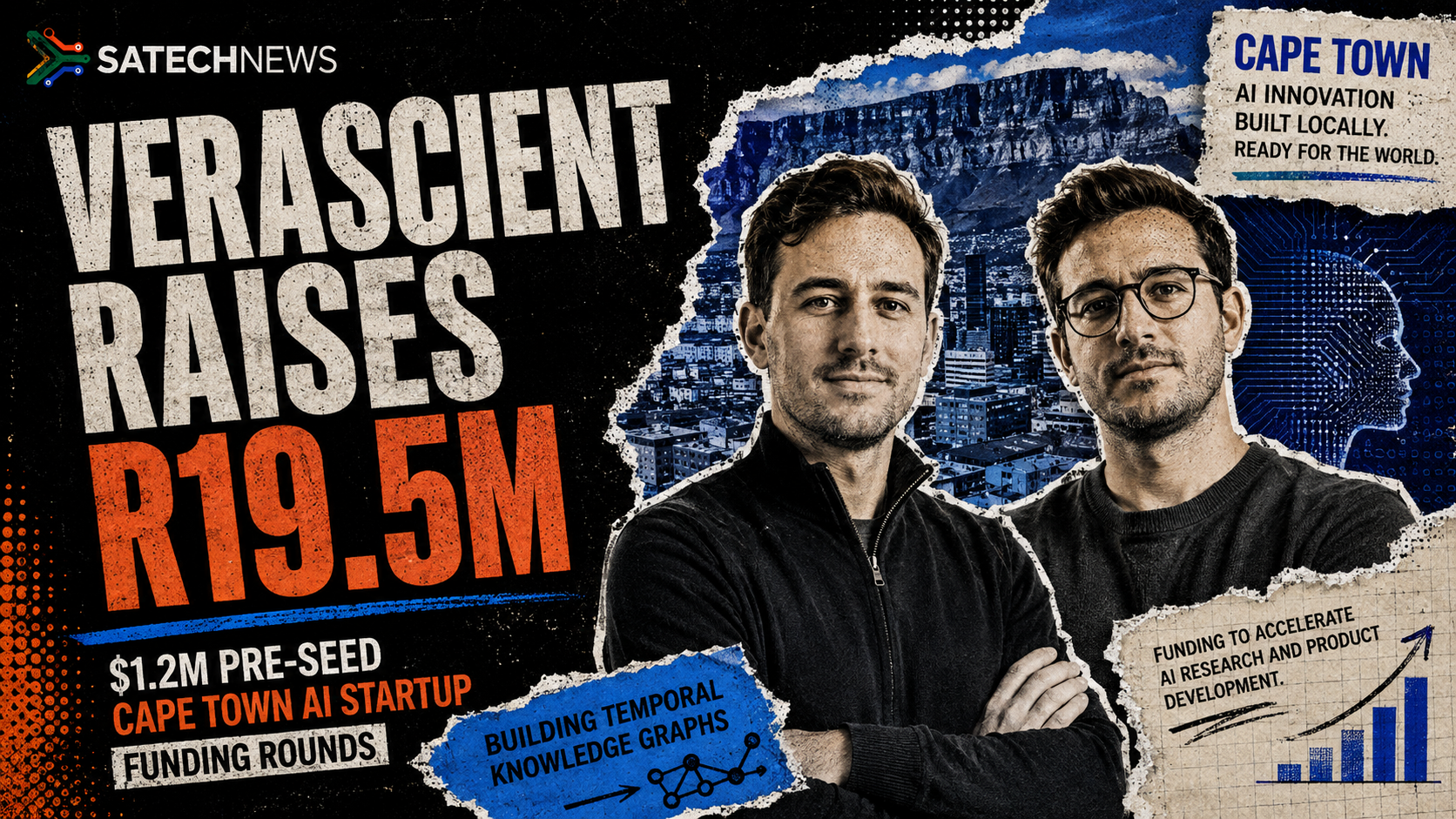
Verascient has closed an oversubscribed $1.2 million pre-seed round to build enterprise AI systems around the knowledge companies already have.
Cape Town-founded Verascient has raised $1.2 million, roughly R19.5 million, in an oversubscribed pre-seed round built around a fairly unglamorous AI problem: most companies still cannot get their own information into a shape that useful AI agents can reliably work with.
The startup says it turns knowledge scattered across documents, internal systems and employees into shared organisational context, then builds workflows and agents that can use that context in day-to-day work.
The round was backed by Founder Collective, Andrena Ventures, Cambridge Enterprise and Summit Ventures, with participation from South African angel investors including Alan Knott-Craig and Shayne Mann.
Verascient was founded by Keagan Stokoe and Emile Dos Santos Ferreira. Stokoe is chief executive and Ferreira is chief technology officer.
The company plans to use the capital primarily to expand its engineering team and deepen its technology as it takes on more enterprise deployments.
Verascient’s pitch is deliberately different from selling companies a general-purpose chatbot and hoping employees discover useful things to do with it.
Large organisations already have enormous amounts of useful context. The problem is that it lives in email threads, meeting notes, CRM records, shared drives, spreadsheets, policy documents and the heads of individual staff members.
When an AI system cannot see that context, it can answer general questions but struggles with the work that actually makes a company distinctive.
Verascient says its core technology uses a temporal knowledge graph to connect that information while preserving history, permissions and provenance. In practice, that means an AI agent should be able to understand not only what a document says, but which version is current, who is allowed to use it and where the information came from.
That is a much harder problem than simply embedding a folder of PDFs into a search index.
It is also where many enterprise AI projects start to break down.
The first wave of corporate generative AI adoption was dominated by experimentation: internal chatbots, meeting summaries, coding assistants and pilots that could be launched without touching the most sensitive parts of a business.
The next phase is more difficult.
Companies want AI systems that can complete processes, query operational data and take actions. That requires cleaner integration with existing systems and tighter controls over who or what is allowed to access information.
Verascient is targeting sectors including financial services, insurance and logistics, where institutional knowledge is valuable but often fragmented across old systems and highly regulated workflows.
Those industries are also exactly where loose permissions and unreliable answers can become expensive.
The company’s approach therefore combines software with hands-on deployment work inside client organisations. That makes the model more services-heavy than the classic “sign up and start using it” SaaS playbook, but it reflects the reality of enterprise AI today: the difficult part is often integration, governance and organisational change rather than access to a foundation model.
At $1.2 million, this is not a huge AI funding round by global standards. It is more interesting because of where Verascient is trying to position itself.
Founder Collective is a US venture firm whose historical portfolio includes companies such as Uber and Airtable. Cambridge Enterprise is linked to the University of Cambridge’s innovation ecosystem, while the round also includes local capital and operators.
For a South African pre-seed company, that mix provides access to networks outside the domestic market without forcing the company to pretend its opportunity is limited to South Africa.
Verascient says it wants to build from Cape Town while serving companies internationally.
The funding also arrives at a moment when investors are becoming more selective about AI startups. A generic wrapper around a third-party model is increasingly difficult to defend. Startups need proprietary data, deep workflow integration, specialised distribution or a technical layer that customers cannot easily reproduce themselves.
Verascient is betting that organisational context can be that layer.
The company still has plenty to prove.
Temporal knowledge graphs sound useful, but enterprise buyers will care about deployment time, security, integration cost, accuracy and whether the system can stay up to date as staff, documents and permissions change.
They will also want clarity on which model providers sit underneath the product, how sensitive data is isolated and what happens when an agent is wrong.
Those are not edge cases. They are the actual buying criteria for AI inside banks, insurers and logistics companies.
Verascient’s R19.5 million gives it time to build the engineering capacity to answer those questions.
The more important test is whether it can turn a compelling technical thesis into repeatable deployments. If it can, the company may have found a useful position in the AI stack: not another assistant that knows the internet, but infrastructure that helps an AI system understand the company it is supposed to work for.
Source: SA Tech News