
Breaking
Latest tech news from South Africa and around the world•Stay updated with breaking technology developments•Innovation and digital transformation news•AI, gaming, and gadget updates daily•Crypto and fintech news from Africa•
 SA Tech News Desk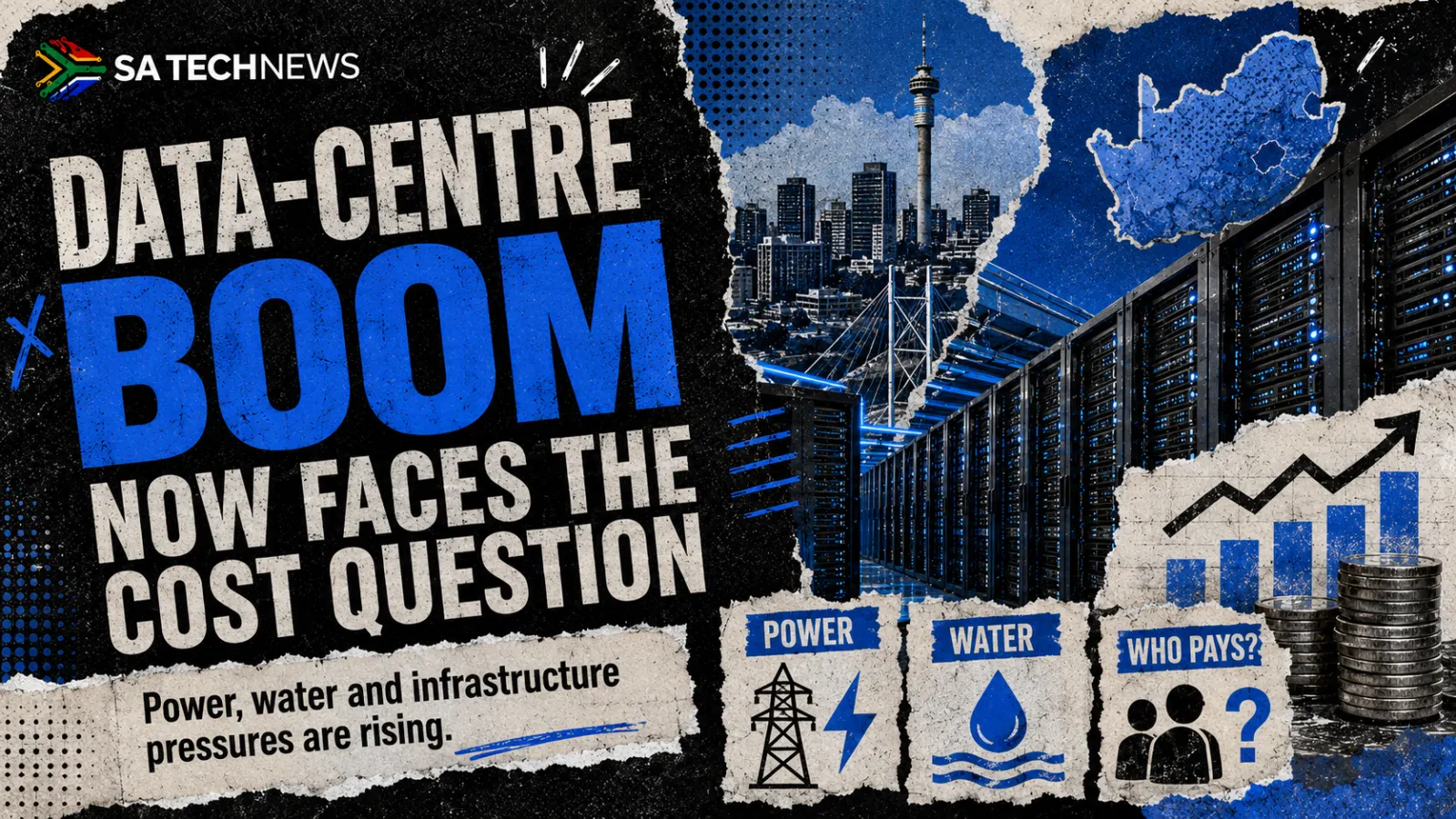
South Africa wants more cloud and AI capacity. Civil society is asking who absorbs the pressure on water, power and land.
Data centres are usually sold through images of polished corridors, blue LEDs and very expensive servers.
The South African Human Rights Commission is asking everyone to look outside the building.
Who supplies the water? Who builds the grid connection? What happens to nearby communities if electricity demand rises? Who benefits from the investment? And how transparent should developers be about what the facilities are actually used for?
Those questions are now part of an SAHRC inquiry into the human-rights implications of South Africa's rapidly expanding data-centre and digital-infrastructure sector.
The debate has quickly split into two familiar camps.
Civil-society groups warn that communities could carry the environmental and infrastructure costs while profits flow elsewhere.
The technology industry argues that data centres are being singled out unfairly, that local facilities use water and energy more efficiently than critics suggest, and that digital infrastructure itself enables important rights such as access to information.
Both sides have a point.
That is exactly why this debate matters.
South Africa has hosted serious data-centre infrastructure for years.
Johannesburg and Cape Town are established regional hubs, with global cloud providers and specialist operators investing heavily in local capacity.
But artificial intelligence has changed expectations.
Traditional cloud workloads already require enormous computing infrastructure. AI training and inference add another layer of demand, particularly for power-hungry GPU clusters.
Every major technology company wants more capacity. Every government wants to attract the investment. Every city wants the jobs and tax base.
The physical footprint arrives with the digital one.
Servers produce heat. Heat has to be removed. Cooling consumes energy and, depending on the design, water. Backup systems need fuel or batteries. Large facilities require high-capacity grid connections and often dedicated substations.
None of this is inherently unacceptable.
It is simply infrastructure, and infrastructure has trade-offs.
The Climate Justice Coalition, a grouping of trade unions, civil-society organisations and community groups, has taken the hardest line in its submission to the SAHRC.
It argues that new data-centre developments should be halted while South Africa establishes more transparent and inclusive planning processes.
The coalition's concerns centre on electricity, water, land and pollution.
It warns that host communities could face pressure on scarce public resources while the financial benefits accrue to a small group of companies and investors.
It also opposes the possibility that rising data-centre demand could be used to justify new fossil-fuel generation, gas infrastructure or expanded nuclear capacity.
The group has called for greater transparency around planned developments and wants non-disclosure agreements restricted where they prevent communities from understanding the scale and purpose of projects.
That last point is likely to become increasingly important.
Data-centre projects are often discussed publicly in megawatts and investment values while details about water usage, grid arrangements and actual computing workloads remain commercially sensitive.
The bigger the projects become, the harder it is to argue that those details have no public-interest dimension.
The Internet Service Providers' Association has pushed back strongly against the idea that data centres should be treated as a standalone human-rights threat.
Its argument is essentially that the system is more complicated than "data centre uses water, therefore community loses water".
South Africa already has serious failures in municipal water infrastructure. Electricity demand has also changed significantly as households and businesses install solar and some energy-intensive industries shrink.
ISPA argues that data centres can create stable, predictable electricity demand that supports investment in the grid and can even help reduce unit costs over time.
It also says local operators have strong commercial incentives to minimise water and energy consumption because both are major operating expenses.
That is an important counterpoint.
A modern hyperscale facility in Gauteng cannot be assumed to consume resources in the same way as an older data centre in Arizona or Ireland. Climate, cooling design and operating practices differ.
Imported headlines about global data-centre water consumption are not automatically evidence of local impact.
South Africa needs local measurements.
Few infrastructure debates become emotional as quickly as water.
Cape Town's drought is still recent enough that residents remember restrictions, queues and "Day Zero" language clearly.
When reports claim a new data centre could consume millions of litres per day, the instinctive response is obvious: why should servers receive water when communities struggle with supply?
The problem is that data-centre water numbers are often presented without context.
Some facilities use closed-loop cooling. Some rely heavily on air cooling. Others use treated or non-potable water. Consumption changes with weather and workload.
The correct response is not to dismiss the concern. It is to require accurate disclosure.
Developers should publish expected annual water consumption, peak demand, water source and cooling technology in a form that can be compared with other industrial users.
If a facility genuinely uses little water, transparency helps the developer.
If it uses a lot, the public deserves to know.
South Africa spent years with too little generation and rolling blackouts.
Now Eskom periodically faces excess supply as demand patterns change and private solar reduces grid consumption during the day.
That makes the claim that data centres simply "steal electricity from households" too simplistic.
Large, predictable customers can improve utilisation of generation assets and support new transmission investment.
But timing matters.
A data centre needs power 24 hours a day. Solar is intermittent. Backup systems cannot carry hyperscale operations indefinitely. If several large facilities cluster in a constrained part of the grid, local transmission and substation upgrades may still be required.
The central policy question is who funds those upgrades.
If private developers pay the full cost of the infrastructure they need, the public may benefit from stronger networks.
If taxpayers or ordinary electricity users subsidise upgrades primarily required by large commercial facilities, the argument changes.
That is the "who pays?" question at the heart of the debate.
The industry is correct about one thing that often disappears from environmental arguments: data centres are not optional decoration in a digital society.
Banking systems run in them. Government services depend on them. Websites, messaging platforms, streaming, e-commerce and cloud business tools all need physical computing infrastructure somewhere.
As South Africa digitises identity documents and more public services, local data infrastructure becomes even more important.
Keeping data close to users improves latency and resilience. Local hosting can also simplify compliance with privacy and sovereignty requirements.
The goal therefore cannot realistically be "no data centres".
The real question is what responsible expansion looks like.
This is the moment to set them.
Developers need predictable approval processes. Communities need access to credible information. Utilities need clarity on grid costs. Municipalities need standards for water disclosure. Regulators need to understand how AI workloads change demand.
Without that framework, every major project risks turning into the same argument after construction has already been proposed.
South Africa should want the investment.
Cloud and AI infrastructure can create skilled jobs, attract international capital and make the country a more important digital hub for the continent.
But "investment" cannot be the end of the conversation.
The SAHRC inquiry is useful because it forces the industry to explain the physical consequences of the digital economy in plain terms.
The strongest outcome would not be a blanket moratorium or a free pass for developers.
It would be a transparent set of rules that answers four basic questions before the first server arrives: how much water, how much power, who pays for the infrastructure, and what does the surrounding community get in return?
If South Africa can answer those properly, the data-centre boom becomes much easier to defend.
Source: SA Tech News