
Breaking
Latest tech news from South Africa and around the world•Stay updated with breaking technology developments•Innovation and digital transformation news•AI, gaming, and gadget updates daily•Crypto and fintech news from Africa•
 Tech Team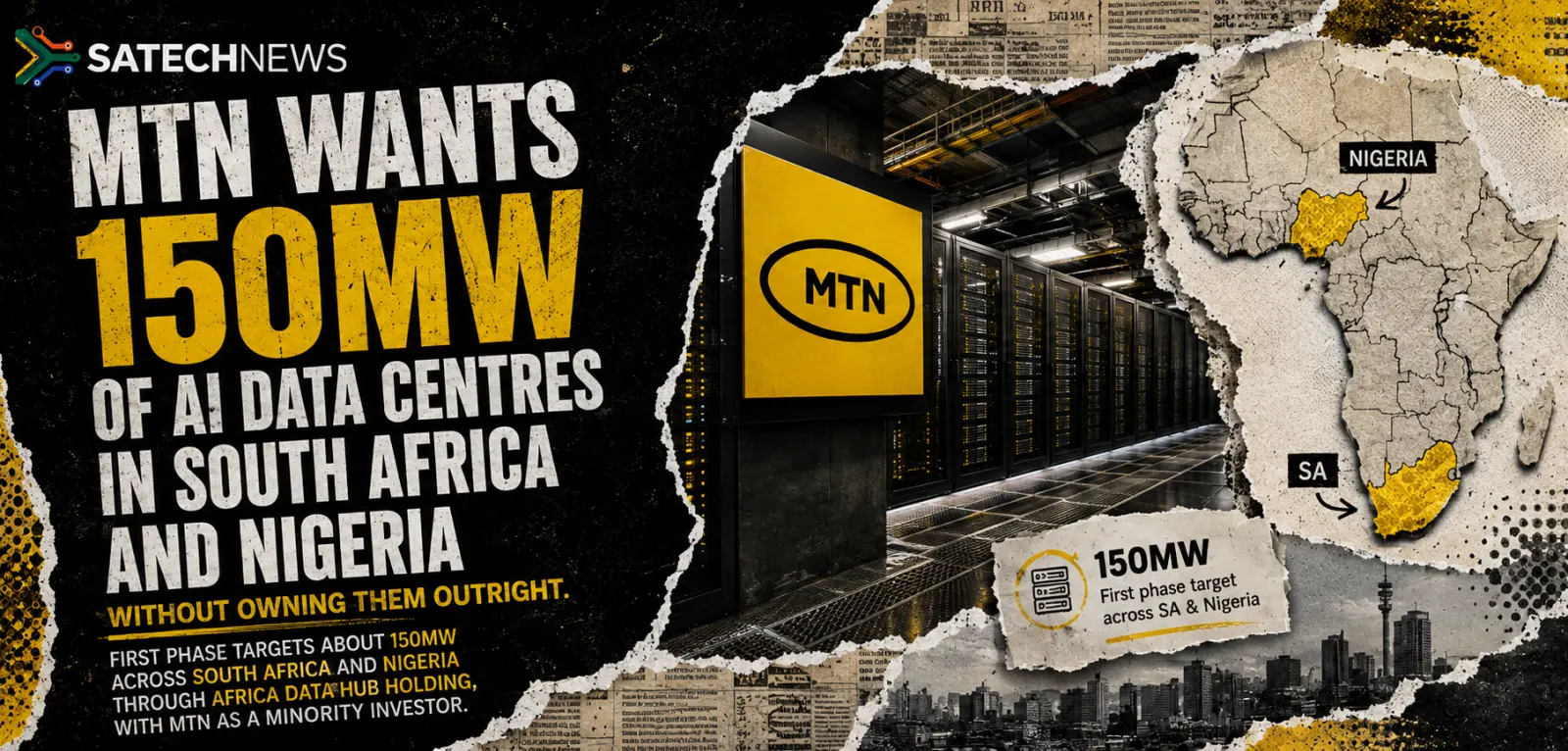
MTN wants about 150MW of AI-ready capacity in South Africa and Nigeria in a UAE-backed venture, staying a minority investor.
MTN Group has put a hard number on the first phase of its African AI infrastructure push: about 150MW of data-centre capacity across South Africa and Nigeria.
The important part is not only the size. MTN does not plan to carry the build on its own balance sheet.
Group CEO Ralph Mupita said the operator will be a minority investor in Africa Data Hub Holding, a venture formed with an unnamed UAE-backed data-centre investment platform. The partner is expected to bring most of the capital and specialist infrastructure expertise, while MTN contributes access to markets, network infrastructure and demand across its footprint.
That is a different model from simply turning a telecoms operator into a hyperscale data-centre owner.
MTN disclosed the partnership in its interim results for the six months ended 30 June 2026, saying its digital-infrastructure arm had entered a strategic partnership to accelerate AI-ready infrastructure across Africa.
The results did not initially spell out the capacity target. Mupita later told journalists that phase one is aimed at roughly 150MW across South Africa and Nigeria, with further phases built as demand develops.
For context, 150MW is meaningful data-centre capacity. AI facilities consume large amounts of electricity because the GPUs and other accelerators used for training and inference run densely and require significant cooling. The power requirement is now one of the defining constraints in the global race to add AI compute.
MTN says the venture is already looking at land and power arrangements for later phases rather than waiting for the first facilities to fill up.
That matters in South Africa, where securing grid capacity can be as difficult as securing finance or servers.
The structure tells us something about MTN's broader strategy.
Instead of trying to fund every data-centre build itself, the group is using partnerships to move into infrastructure categories that require huge amounts of capital but sit close to its existing network business.
The logic is straightforward: MTN already carries enterprise and mobile traffic, sells cloud and connectivity services, owns fibre and transmission assets in multiple markets, and has relationships with governments and large businesses. AI data centres create another layer of infrastructure that can sit beside those businesses.
But data-centre construction is expensive, specialised and exposed to long development cycles. Keeping a minority position limits MTN's capital burden while still giving it a seat at the table.
It is similar to the way large telecom groups have increasingly separated towers, fibre and other infrastructure from their traditional retail operations.
South Africa is already the continent's largest data-centre market, with major global and regional operators concentrating capacity in Johannesburg and Cape Town.
The arrival of generative AI is changing the economics. Conventional cloud workloads can often be distributed relatively flexibly. Large AI training and inference workloads need dense GPU clusters, fast interconnects, reliable power and, in many cases, substantial cooling infrastructure.
That creates opportunity, but also pressure.
South Africa is simultaneously trying to expand renewable generation, stabilise the grid and deal with water constraints in several major urban areas. New AI-ready campuses will therefore be judged not only on computing capacity, but on where their electricity and water come from.
MTN's decision to secure land and power for multiple phases shows that it understands the bottleneck is not simply buying servers.
There is another risk: capacity does not automatically equal demand.
African companies are adopting AI quickly, but large-scale GPU demand is still concentrated among a relatively small number of hyperscalers, financial institutions, telecom operators, governments and well-funded technology companies.
MTN will need enough anchor customers to justify repeated expansion beyond the initial sites.
Mupita has also spoken about creating an open AI environment that can route workloads to different frontier and open-weight models rather than tying customers to one provider. If MTN can combine that software layer with local compute and connectivity, the proposition becomes more interesting than simply renting racks.
The first test, however, is execution.
MTN now has a partner, a structure and a 150MW target. What it has not yet disclosed is the UAE partner's identity, the split of capacity between South Africa and Nigeria, the exact sites, the investment value or when the first megawatts will come online.
Those details will determine whether this becomes a major new African infrastructure platform or another ambitious data-centre plan waiting for power, permits and customers.
Source: SA Tech News