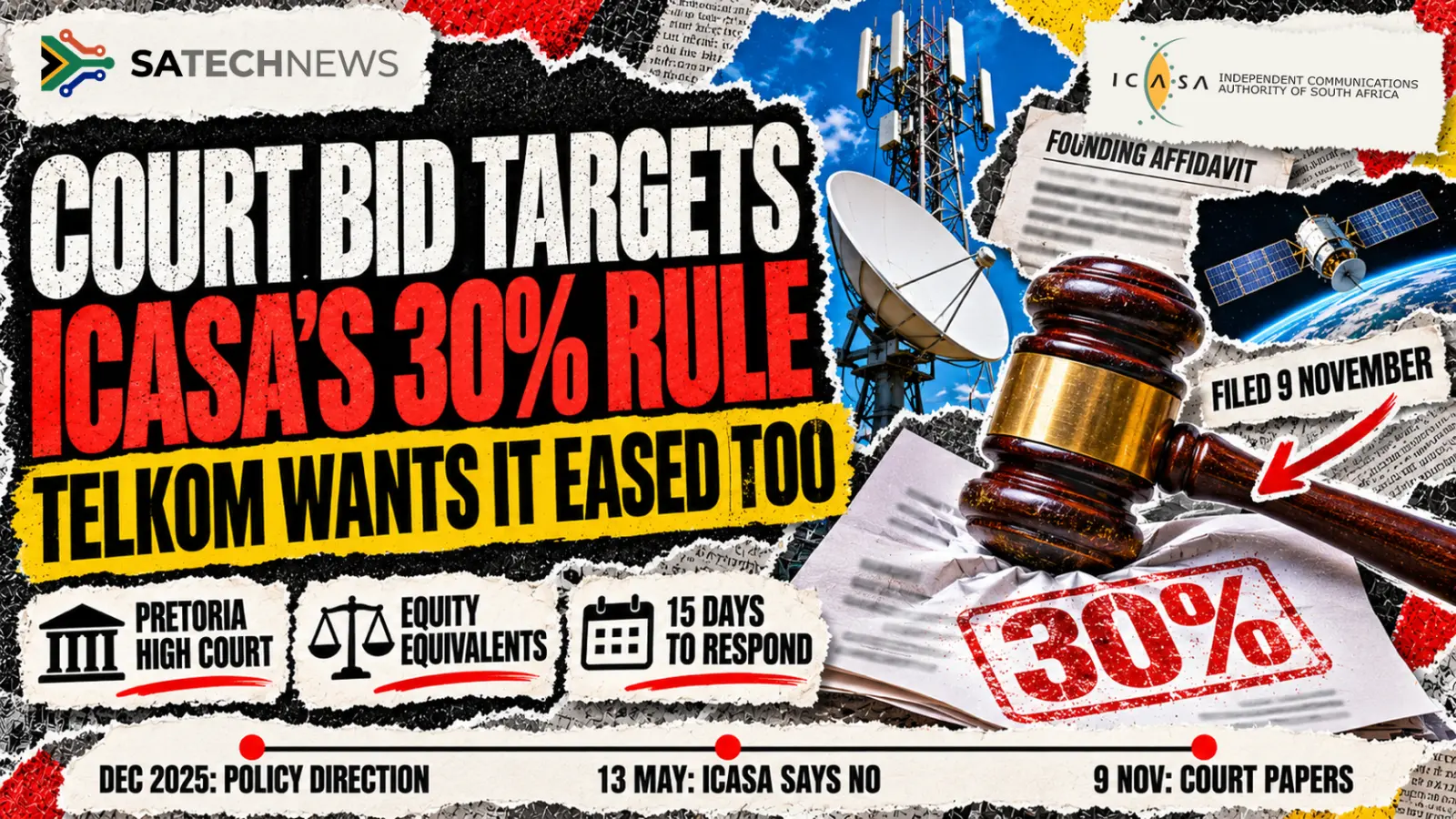
Sakeliga has asked the Pretoria High Court to set aside Icasa's 30% ownership stance. Telkom also wants the rule eased, for every operator, Starlink too.
Business group Sakeliga has asked the Pretoria High Court to overturn Icasa's position that every individual telecoms licensee must be at least 30% owned by historically disadvantaged groups. The papers were filed on 9 November and target a decision the regulator communicated on 13 May.
The case matters to anyone waiting for Starlink, and to every operator already licensed here. If the court agrees with Sakeliga, Icasa could accept equity-equivalent investment programmes in place of a shareholding, without waiting for Parliament to change the law. SpaceX has refused to sell 30% of a local Starlink business, which is why the service still has no South African licence.
Sakeliga is not alone in objecting to how the rule works. A submission Telkom made to Icasa in February, now published on the regulator's website and reported by TechCentral this week, argues that Icasa's ownership regulations go further than the B-BBEE Act and the ICT sector code.
What Sakeliga wants the court to do
The application asks for three things. First, that Icasa's 13 May decision be reviewed and set aside. In that decision the regulator said it could not give full effect to communications minister Solly Malatsi's December 2025 policy direction without a legislative amendment, because the Electronic Communications Act "requires a minimum 30% ownership by historically disadvantaged groups for individual licence holders".
Second, Sakeliga wants a declaration that section 9(2)(b) of the Act does not fix 30% as a precondition for granting, renewing or transferring a licence. The section says the equity percentage "must not be less than 30%, or such other conditions or higher percentage as may be prescribed". Sakeliga reads "such other conditions" as giving Icasa a choice. Johann Venter, the group's legal officer, puts it this way in the founding affidavit: "A 30% equity ownership requirement is one condition Icasa may prescribe. But it is not the only one."
Third, if the court finds Icasa's reading is correct, Sakeliga asks that the section be declared unconstitutional to the extent that it makes 30% ownership a precondition without recognising equity equivalents. An order of that kind would have no force until the Constitutional Court confirmed it.
The respondents are Malatsi, Icasa, its chairperson and the director-general of the Department of Communications and Digital Technologies. Sakeliga's own statement says the order it seeks would not scrap the requirement, only compel the state to offer alternatives, and it is blunt about what it thinks of that outcome: the state "would replace a racial quota with a racial handicap".
Telkom's objection is narrower
Telkom, which is partly state-owned, told Icasa it is "in full support" of the regulator's empowerment mandate. Its complaint is that the 2021 regulations, which require 30% ownership by historically disadvantaged groups for the life of a licence plus at least level 4 B-BBEE status, have created "regulatory and policy uncertainty" that raises compliance costs and may have discouraged network investment.
It wants empowerment to be measurable through skills development, local supply chains, infrastructure investment and research funding as well as equity. It also wants one rulebook. Separate treatment for new entrants, Telkom warns, "may ultimately result in the creation of a dual regulatory regime". Any satellite operator selling directly to South Africans, it says, should hold the same network, service and spectrum licences as everyone else. It names Starlink, Amazon Leo, Spacesail, Eutelsat OneWeb and Avanti.
That is a different position from Sakeliga's. Telkom is asking for the rule to be eased for all licensees on equal terms. Sakeliga opposes race-based ownership rules in principle and won a high court ruling in June that international airlines cannot be made to meet B-BBEE licensing criteria.
Where the law stands
Malatsi told Parliament in May that government would "pursue legislative amendments that will enable equity equivalent investment programmes". The Electronic Communications Amendment Bill tabled in April does not deal with ownership. In a discussion document dated 30 October, Icasa provisionally concluded that would-be operators should be able to apply for network licences directly, but they would still have to meet the Act's ownership requirement.
Icasa now has 15 days to file the record of its May decision, after which Sakeliga may amend its case. The respondents have 15 days to say whether they will oppose.
The dates, in order
The dates in the papers run in a line. In December 2025 communications minister Solly Malatsi issued a policy direction. On 13 May Icasa said it could not give that direction full effect without a legislative amendment, because it reads the Electronic Communications Act as requiring a minimum 30% ownership by historically disadvantaged groups for individual licence holders. Telkom's submission, made in February and now published on the regulator's website, argues that Icasa's 2021 ownership regulations go further than the B-BBEE Act and the ICT sector code. On 30 October a discussion document from Icasa provisionally concluded that would-be operators should be able to apply for network licences directly, and that they would still have to meet the Act's ownership requirement. On 9 November Sakeliga filed in the Pretoria High Court.
Malatsi told Parliament in May that government would "pursue legislative amendments that will enable equity equivalent investment programmes". The Electronic Communications Amendment Bill tabled in April does not deal with ownership. That is the gap the court papers are aimed at: whether section 9(2)(b) already lets Icasa prescribe something other than a 30% shareholding.
Two objections, not one
Telkom and Sakeliga are not asking for the same order. Telkom told Icasa it is "in full support" of the empowerment mandate. Its complaint is that the 2021 regulations, which require 30% ownership by historically disadvantaged groups for the life of a licence plus at least level 4 B-BBEE status, have created "regulatory and policy uncertainty", raised compliance costs and may have discouraged network investment. It wants empowerment measured through skills development, local supply chains, infrastructure investment and research funding as well as equity. It wants one rulebook. Separate treatment for new entrants, it warns, "may ultimately result in the creation of a dual regulatory regime". Any satellite operator selling directly to South Africans should, in Telkom's submission, hold the same network, service and spectrum licences as everyone else. It names Starlink, Amazon Leo, Spacesail, Eutelsat OneWeb and Avanti.
Sakeliga wants the 13 May decision reviewed and set aside. It wants a declaration that section 9(2)(b) does not fix 30% as a precondition for granting, renewing or transferring a licence. The section says the equity percentage "must not be less than 30%, or such other conditions or higher percentage as may be prescribed". Johann Venter, Sakeliga's legal officer, says in the founding affidavit: "A 30% equity ownership requirement is one condition Icasa may prescribe. But it is not the only one." If the court finds Icasa's reading is the correct one, Sakeliga asks that the section be declared unconstitutional to the extent that it makes 30% ownership a precondition without recognising equity equivalents. An order of that kind would have no force until the Constitutional Court confirmed it.
Sakeliga's own statement says the order it seeks would not scrap the requirement, only compel the state to offer alternatives. It describes that outcome in its own words: the state "would replace a racial quota with a racial handicap". Sakeliga opposes race-based ownership rules in principle, and it won a high court ruling in June that international airlines cannot be made to meet B-BBEE licensing criteria. Telkom is asking for the rule to be eased for all licensees on equal terms.
What happens in the next fortnight
Icasa now has 15 days to file the record of its May decision. After that record is in, Sakeliga may amend its case. The respondents have 15 days to say whether they will oppose. Those respondents are Malatsi, Icasa, its chairperson and the director-general of the Department of Communications and Digital Technologies. The chairperson is not named in this account.
The practical stake for a South African reader is the licence Starlink does not have. SpaceX has refused to sell 30% of a local Starlink business. If the court agrees with Sakeliga, Icasa could accept equity-equivalent investment programmes in place of a shareholding, without waiting for Parliament to change the law. If the court does not, the 13 May position stands: the Act, as Icasa reads it, still requires that minimum for an individual licensee.