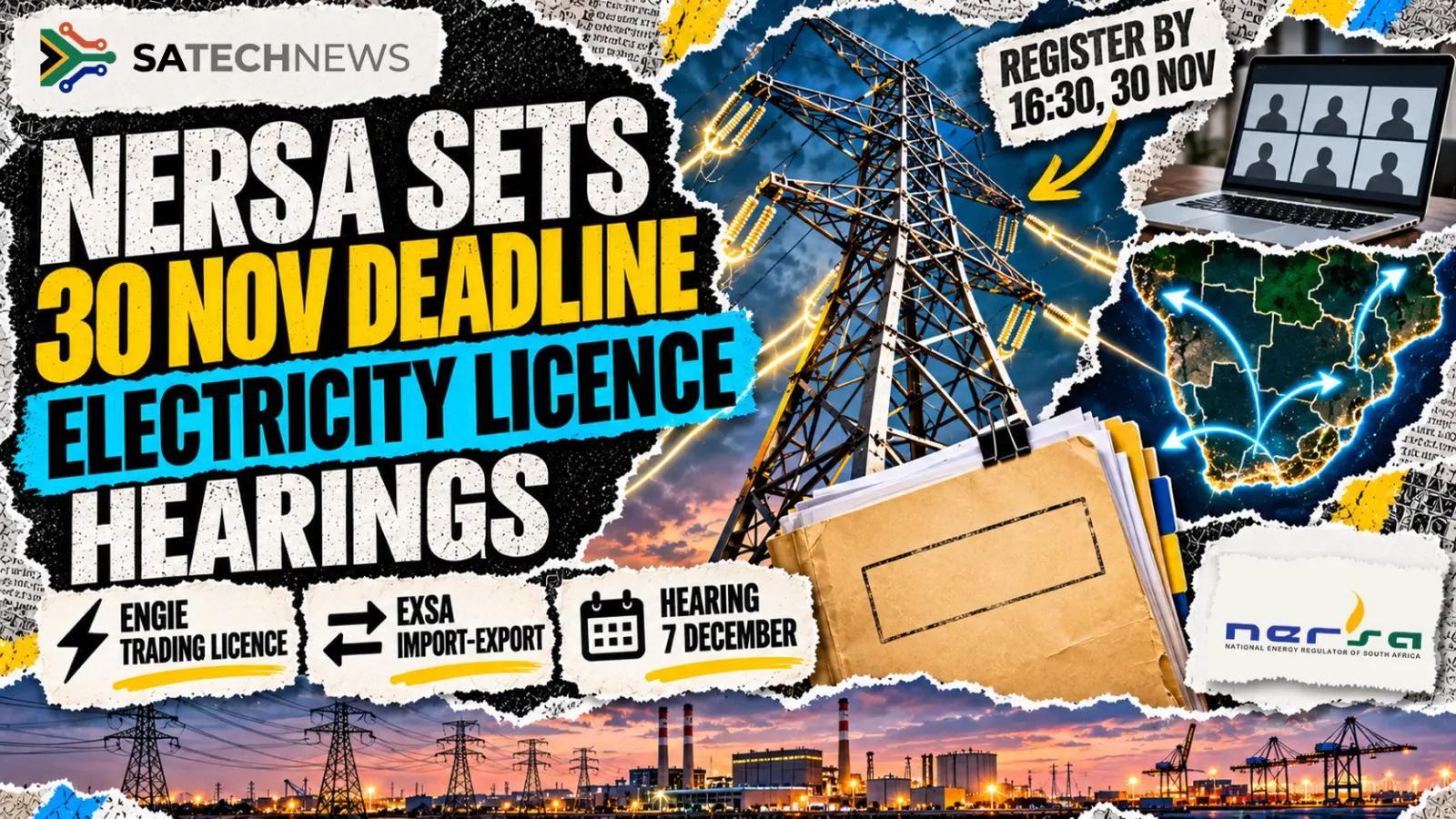
Nersa will hear Engie and EXSA licence applications on 7 December. South African stakeholders must register by 30 November to make representations.
South African electricity buyers and traders have until 16:30 on 30 November to register for a regulatory hearing on two licence applications that could affect domestic and cross-border electricity trading.
The National Energy Regulator of South Africa (Nersa) has scheduled a virtual hearing for 7 December 2026, from 09:30 to 13:00. Engie Energy Marketing South Africa is seeking a trading licence covering the Eastern Cape and KwaZulu-Natal. Energy Exchange of Southern Africa (EXSA) is seeking an import-export licence covering South Africa and the Southern African Development Community.
Neither application has been approved. The hearing is a public participation stage, not a licence award.
Two applications, different markets
Engie's application concerns electricity trading in two provinces where customers are supplied by Eskom. EXSA's application concerns electricity imports and exports across borders.
A trading licence does not create generation capacity or transmission lines. For industrial buyers, the ability to contract with a trader still depends on grid access, wheeling arrangements and electricity availability.
The applications come as South Africa seeks to expand private participation in the electricity market. Transmission constraints remain a barrier to moving power from generation sites to demand centres.
The hearing and the deadline
Nersa's scheduled session will take place through Microsoft Teams and will be streamed on X. Interested parties wishing to attend or make oral representations must register by 16:30 on Monday, 30 November.
According to the hearing notice, the regulator may cancel the hearing for an individual application if nobody registers to make representations on it. Written submissions are also provided for in the process.
For businesses in Durban, Gqeberha and other industrial centres, additional licensed traders could eventually widen procurement choices. That outcome remains conditional on physical capacity, contractual terms and regulatory decisions. No tariff reduction can be inferred from the applications alone.
What remains unresolved
Nersa must still assess the applications and representations. The conditions of any eventual authorisation, particularly the practical cross-border arrangements for EXSA, remain to be determined.
The confirmed milestones are the 30 November registration deadline and the scheduled 7 December hearing. Until a decision is issued, both proposals remain applications.
What each application asks for
Engie Energy Marketing South Africa wants a trading licence for the Eastern Cape and KwaZulu-Natal, provinces where the notice says customers are supplied by Eskom. A trading licence would allow a trader to buy and sell electricity. It would not build a power station and it would not add a transmission line. A buyer in Durban or Gqeberha who wanted to contract with a trader would still need grid access, a wheeling arrangement and electricity that is actually available. The hearing does not supply any of those.
Energy Exchange of Southern Africa wants an import and export licence covering South Africa and the Southern African Development Community. That is a cross-border application, not a provincial trading application. The notice does not set out how power would move across those borders. Nersa has not set conditions, because it has not decided the application. The practical arrangements for EXSA are among the things still to be determined.
The two requests can be heard on the same day and still be different decisions. One is about trading inside two provinces. The other is about moving electricity across borders. Approving one would not approve the other, and the notice does not say either will be approved.
How a reader uses the two dates
Registration closes at 16:30 on Monday, 30 November. The hearing is on 7 December 2026, from 09:30 to 13:00. It is virtual, on Microsoft Teams, and it will be streamed on X. Someone who wants to attend, or to speak, has to register by that Monday deadline. The notice says Nersa may cancel the hearing for an individual application if nobody registers to make representations on it. Written submissions are also provided for. Registering to watch is not the same as making a representation, and missing the oral sitting is not the same as missing the written route.
7 December is a hearing date. It is not the day a licence is issued. Nersa still has to assess the applications and the representations. Until a decision is published, both proposals remain applications. No tariff cut follows from the fact that the applications exist. A wider choice of licensed traders, for businesses in the industrial centres named in the notice, would still depend on capacity, on contracts and on the regulator's decision.
South Africa is trying to widen private participation in the electricity market, and transmission constraints remain the barrier between generation and demand. That is the setting. It is not an outcome of this sitting. The milestones that are fixed are the 16:30 registration deadline on 30 November and the hearing on 7 December. Everything after that is a decision Nersa has not taken.
## A hearing is not a licence
Nothing in the notice awards Engie a trading licence or EXSA an import and export licence. The regulator has opened a public participation stage. Parties can register until 16:30 on 30 November, the sitting is set for the morning of 7 December, and Nersa may drop the oral hearing on an application that draws no speakers. Written submissions remain part of the process either way.
For a factory or a municipality watching the electricity market, the useful distinction is between a trader and the grid. Engie's application, if it were later granted, would still leave generation, transmission and wheeling where they are. EXSA's application, if it were later granted, would still need the cross-border arrangements the notice does not yet describe. Private participation in the market is the direction South Africa has been taking. Transmission constraints are still what stop power moving from where it is generated to where it is used. Neither fact is changed by a registration deadline.
Until Nersa publishes a decision, the only dates a reader can put in a diary are 30 November and 7 December.