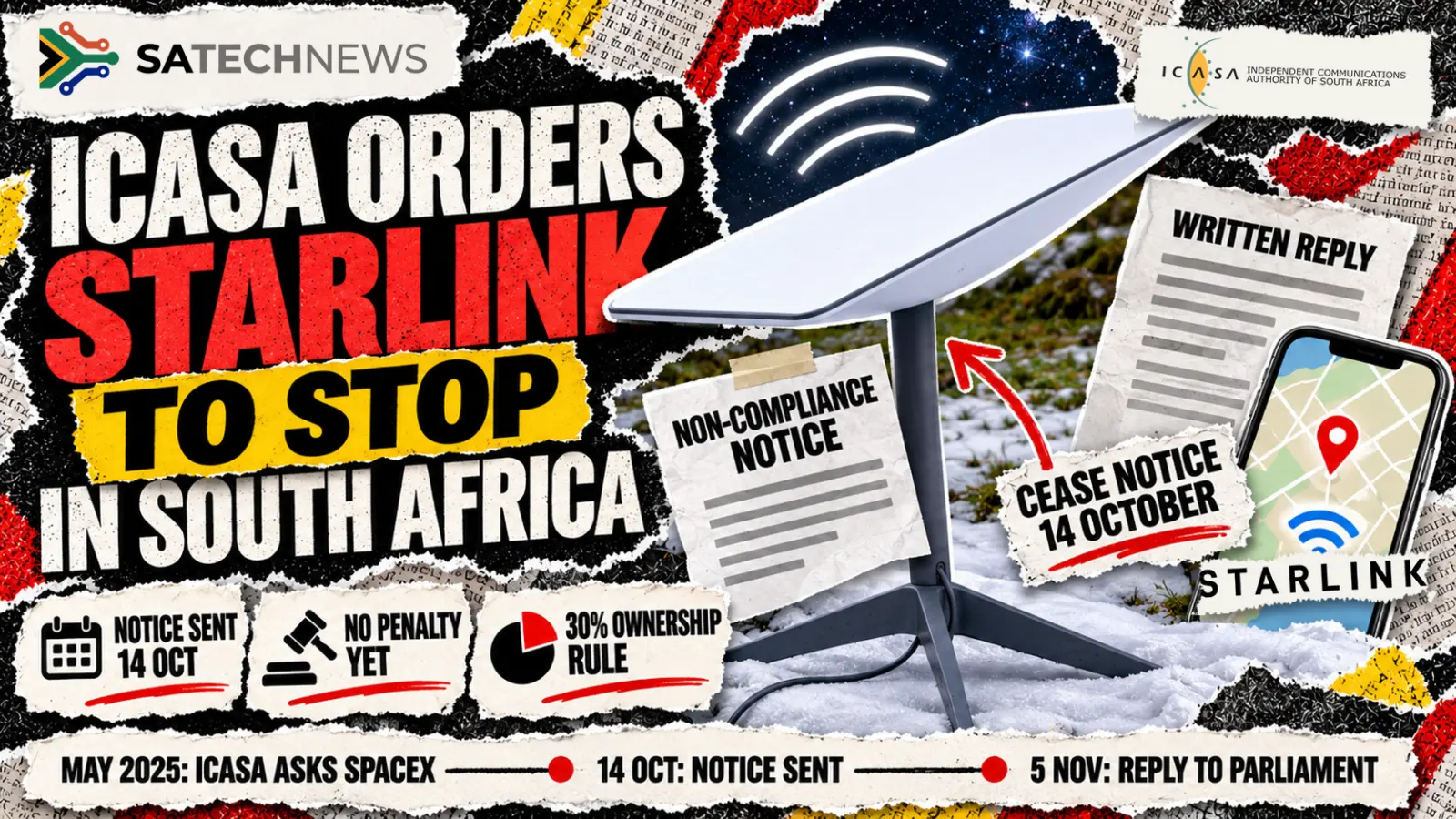
Icasa sent SpaceX a non-compliance notice on 14 October demanding Starlink stop in South Africa. No deadline, penalty or SpaceX reply is on record yet.
Icasa told SpaceX on 14 October to stop providing and operating Starlink services in South Africa. The notice stayed between the regulator and the company until Communications Minister Solly Malatsi put it in a written reply to Parliament, published on 5 November and reported on 16 November.
It is the first formal enforcement step disclosed in more than three years of Starlink kits being used here without a licence. The reply records no deadline, no penalty and no public answer from SpaceX. For the households, farms and small businesses running roaming dishes registered in neighbouring countries, nothing visible has changed.
What Parliament was told
The question came from MK Party MP Adil Nchabeleng. He asked why enforcement against Starlink appeared ineffective, which officials were responsible, and whether the minister would commit to an accountability report with an enforcement plan that required action within 60 days.
The reply says Icasa first asked SpaceX for clarification in May 2025, after reports that Starlink could be used in the country. SpaceX told the regulator it had "implemented measures to prevent unauthorised access". Icasa then set up a dedicated task team, carried out further investigations and inspections, and on 14 October issued a formal notice of non-compliance. The notice demands that SpaceX "cease the unauthorised provision and operation of Starlink services in the Republic".
Malatsi said no officials had been identified as responsible for enforcement failures and that no disciplinary steps had been taken. Icasa, he said, was "not currently in a position" to provide a full accountability report because its enforcement processes were still under way. He did not commit to the 60-day timeline Nchabeleng asked for. Any penalty or further legal action, the reply says, depends on what the investigation finds.
The dates are the story as much as the notice. A clarification request in May, a task team, inspections, and a notice in October is a long stretch for a service that has been in use since early 2023. The notice is real. The reply does not say what happens if SpaceX does nothing with it, and it does not say when "still under way" ends.
A licence is a separate argument
Starlink has never held a South African licence, and under the current rules it cannot get one. The Electronic Communications Act and Icasa's ownership regulations require licensees to be at least 30% owned by historically disadvantaged groups. SpaceX has argued that an equity equivalent investment programme, which the B-BBEE codes already recognise, should count instead of a direct equity stake.
Malatsi issued a policy direction asking Icasa to consider that route. Icasa declined, saying the Act itself would have to change first. The ownership fight and the enforcement notice are therefore two different problems. The notice treats the current operation as unauthorised. The policy argument is about whether a future licence could be issued without a change to the Act. Settling one does not settle the other.
Business lobby group Sakeliga has gone to the High Court in Pretoria to challenge the ownership rule. That case could change the test itself. It has not been decided. The parliamentary reply does not treat the court case as a reason to pause the notice, and it does not say the notice will wait on the judgment.
President Cyril Ramaphosa added to the pressure this week. In an interview during his Silicon Valley trip, he said SpaceX had to comply with the country's equity rules and that Elon Musk "has had difficulty in understanding the policy position". A published account of the same week said SpaceX had offered R500 million, plus fully funded Starlink kits and connectivity for more than 5,000 rural schools, and that South Africa did not take the offer up. The parliamentary reply does not mention that offer, so it is not part of the enforcement record Malatsi put before Parliament.
The roaming rules that still keep dishes on
Most local users connect through Starlink's roaming plans. Those plans have worked in South Africa since early 2023, with kits registered in countries where the service is licensed. SpaceX has tightened the rules several times: a 60-day continuous-use limit in mid-2024, then 30 days, then a seven-day limit in October, along with identity and country-of-origin checks at registration. Each change has cut some users off. Others have found ways around it.
The October seven-day limit landed in the same month as the non-compliance notice. The reply does not say the two are connected. What the public record does show is that the company has been changing the terms of roaming while the regulator's formal step sat unpublished. A user whose kit is registered next door is not a licensed South African subscriber. The notice is addressed to SpaceX, not to that user. Icasa has not said whether it can act against individual users or against resellers.
Licensed rivals are moving through local partners. Telkom said this week it will distribute Amazon Leo's satellite broadband, described as the service's second South African distributor. That is the contrast the notice does not spell out. A satellite service can be sold here when a licensed local company carries it. Starlink's path, on the record so far, is a cease notice rather than a distribution deal.
What is still open
Icasa has not said what it will do if SpaceX ignores the notice, whether a penalty is available on these facts, or when the investigation will end. SpaceX has not responded publicly. Sakeliga's challenge to the ownership rule is still before the High Court in Pretoria. The minister did not accept a 60-day enforcement plan, and he said the regulator is not yet able to give Parliament a full account.
Until one of those moves, the notice dated 14 October is the only formal step on record. The dishes that were on before the reply was published are not, on anything Icasa has said in public, switched off by it.