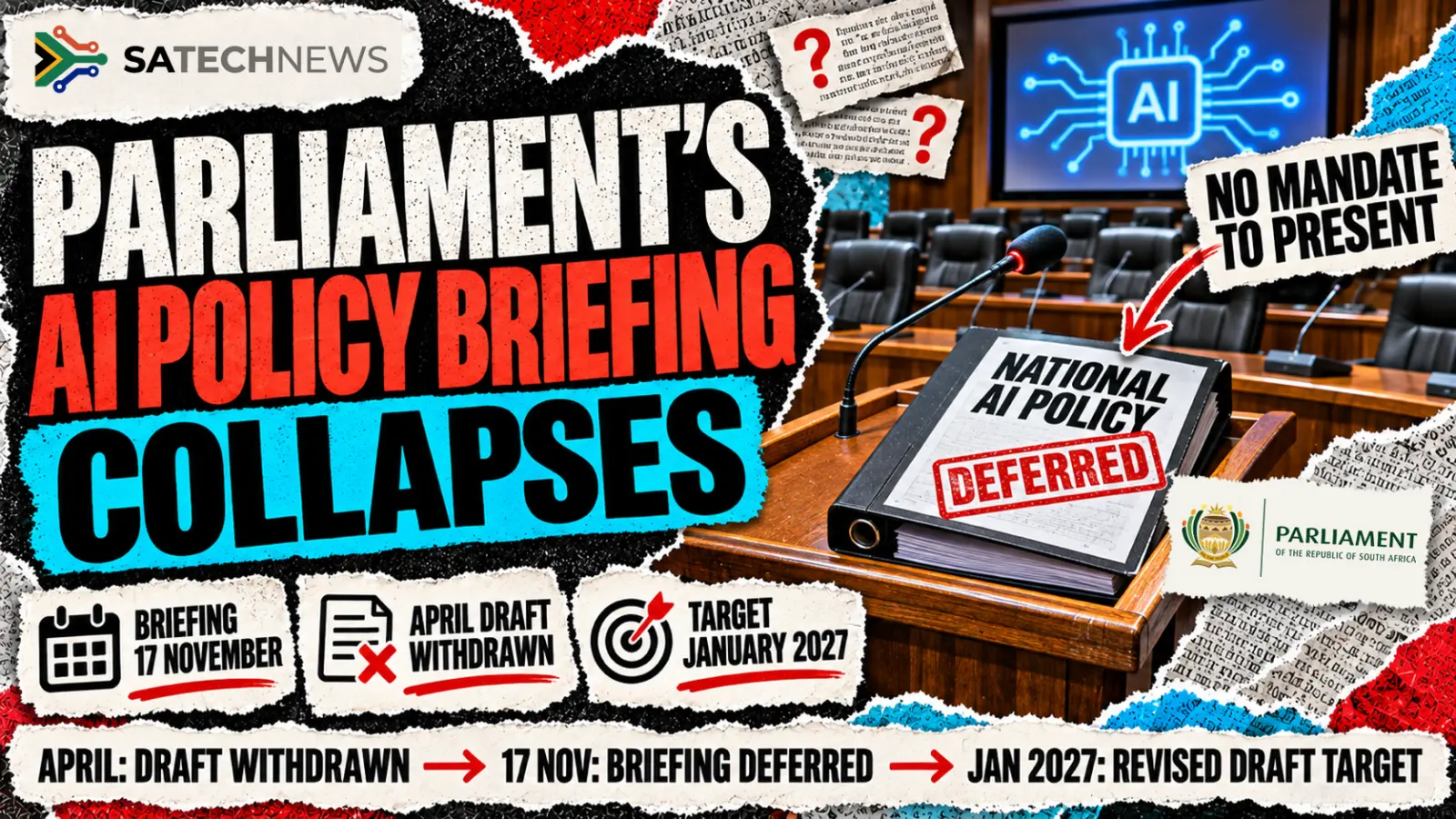
Parliament deferred its 17 November AI policy briefing after officials lacked a mandate to present, extending scrutiny of South Africa's withdrawn draft.
Parliament's Portfolio Committee on Communications and Digital Technologies deferred its 17 November briefing on South Africa's national artificial intelligence policy after departmental officials said they were not authorised to present the update.
The delay lands on a policy that has already been pulled once. The government withdrew an April draft after fictitious references were found in its source material. Parliament was meant to scrutinise whatever is replacing that draft. On 17 November it did not get the briefing.
What actually happened in the room
According to a 19 November account of the sitting, committee chair Khusela Sangoni stopped the departmental presentation when the mandate problem became clear. The officials were in the room. They did not have formal authority to give the update. The committee did not receive the progress briefing it had scheduled.
That is a procedural failure, not a decision on the policy itself. Stopping a presentation does not withdraw the replacement draft, and it does not adopt one. It means the department left Parliament without the account MPs had asked to hear.
The Parliamentary Research Unit did table a position paper at the same sitting, titled "A Constitutional, Developmental & Auditable Artificial Intelligence Legislative Framework for South Africa". A research paper on the table is not a bill, and it is not a government policy. MPs can read it. They have not adopted it, and the department did not present it as the replacement for the withdrawn draft.
The timetable that was already public
Reuters reported in May that the department was targeting January 2027 for a revised draft to go out for public comment, after the April withdrawal. The minister had described an independent seven-member expert panel to review citations and the wider policy text.
Nothing in the postponed briefing establishes that the January 2027 target has been dropped. Nothing in it establishes that the revised document has cleared those checks, or that the panel has finished. The department was not authorised to say so on the day, which is the point. The target and the panel remain descriptions from May, not a status report from November.
For anyone building or buying software that makes automated decisions, the legal position is the one that existed before the briefing. A withdrawn draft creates no new AI regulator. Privacy law, consumer-protection law and the rules of the sector a firm already works in still apply. A future policy may add duties. It has not added them yet, and a postponed meeting does not fill the gap.
What the fictitious references still require
The April draft was withdrawn because references in it were not real. The promised answer was an independent check of citations and of the policy content, by the panel the minister described. A briefing that cannot be given is not that check. It also does not show the check has failed. It shows Parliament still has not heard an authorised account of where the work stands.
Developers, universities and firms cannot treat the research unit's paper as the new rules. They also cannot treat the January 2027 date as a promise that a clean draft will appear then. Both are documents and dates on the record. Neither has been confirmed, amended or replaced in an authorised briefing.
The credibility problem is specific. A policy document that cited sources which do not exist cannot be repaired by a meeting that does not happen. The panel was described as the repair. Parliament has not been told, by anyone with a mandate, whether that panel has read the replacement text, what it changed, or whether the fictitious references are gone.
What is still open
The committee has not said when the authorised briefing will be rescheduled. The department has not, in what has been published from this sitting, said whether the revised policy has cleared the promised checks, or how it will show that the citations have been independently verified.
Public comment cannot start on a text the department was not authorised to present. The January 2027 target, as Reuters reported it in May, is a date for a revised draft to go out for comment. Comment is how universities, firms and the public are supposed to test the replacement for the April document. A sitting that ends without a presentation does not open that comment period, and it does not move it. It leaves the date hanging.
The research paper does not fill that role either. Its title sets out a constitutional, developmental and auditable framework. Those are the research unit's words for what a law might need. They are not clauses in force, and Sangoni did not treat the paper as a substitute for the department's update. MPs have a paper. They do not have an authorised account of the government's own draft.
The fictitious references are still the reason the April text was withdrawn. An independent seven-member panel was the minister's described answer. A panel that has not reported, to a committee that did not receive a briefing, has not yet shown the public that the citations were checked. Firms deploying automated decisions should keep following the privacy, consumer and sector rules they already have. They should not build a compliance programme on a draft that was withdrawn, or on a meeting that was stopped.
Until that briefing happens, the national AI policy is a withdrawn draft, a May timetable and a research paper that Parliament has not adopted. The open questions are the date of the next authorised sitting, whether the revised text has cleared the promised checks, and how the department will show that the citations are real.