Binance says its record $6.3bn theft began with a fake job interview. Withdrawals are back and it claims 98% is replenished, but the figures are unaudited.
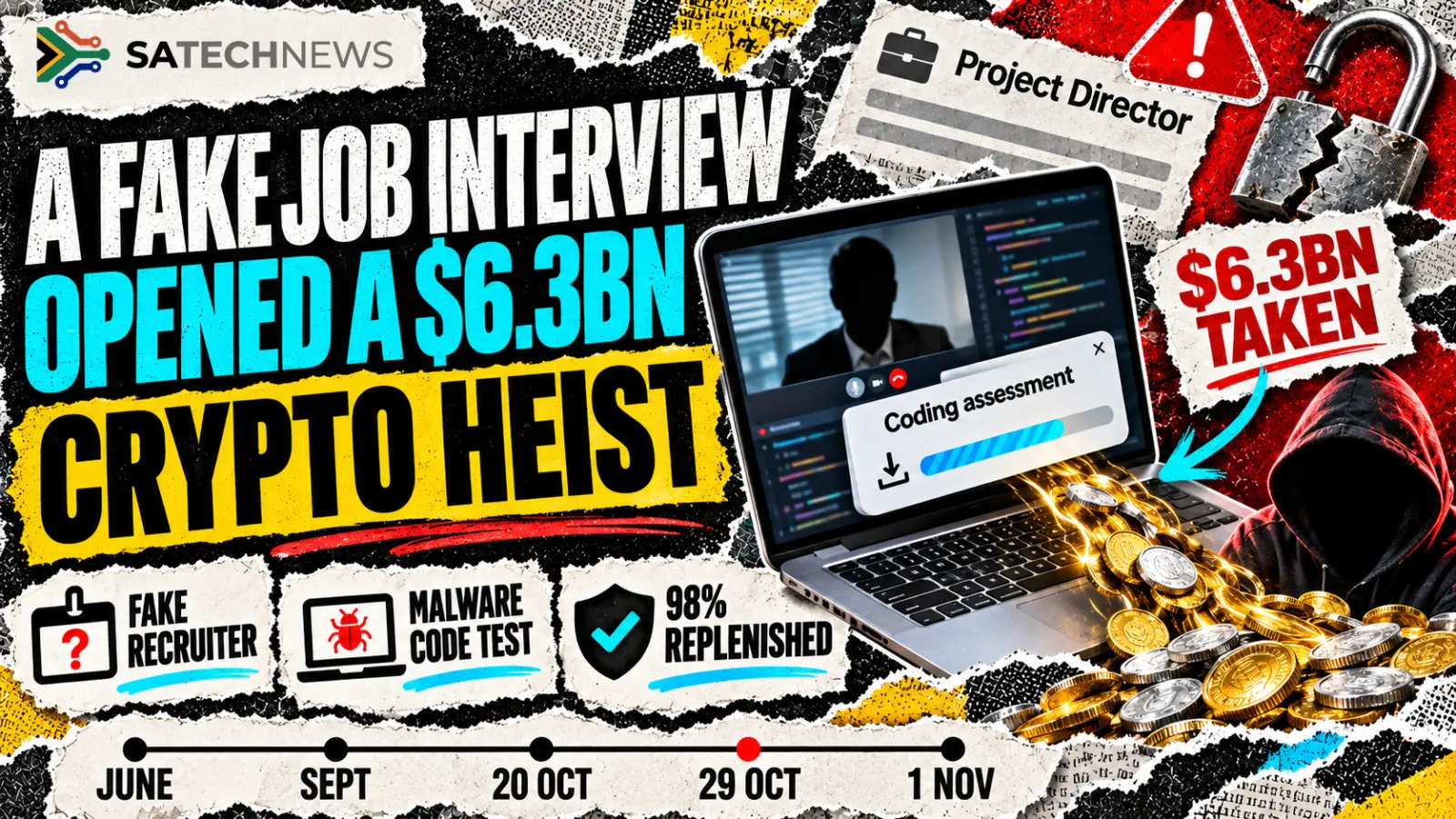
The record US$6.3bn theft from Binance started months before the money moved, with a job interview that never existed. In findings published on 3 November, the exchange said a software engineer was approached through a legitimate job-hunting platform by someone posing as a "Project Director", interviewed twice, and then asked to download a code "assessment" that carried malware.
Withdrawals are running again. Binance began restoring them in phases from 1 November, after a halt of about 48 hours, and co-CEO Richard Teng says affected assets are "now 98% replenished". For South Africans who buy and trade on Binance with rand, access is back. What remains open is the evidence behind the recovery figures.
The way in matters more widely. The attack didn't break Binance's cryptography; it went through its people, and the lure was a job offer aimed at someone whose public profile mentioned Binance experience. Anyone who lists a crypto or fintech employer online fits that description.
How the attack worked
Binance's report, as described by Help Net Security and Fortune, sets out three stages.
In June, a wallet DevOps engineer installed a tampered copy of Homebrew, a common developer tool, while looking for a popular AI coding tool, after following an internet ad. Binance's security team caught it, replaced his laptop and reset his credentials. By then, according to the report, the attackers had learned his role and the names of colleagues.
In September, a second engineer was contacted on a job-hunting platform. He went through a first interview with a supposed HR representative and a second with someone claiming to be the chief executive of a company that didn't exist. He was then asked to download a code repository onto a company computer as a test. It replaced a legitimate developer tool, pyenv, with a malicious copy. Binance says "the 0-day malware was not detected by the endpoint security protection tools at the time". Not everyone accepts that label: security researcher Will Dormann objected that there is no such thing as "0-day malware".
On 20 October, the attackers used that laptop and an internal Binance AI tool to take control of two more engineers' machines. One held a token that allowed containers to be deployed. On 29 October, they used stolen credentials to deploy a container, reach Binance's internal wallet-signing service and give a contract they controlled partial rights over a hot wallet. Binance removed that access on 30 October.
"It was not a single isolated breach or a simple phishing incident," Binance said.
Who did it, and what has been recovered
The FBI said on 31 October that North Korea was responsible, naming the group it calls TraderTraitor. The same group was blamed for the US$1.5bn Bybit theft in February 2025. North Korea denied the allegation on 2 November.
Tether, Circle and other partners froze close to US$3bn of the stolen stablecoins within the first day. Fortune reports about US$2.5bn has been recovered through those freezes. Binance says it has replaced about 98% of the stolen coins from its reserves and other sources and is buying the remaining 2%, which it describes as less-used currencies. It has said customers will not carry the loss, which is being covered through its Secure Asset Fund for Users.
What it means in South Africa
Binance markets ZAR deposits, rand trading and peer-to-peer services to South African residents. When we reported the theft on 31 October, its South African page said it was engaged in the Financial Sector Conduct Authority's crypto licensing process, which is not the same as holding a licence. We have not seen a South African account count in its updates, or any statement on whether local users were affected beyond the withdrawal halt.
The more practical lesson is for local employers. South Africa's licensed exchanges, banks and fintechs employ engineers whose job histories are public, and the Binance attack shows what a fake recruiter can do with one of them. The controls that might have stopped it are mundane: no take-home tests on work machines, limits on what software can be installed, and short-lived deployment tokens.
What is still unresolved
The 98% figure is Binance's own. We could not find an independently verified reconciliation of the stolen assets against what has been frozen, recovered and bought back. Until one appears, the public record rests on three numbers from the company: US$6.3bn taken, close to US$3bn frozen, and 98% replenished.
Three dates, three different claims
The public record is a stack of claims from different parties, and they do not all do the same job. Binance's own findings, published on 3 November, describe how the access was won. The FBI said on 31 October that North Korea was responsible and named the group it calls TraderTraitor, the group it also blamed for the US$1.5 billion Bybit theft in February 2025. North Korea denied that on 2 November. A denial and an attribution can both be on the record. Neither is a court finding reproduced here.
The recovery figures have the same split. Tether, Circle and other partners froze close to US$3 billion of the stolen stablecoins within the first day, and Fortune reports about US$2.5 billion recovered through those freezes. Binance says about 98% of the stolen coins have been replaced from its reserves and other sources, that it is buying the remaining 2%, which it calls less-used currencies, and that customers will not carry the loss. That loss is being covered through its Secure Asset Fund for Users. Co-CEO Richard Teng says affected assets are now 98% replenished. The 98% is the company's figure. An independent reconciliation of what was taken, frozen, recovered and bought back was not found.
What the halt means for a rand account
Withdrawals stopped for about 48 hours and Binance began restoring them in phases from 1 November. For South Africans who buy and trade on Binance with rand, access is back. That is a statement about the withdrawal pipe. It is not a statement that a South African account was among those drained, because the company's updates reviewed here do not give a South African account count or say whether local users were affected beyond the halt.
Binance markets ZAR deposits, rand trading and peer-to-peer services to South African residents. When this desk reported the theft on 31 October, the South African page said the company was engaged in the Financial Sector Conduct Authority's crypto licensing process. Being in that process is not the same as holding a licence.
The route in is the part that travels. The attackers did not break Binance's cryptography. They used a job offer aimed at an engineer whose public profile mentioned Binance experience, after an earlier tampered download had already taught them names and roles. South African exchanges, banks and fintechs employ engineers with public job histories. The controls named in the account are ordinary ones: no take-home test on a work machine, limits on what software can be installed, and deployment tokens that do not live long. The US$6.3 billion, the freeze of close to US$3 billion, and the 98% replenishment remain the three numbers on the public record, and the third of those is still Binance's own.