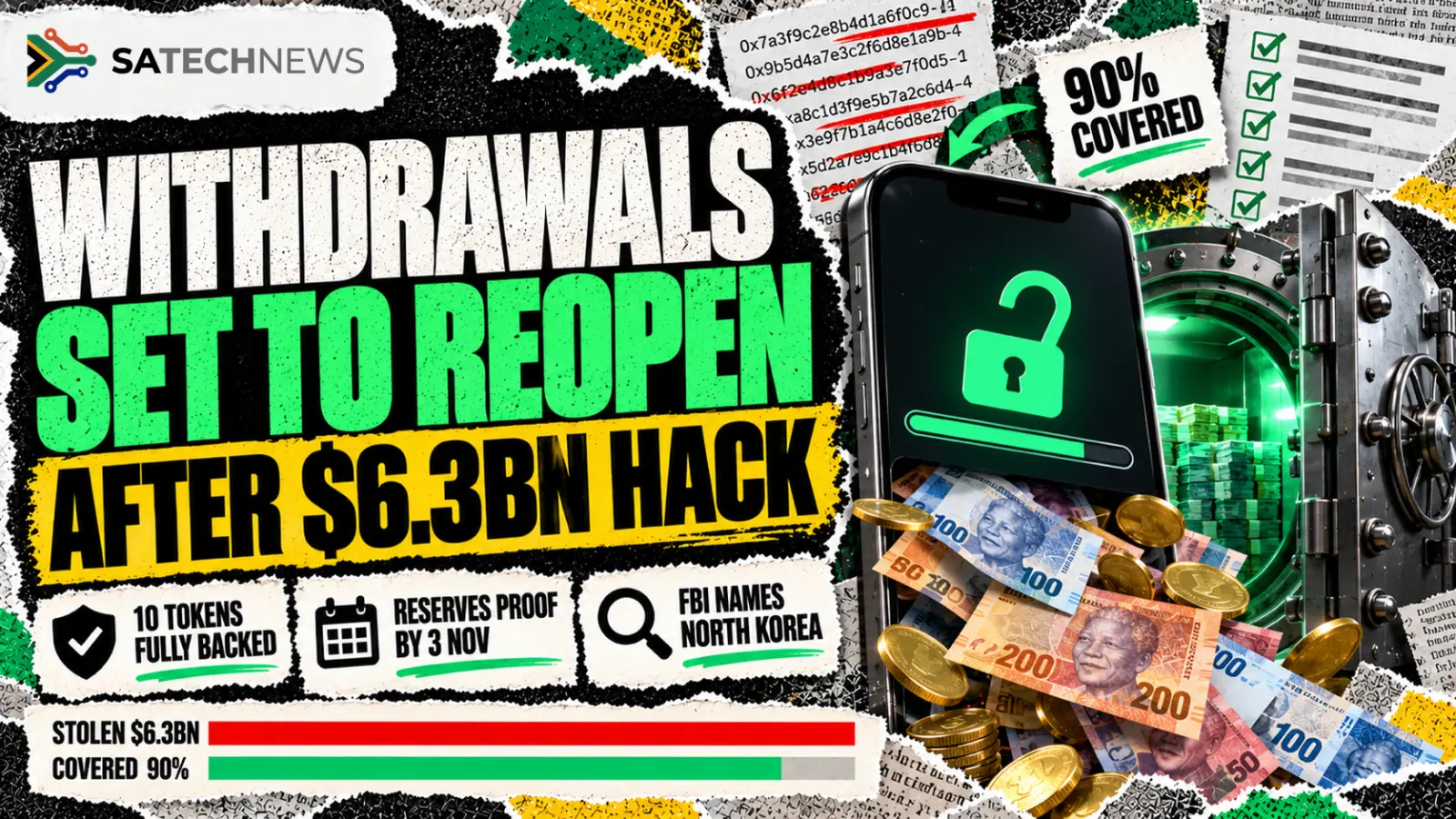
Binance says withdrawals restart on Sunday, 1 November, with 90% of the stolen $6.3bn covered, while its proof of reserves slips to 3 November.
Binance said it would start reopening withdrawals on Sunday, 1 November, three days after hackers took about US$6.3 billion from its internet-connected wallets. Its latest notice puts its cover for the stolen assets at 90%, up from about 80% on Friday.
For South Africans with rands or crypto stuck on the exchange, that Sunday date was the first firm one. The Friday story recorded withdrawals still suspended, with Binance then saying a proof of reserves would land on Monday, 2 November. The later notice moves that report to Tuesday, 3 November. Binance's local site offers ZAR deposits by Instant EFT and bank transfer, and withdrawals to the major South African banks. MyBroadband confirmed on Friday that local users could deposit but not withdraw. Binance has still not said how many South African accounts are affected.
What changed since Friday
In its third recovery update, published on Saturday, Binance said ten tokens are now fully backed: bitcoin, ether, USDT, BNB, SOL, USDC, XRP, USD1, RLUSD and ZEC. The missing 10% sits in smaller, less liquid tokens outside that list, which it says it is still buying on the market and over the counter.
Read against Friday's figure, the shift is from about 80% covered to 90%. The ten names are the liquid ones. Everything else is the remainder Binance says it is still purchasing. "Fully backed" here is the company's description of those ten tokens, not an outside audit of customer balances.
The cover comes from three places: part of its Secure Asset Fund for Users (SAFU), a portion of its futures insurance fund, and its corporate treasury. Binance had already said it set aside more than US$6.34 billion. It now also commits to refilling SAFU to about US$1 billion, and repeats that "Binance will absorb the financial impact of these stolen funds, not our users."
The proof-of-reserves report has slipped by a day. On Friday, Binance said results would be ready on Monday, 2 November. It now says a snapshot was taken at 00:00 UTC on 31 October (02:00 in South Africa) and that the full zero-knowledge proof takes 40 to 50 hours to generate, which puts it at Tuesday, 3 November. The Monday date in the earlier story is the one Binance has replaced.
The FBI names North Korea
On Saturday the FBI said North Korea's TraderTraitor group was behind the theft, according to Bloomberg and CoinDesk. It is the same group the bureau blamed for the US$1.5 billion Bybit hack in 2025. With the US Secret Service and IRS Criminal Investigation, the FBI published more than 600 Ethereum addresses, just under 20 bitcoin addresses and one Solana address, and asked exchanges, DeFi services and node operators to block transactions linked to them. It said the stolen funds were mostly being converted into ether.
That takes the attribution beyond the blockchain analytics firms that pointed to North Korea first. It does not return any money. Binance said on Friday that about US$3 billion had been frozen on-chain, and a freeze stops tokens from moving without giving them back. A published address list is a request that other services block those flows. It is not a recovery figure, and it does not change the 90% cover Binance is claiming from its own funds.
What rand users should check
Binance's own notice gives a date, but no time and no order of assets. Its Friday update said the restart would be phased, with notices as each phase opens. Crypto outlet TechFlow, citing a Binance announcement, reported that the first phase runs from 14:00 to 17:00 Beijing time, which is 08:00 to 11:00 in South Africa, starting with BTC, ETH, BNB and SOL on several networks. We could not find that schedule in Binance's published announcements, so treat it as reported rather than confirmed.
Check Binance's withdrawal page or network status before moving funds, and expect delays if everyone tries at once. Binance's recovery notices do not ask customers to apply for compensation, so treat unsolicited "recovery" offers by email, SMS or WhatsApp with suspicion.
On the local rules, Binance's South Africa page says the company is "actively engaged" in the Financial Sector Conduct Authority's crypto-asset service provider licensing process. That is not a statement that it holds a licence. We found no FSCA statement on the hack.
Still open
Binance has not published a post-mortem of how the attackers got in, a count of South African accounts, or a time for any phase after the first. Sunday's notice is a coverage update, not a withdrawal receipt. Ninety percent is the company's figure, up from about 80% on Friday, and it applies once the ten named tokens are set aside. The rest is still being bought. SAFU is to be refilled to about US$1 billion from the same response that draws on the futures insurance fund and the corporate treasury. None of those lines names a South African bank, a rand amount, or a queue.
The checks that were still open on Sunday morning were whether withdrawals actually opened that day, and whether Tuesday's proof shows reserves covering what customers hold. The 90% figure, the ten named tokens and the move of the proof to 3 November are what the Saturday notice added. They do not, on their own, show that a rand withdrawal has gone through.