
Breaking
Latest tech news from South Africa and around the world•Stay updated with breaking technology developments•Innovation and digital transformation news•AI, gaming, and gadget updates daily•Crypto and fintech news from Africa•
 Tech Team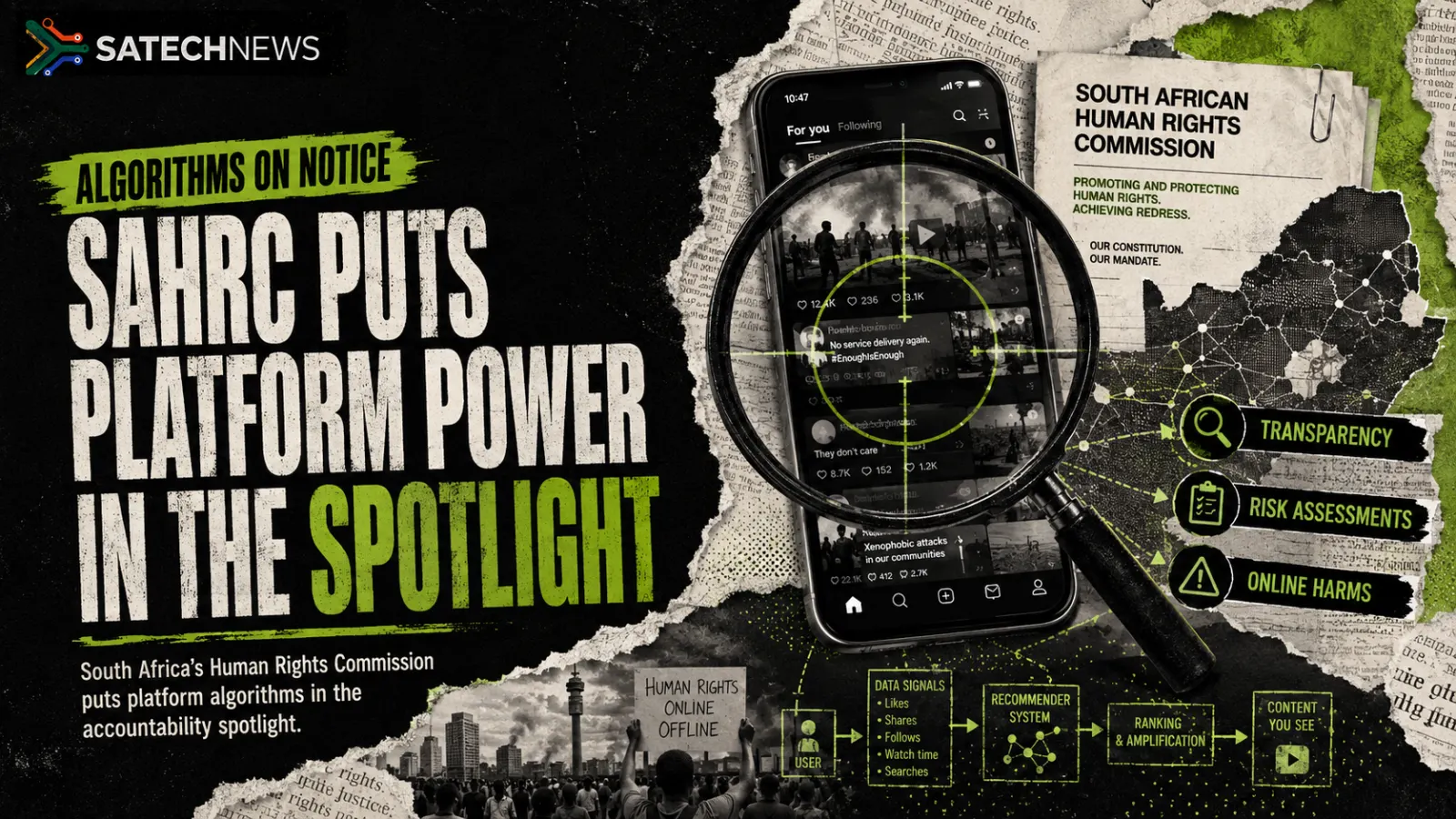
A new SAHRC policy brief argues that South Africa needs systemic platform accountability, transparency and risk assessment rather than relying on criminal law to fight disinformation.
South Africa’s debate over misinformation is moving away from the simple question of whether bad posts should be removed and towards a more difficult one: what responsibility should the platforms that rank, recommend and amplify information carry?
The South African Human Rights Commission has released a policy brief on information integrity and human rights that places systemic platform accountability among its core recommendations.
Deputy Justice and Constitutional Development Minister Andries Nel backed that direction during the launch, arguing that criminalisation on its own is not an adequate response to a damaged information environment.
The Commission’s framework identifies five areas for action: platform accountability, early-warning and rapid-response capacity, targeted legal and regulatory reform, support for independent public-interest media, and sustained media and information literacy.
The most consequential part for the technology industry is the first one.
Social platforms do not simply host posts in chronological order.
Recommendation systems decide what millions of people see, how often they see it and which material is pushed beyond the audience that originally chose to follow an account.
That design can be enormously useful. It is also why a misleading video or inflammatory claim can move from a small group to a national conversation in hours.
Nel told the SAHRC engagement that where algorithms and recommender systems can amplify harmful material to millions of people, transparency, risk assessment and accountability are legitimate matters of public policy.
That does not amount to a proposed ban on recommendation algorithms.
It does signal that South African policymakers are increasingly interested in the systems behind content distribution rather than focusing only on individual users who post unlawful material.
The Commission’s approach is notable because it does not argue that government should decide what is true online.
Nel explicitly warned that government should not become the custodian of truth.
That matters in South Africa, where freedom of expression is constitutionally protected and political speech is especially sensitive.
A badly designed anti-disinformation law can easily become a tool for suppressing criticism or inconvenient reporting.
The SAHRC framework instead treats information integrity as an ecosystem problem.
That includes how platforms are designed, whether institutions can respond quickly to coordinated manipulation, whether independent media remains viable and whether citizens have the skills to evaluate what they encounter online.
In other words, the proposed response is broader than deleting posts or arresting people.
The phrase “platform accountability” is easy to support in principle and difficult to define in law.
It could mean requiring major platforms to publish more information about how recommendation systems operate.
It could involve risk assessments for features that amplify political or harmful content, better researcher access to platform data, clearer reporting on moderation decisions, or stronger processes for users to challenge enforcement.
It could also move into much more contentious territory if government tries to prescribe how algorithms should rank lawful speech.
The SAHRC policy brief does not by itself create new legal duties for Meta, TikTok, X, YouTube or other platforms.
It is a policy intervention rather than legislation.
But it gives government and Parliament a rights-based framework that could influence future regulation.
South Africa would not be working in isolation. The European Union’s Digital Services Act already imposes risk-assessment and transparency duties on very large online platforms, while other jurisdictions are experimenting with different forms of online-safety regulation.
The challenge is adapting those ideas to South Africa’s Constitution, institutions and enforcement capacity rather than copying them wholesale.
South Africa has already seen how online information can interact with real-world instability.
The SAHRC’s earlier investigation into the July 2021 unrest found that social media amplified grievances and helped spread inflammatory content, while the state lacked adequate mechanisms to counter misinformation and disinformation.
That history is one reason the Commission is treating information integrity as a human-rights issue rather than simply a media problem.
Online manipulation can affect dignity, equality, privacy and personal safety. During elections or periods of political tension, it can also affect participation and trust in democratic institutions.
At the same time, aggressive content controls can threaten those same rights.
That tension is why transparency and systemic accountability may prove more defensible than giving the state broad powers over individual speech.
The policy brief creates a direction of travel, not a finished regulatory model.
The next stage will determine whether “platform accountability” becomes a useful set of measurable obligations or a vague phrase that can be stretched to justify almost anything.
Policymakers will need to answer practical questions.
Which platforms would fall under new rules? Would duties depend on user numbers or risk? What information would companies have to disclose? Who would audit algorithmic risk assessments? How would researchers gain access to data without exposing private user information? What penalties would apply for non-compliance?
And, critically, how would any new regime protect lawful political speech from government pressure?
Those details will decide whether South Africa can regulate the architecture of online influence without regulating opinion itself.
The SAHRC has put the algorithm squarely into the accountability debate.
What comes next should be judged not by how aggressively it promises to fight disinformation, but by whether it makes powerful platforms more transparent while preserving the constitutional space for people to disagree.
Source: SA Tech News