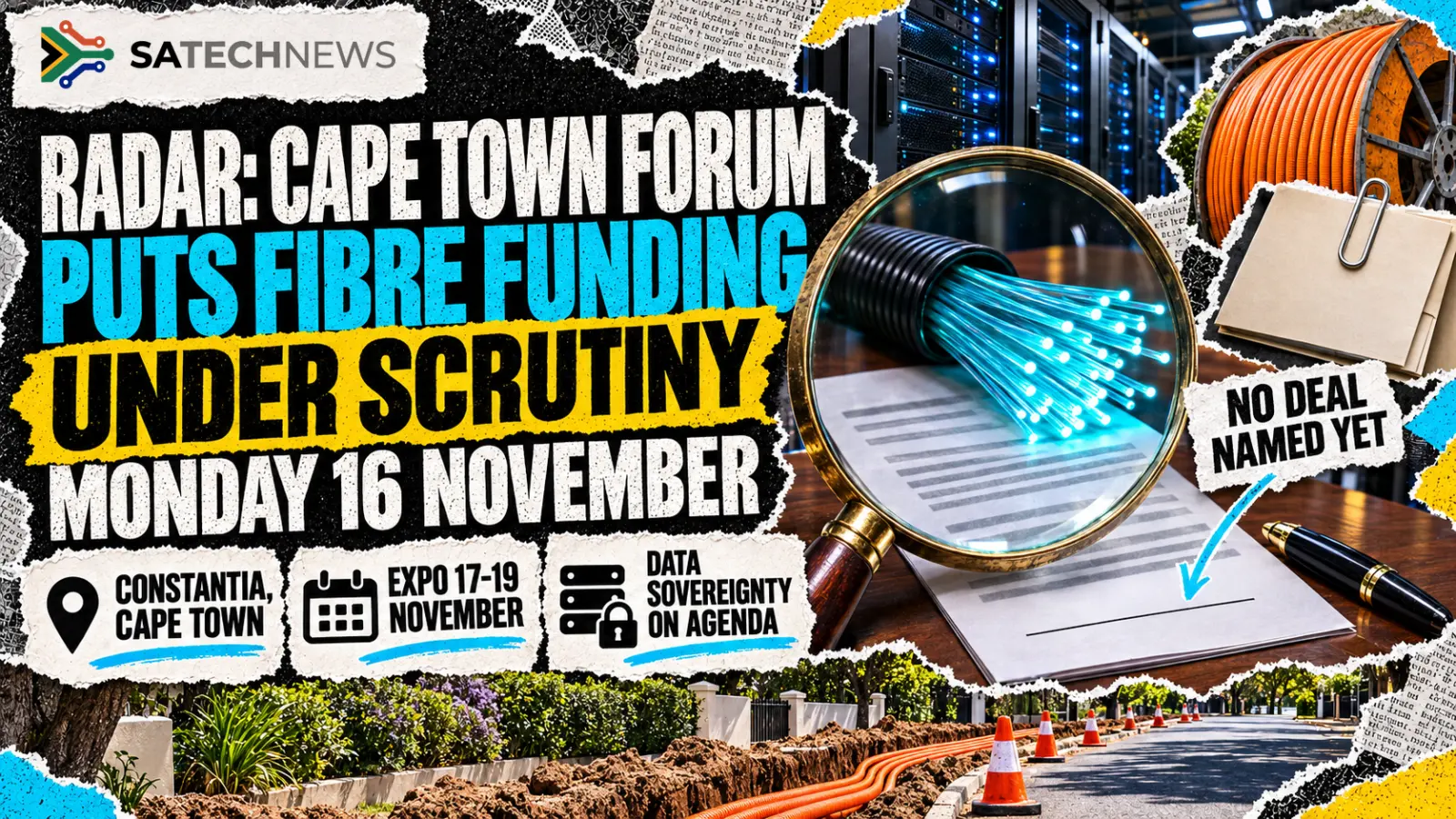
Africa Tech Festival's Cape Town infrastructure forum starts on 16 November, with fibre finance, data sovereignty and investment terms on the agenda.
Africa Tech Festival's Infrastructure Investment Forum was scheduled for Monday, 16 November at The Forum Embassy Hill in Constantia, Cape Town, a day before the main conference opened at the Cape Town International Convention Centre. The meeting was billed around how African fibre networks, data centres and other digital infrastructure get financed. For South African operators, the useful question is whether that conversation produces a named, funded project.
The organiser's forum page lists the Infrastructure Investment Forum and the Leaders In Africa Summit on the same day at the same venue. Only the Leaders In Africa Summit is marked invitation-only on that page. The page does not say the Infrastructure Investment Forum itself is invitation-only. Neither meeting is the public exhibition. The main exhibition and conference run from 17 to 19 November at the CTICC, with published visitor hours of 09:00 to 18:00 on 17 and 18 November and 09:00 to 16:30 on 19 November.
What was on the programme
The organiser identifies funding models, shared digital infrastructure, regional cooperation, data sovereignty, foreign investment and delays to fibre deployment as the forum's discussion themes. The wider festival programme also lists sessions on cloud and data centres, connectivity, artificial intelligence, cybersecurity and startups. A listed session is not a transaction. As of the organiser's forum description checked on 16 November, that page did not name a concluded deal, a committed capital amount, or an infrastructure project resulting from the meeting.
That distinction matters more than the size of the programme. A forum can put fibre finance, shared towers and data-centre capital in the same room as public agencies and operators. It cannot, by being scheduled, create a binding commitment. Readers should treat a line on a programme the way they would treat any other calendar entry: it says who intended to talk, and about what, and it stops there until someone publishes a deal.
Why the financing talk matters in South Africa
Fibre construction and data-centre builds need large sums before customer revenue catches up. That is true for smaller network builders as well as for the big telecommunications groups. Shared infrastructure can mean less duplicate digging. The commercial terms decide whether a smaller provider actually gets access, or whether it stays dependent on whoever owns the duct, the tower or the hall.
Data sovereignty is a separate argument from where a server sits. Local hosting can change latency, a compliance review and who is on site when something breaks. It does not, by itself, decide who can demand access to the data. The forum's published themes put data sovereignty next to foreign investment, which is the tension rather than a resolution of it.
There is a consumer test underneath the infrastructure language. Extra spending should eventually show up as coverage, fewer outages, or a price that is not only for business districts. An intention to invest, read out at a conference, does not establish any of those.
What would count as news after the meeting
The evidence worth watching for is specific: named investors, a binding funding commitment, a project location, a deployment date and the access terms for other operators. An agreement to explore a project is not a funded build. Until organisers or participants publish those details, the Constantia meeting stays a calendar event.
The main exhibition is the part the public can actually attend, on the hours above, from Tuesday 17 November. Attendance there is not the same thing as a fibre project being financed. No deal had been named on the organiser's forum page when this briefing was filed.
The themes themselves are familiar to anyone who has followed South African network builds. Funding models are the argument about who pays for a route before the customers are on it. Shared digital infrastructure is the argument about whether one trench, one tower or one data hall serves more than its owner. Regional cooperation is the argument about routes that cross a border. Delays to fibre deployment are on that list as a theme. The page does not say which routes are late, or why. None of those themes, listed on a forum page, is a project with a site and a date.
Foreign investment and data sovereignty sit next to each other on that same list, and they pull in different directions. Capital from outside the country can build a hall or a cable. A sovereignty claim asks who can see the data once the hall is switched on, and under which law. Locating equipment in South Africa answers the first only in part. It does not answer the second. The organiser's page pairs the two themes. It does not say a session resolved them.
A reader trying to use the week as more than a diary has a short checklist, and it is the same one whether the meeting was in Constantia or on the CTICC floor. Is there an investor with a name? Is the money committed, or only discussed? Where is the build, and when does it start? Who else may use it, and on what terms? If those four are missing, the honest description is that the forum happened on the programme. It is not that African fibre finance changed on Monday.
South African operators reading the week as a buying signal should wait for those four details. A panel on fibre finance does not move a rand of capital. A panel on data sovereignty does not change who can demand access to a server. The festival can still be a useful place to hear how builders talk about delays, shared ducts and foreign capital. That is a conversation. It becomes news when a named party commits money to a named build.