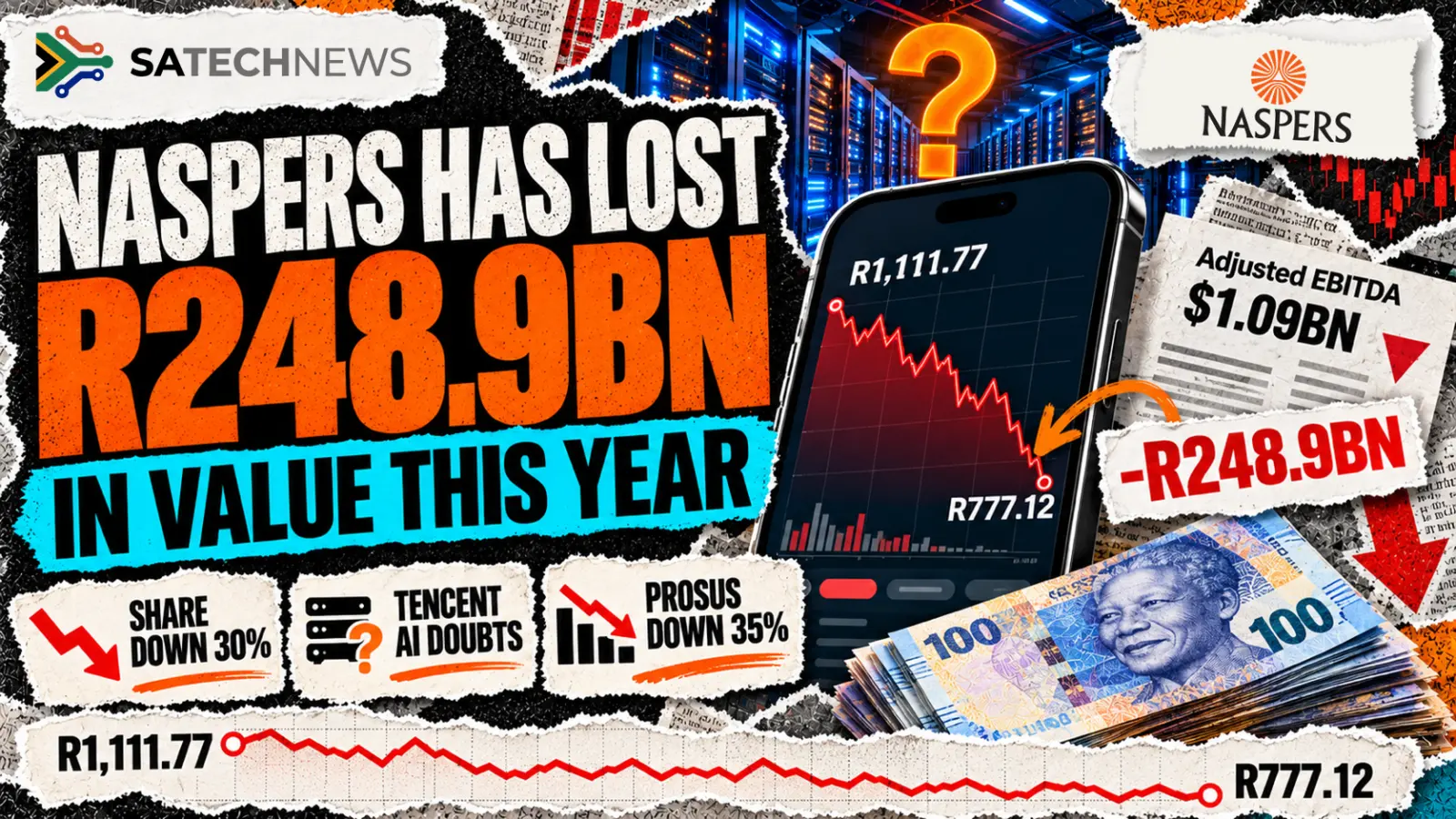
Naspers has shed R248.9bn in market value in 2026 as doubts over Tencent's AI spending and the Just Eat Takeaway deal weigh on a JSE Top 40 heavyweight.
Naspers, the JSE's most valuable technology company, has lost R248.9bn in market value since the start of the year. Its share closed at R777.12 on Thursday, 5 November, down 30% from R1,111.77 at the start of 2026, according to figures compiled by MyBroadband. Its market capitalisation fell from R828.1bn to R579.1bn over the same period.
Naspers is one of the largest companies in the JSE Top 40, so a fall of this size also reaches index trackers, unit trusts and retirement funds that follow the local market.
The fall has little to do with Naspers's own businesses in South Africa, which include Takealot, Mr D, Media24, Property24 and Autotrader. It is mostly about China, and about whether spending on artificial intelligence will pay.
Why the share keeps falling
Naspers owns about 23% of Tencent through Prosus, its Netherlands-based subsidiary, which is also listed on the JSE. Prosus's share price tracks Tencent's closely and is down about 35% this year. Investors have grown uneasy about how much Tencent is spending on AI infrastructure and computing power, and how long it will take to earn that money back. The same question has been asked of Microsoft and Meta in the US, and it hit technology shares hard on the Nasdaq last week.
The second weight is Just Eat Takeaway.com. Prosus paid €4.1bn (about R75.5bn) in cash for the European food-delivery group in October 2025 and took control in December. Analysts questioned the price for a business with thin margins, a weak profit history and rising competition. As a condition of the European Union's approval, Prosus also had to cut its stake in Delivery Hero, and it has been selling those shares to Uber and Aspex Management since April 2026.
The results don't match the share price
For the year to 31 March 2026, Naspers reported an operating loss of US$217m, against a profit of US$124m a year earlier, which MyBroadband attributes mainly to once-off costs of the Just Eat Takeaway deal. Most other measures went the other way. Adjusted EBITDA more than doubled from US$499m to US$1.09bn. Free cash flow rose from about US$968m to US$1.49bn, and core headline earnings rose from US$3.13bn to US$3.57bn. Naspers lifted its ordinary dividend 40% to 28 euro cents a share.
The gap between those numbers and a share down 30% is the market's verdict on what comes next, not on last year. The share peaked at R1,305.67 in October 2025 and was above R1,200 a year ago.
What to watch
Naspers and Prosus will report interim results for the six months to 30 September later this month. Last year they published on 24 November, a week after a trading statement, but we could not find an official date for this year's release. The interims will be the first full half-year to include Just Eat Takeaway, and the first clear look at what the deal is costing.
What the results can't settle is the Tencent question. Naspers's value still rests largely on a Chinese company's AI bet, and the share price shows that investors are not yet convinced it will pay. Until Tencent shows a return on that spending, the R248.9bn may not be the end of it.
The market-value sum
The R248.9 billion is the change in Naspers's market capitalisation from the start of 2026 to the close on Thursday, 5 November, using figures MyBroadband compiled. The company was valued at R828.1 billion at the start of the year and at R579.1 billion at that close. The share itself moved from R1,111.77 to R777.12, which is the 30% fall. Naspers sits in the JSE Top 40, so the same move feeds index trackers, unit trusts and retirement funds that follow the local market. It is a price move. It is not a line from the income statement.
The South African businesses do not explain it. Takealot, Mr D, Media24, Property24 and Autotrader are Naspers companies, and the fall has little to do with how those businesses traded. The weight is the stake in China.
Tencent, and the deal that came with a condition
Naspers owns about 23% of Tencent through Prosus, the Netherlands company that is also listed on the JSE. Prosus tracks Tencent and is down about 35% this year. The worry among investors is how much Tencent is spending on AI infrastructure and computing power, and how long that spending takes to earn its way back. The same question has been put to Microsoft and Meta, and it hit technology shares on the Nasdaq last week. Naspers's price is where that question lands on the JSE.
Prosus also paid €4.1 billion, about R75.5 billion, in cash for Just Eat Takeaway.com in October 2025 and took control in December. Analysts questioned the price of a delivery business with thin margins, a weak profit history and rising competition. European Union approval came with a condition: Prosus had to cut its stake in Delivery Hero. It has been selling those shares to Uber and Aspex Management since April 2026.
Last year's numbers, and the date that is not set
For the year to 31 March 2026, Naspers reported an operating loss of US$217 million, against a profit of US$124 million a year earlier. MyBroadband attributes that swing mainly to once-off costs of the Just Eat Takeaway deal. Other measures went the other way. Adjusted EBITDA rose from US$499 million to US$1.09 billion. Free cash flow rose from about US$968 million to US$1.49 billion. Core headline earnings rose from US$3.13 billion to US$3.57 billion. The ordinary dividend was lifted 40% to 28 euro cents a share.
A loss on one line and a higher profit on another can both be true, because they measure different things. None of them is the 5 November share price. The share peaked at R1,305.67 in October 2025 and was still above R1,200 a year ago. The 30% fall is the market's view of what comes next, not a restatement of the year to March.
Naspers and Prosus will report interims for the six months to 30 September later this month. Last year they published on 24 November, a week after a trading statement. No official date for this year's release was found. Those interims will be the first full half-year to include Just Eat Takeaway, and the first clear look at what the deal is costing. They will not, by themselves, show whether Tencent's AI spending earns a return. Until that return is visible, the R248.9 billion already lost is not a floor anyone can treat as the end of the move.