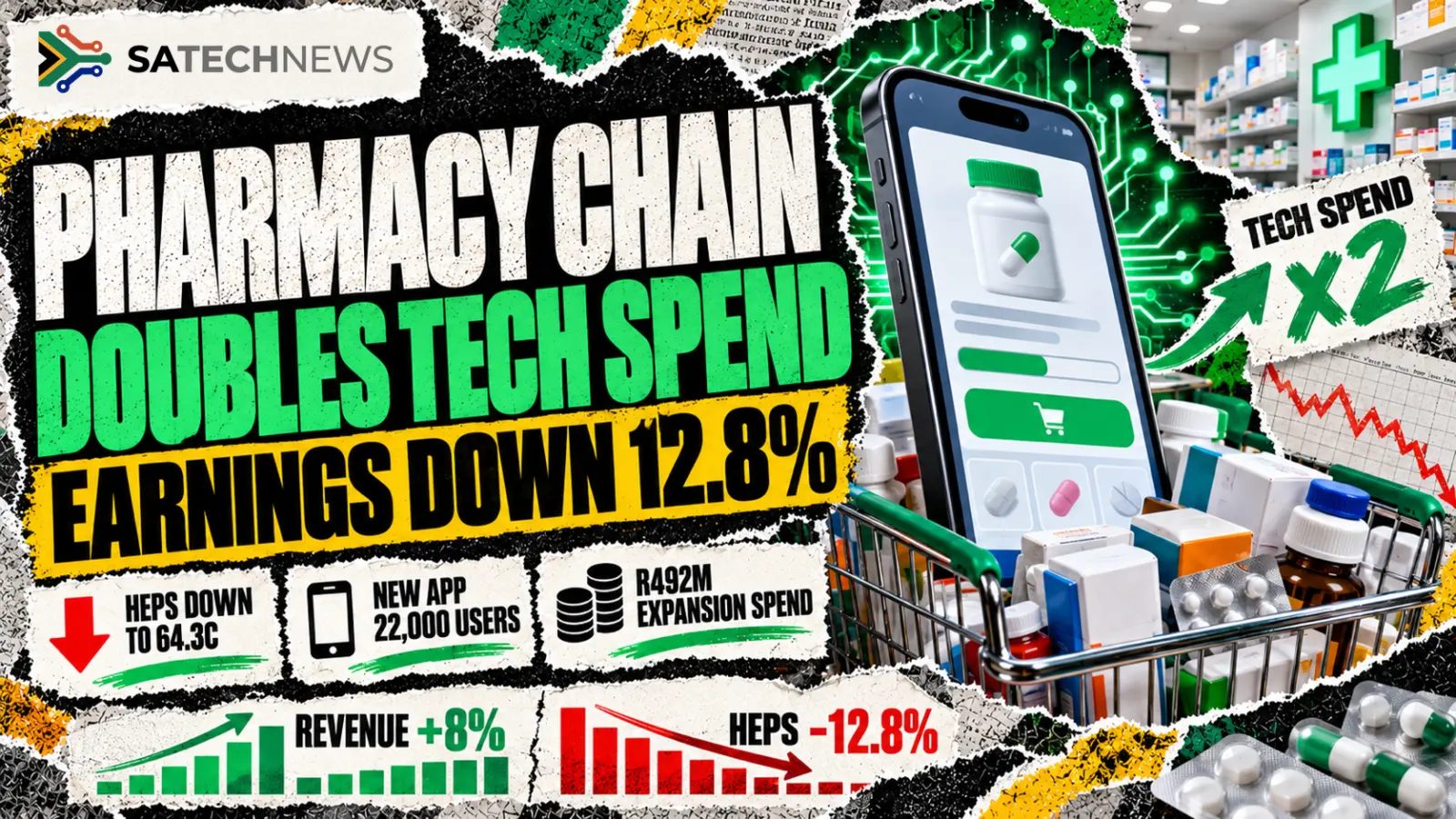
Dis-Chem doubled spending on X, bigly labs as interim HEPS fell 12.8% to 64.3c. Its new app reached 22,000 users, but online sales remain undisclosed.
Dis-Chem has doubled what it spends on X, bigly labs, its in-house technology and innovation unit, and shareholders are paying for it in the short term. Headline earnings per share for the six months to August fell 12.8% to 64.3c, and the interim dividend was cut by 12.9% to 25.62c.
Revenue rose 8% to R22.97bn, so the business is still growing. The problem is cost: expenses climbed 13.1% against a 9% rise in total income, and operating profit fell 10.5% to R1bn, TechCentral reported. Dis-Chem's shares fell sharply on Friday, at one point trading nearly 11% lower at levels last seen three years ago.
The results show what it costs a large South African retailer to build its own technology rather than buy it, and how long investors may have to wait for a return.
Where the money is going
Dis-Chem did not give a rand figure for X, bigly labs in this period, only that spending on the unit doubled. For scale, the group spent R130m on its "integrated healthcare ecosystem" in the six months to August 2025, about 60% of it on X, bigly labs. The unit cost R330m in the year to February 2026, a year in which earnings per share fell 17.1%.
Since the unit was set up, Dis-Chem has spent R240m re-platforming its digital estate: the core commerce platform, cataloguing, pricing, fulfilment and order management. Expansionary capital expenditure, covering new stores, the digital re-platforming and IT upgrades, rose 71% to R492m out of total capital expenditure of R712m.
Those are three different clocks, and they should not be added together as if they were one bill. R130m is a prior half-year on the wider ecosystem, with about 60% of that half attributed to the tech unit. R330m is what the unit cost across the year to February 2026. R240m is the re-platforming spend since the unit was set up, covering commerce, catalogue, pricing, fulfilment and orders. The R492m is this period's expansionary capital expenditure, and the R712m is total capital expenditure, so the expansionary slice is part of the larger capex number, not an extra sum on top of it. What this half still does not give is a rand figure for X, bigly labs itself. The disclosure is that the spend doubled.
The most visible output so far is a rebuilt app. Its first release has gone to 22,000 customers, with a broader release planned between December 2026 and February 2027. A year ago the new app was promised for around August 2026. In September Yusuf Kaka, head of integrated digital engagement at X, bigly labs, said "there was no rescuing the existing app". The August 2026 date has passed. The date now on the table is a wider release in the December to February window, after a first release limited to 22,000 people.
What is working
The loyalty programme is the strongest data point. Better Rewards active membership rose 27% to 8.2 million, members account for 86.1% of sales, and the scheme has handed back R1.5bn in discounts in its first year. Front-shop volumes, excluding pharmacy, grew 5.5% in the year to 27 September against 0.1% for the rest of the market, according to NielsenIQ data cited by the group.
Two new-format stores at Melrose Arch and Irene Village are trading at initial densities 25% above comparable new stores in the old format. Dis-Chem also bought the remaining 50% of Health Window in July for R125m.
The trading picture and the earnings picture are not the same sentence. Revenue is up 8% to R22.97bn. Front-shop volume is ahead of the market on the NielsenIQ comparison the group cited. Loyalty members are 86.1% of sales. Operating profit is still down 10.5% to R1bn, because expenses rose faster than income: 13.1% against 9%.
What management is promising
Chief executive Rui Morais said in the annual report: "In FY2027, we expect to begin demonstrating measurable returns from these investments." With these results he said the group still expects "a very strong year, just supported by a stronger second half", according to Daily Investor. Group revenue grew 7.9% in the seven weeks to 19 October.
The interim numbers already show the cost of waiting. Headline earnings per share are 64.3c, down 12.8%. The dividend is 25.62c, down 12.9%. A year earlier, earnings per share for the year to February 2026 had fallen 17.1% in the same period the tech unit cost R330m. Morais's line is that measurable returns start to show in FY2027, and that this year leans on the second half. The seven weeks to 19 October, with revenue up 7.9%, are the early part of that second half, not the full result.
What is unresolved
Dis-Chem does not disclose online sales, so investors cannot yet measure what the app and platform spend is producing in revenue. Nor has it given a rand figure for X, bigly labs this half. The broad app release in the December to February window will be the first point at which customers, rather than shareholders, decide whether the rebuild was worth it. Until that release, and until online sales are disclosed, the doubled spend is visible in the cost line and not yet in a digital revenue line. Friday's share move, nearly 11% lower and back at a three-year level, is the market's reading of that gap on the day of the numbers. The R125m Health Window purchase in July is a completed deal. The app's wider release is not.