
Breaking
Latest tech news from South Africa and around the world•Stay updated with breaking technology developments•Innovation and digital transformation news•AI, gaming, and gadget updates daily•Crypto and fintech news from Africa•
 SA Tech News Desk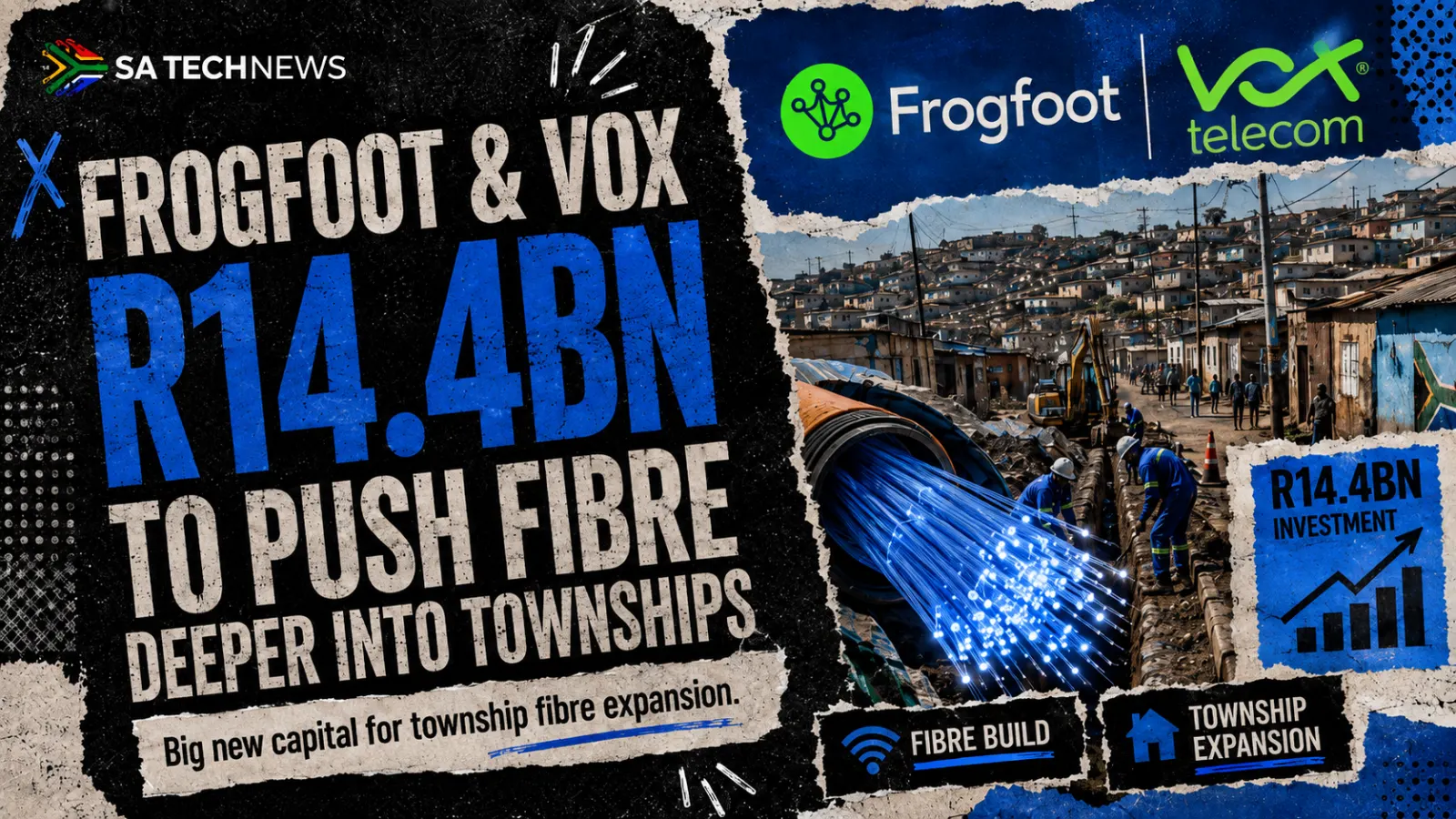
Vox, Frogfoot and Hypa Fibre raised R14.4 billion in fresh capital. The important detail is where they plan to spend it: township fibre builds.
South Africa's fibre build-out is entering a different phase.
The first wave was easy to understand. Operators raced through affluent suburbs, business districts and gated estates where customers could afford R700 or R1,000 a month for uncapped fibre and where dense, predictable demand made the economics attractive.
The next wave is harder.
Vox Telecom, Frogfoot Networks and Hypa Fibre have now raised R14.4 billion to go after it.
The three businesses, all part of Johannesburg-based Vivica Group, secured R8.4 billion in equity funding and another R6 billion in debt. Frogfoot and Vox chief executive Abraham van der Merwe says the capital will be used to sharply accelerate fibre deployment, with a large portion of the rollout aimed at South African townships.
The target is ambitious: increase annual fibre deployment roughly fourfold to around 360,000 homes a year.
That is not simply another network expansion announcement. It is a bet that township broadband can become one of the biggest remaining growth markets in South African fixed connectivity.
The economics of early fibre deployment favoured high-income suburbs.
Homes were close enough together to make trenching efficient. Residents already spent meaningful amounts on ADSL, fixed-LTE or mobile data. Many worked from home and were willing to pay for stable, uncapped connectivity.
Operators could calculate expected take-up with reasonable confidence.
Townships are different.
Household incomes are more varied. Many users rely heavily on prepaid mobile data and buy connectivity in smaller increments. Informal housing can make physical deployment harder. Streets and municipal infrastructure are not always mapped or maintained to the same standard as newer suburbs.
And yet the demand is clearly there.
South Africa is deeply mobile-first, but mobile data remains expensive when used as a permanent home-broadband replacement. A household with multiple smartphones, a smart TV, schoolwork, streaming and remote work can burn through mobile bundles quickly.
Affordable fibre changes that equation.
Van der Merwe estimates there may be an opportunity to connect as many as 15 million South African homes.
That compares with roughly 4.5 million homes already connected to high-speed fixed broadband.
The gap explains why investors are still prepared to put billions into an industry that, in wealthier suburbs, can sometimes feel oversupplied.
South Africa does not have a fibre saturation problem. It has a fibre distribution problem.
A relatively small share of households enjoy world-class fixed broadband while millions remain dependent on mobile networks or slower fixed-wireless alternatives.
The next round of growth therefore depends less on convincing existing fibre users to change providers and more on finding a model that makes fibre affordable in lower-income areas.
That is a much more interesting engineering and commercial problem.
Operators have already learned that a conventional suburban product does not translate neatly into township markets.
The network design may need to be different. Installation processes have to be faster and more flexible. Prepaid billing becomes important. Packages must be priced around how households actually manage cash flow.
Customer service also has to work differently.
A household paying R249 or R299 a month is still entitled to reliable support, but the operator has less revenue available to fund expensive call-centre interactions and technician visits. That pushes companies towards better self-service tools, WhatsApp support, community agents and more efficient local maintenance.
Fibre operators also face an uncomfortable physical reality: network vandalism, theft and construction damage can destroy the economics of a route very quickly.
The companies that succeed will be the ones that design for those conditions from day one instead of treating them as exceptions.
The R14.4 billion package combines R8.4 billion in equity with R6 billion in debt.
That is significant because fibre is a capital-hungry business.
Operators spend heavily upfront to pass homes, often months or years before enough customers sign up to justify the build. Debt can accelerate deployment, but only if take-up and cash flow arrive as expected.
The new equity gives Frogfoot and Vox more room to absorb that risk.
The investor group includes interests led by DNI Group and EM-Three Investments Holdings. DNI chief executive Ryan Noach has said the investment is intended to bring more than capital, pointing to strategic overlap between the businesses.
That may prove useful.
Township fibre is not only a trenching problem. Distribution, devices, payments, retail presence and customer acquisition all matter. Companies with existing footprints in those areas can reduce the cost of reaching customers.
Township fibre growth is not happening in isolation.
Vodacom, MTN, Telkom and Cell C have spent years expanding 4G and 5G capacity in dense urban areas. Fixed-LTE and 5G home products have become credible broadband alternatives, particularly where fibre is unavailable.
The more fibre moves into townships, the more pressure it puts on mobile data pricing.
That is good for consumers.
A household that can choose between prepaid mobile data, uncapped 5G and low-cost fibre is in a stronger position than one with a single practical option.
Mobile networks still have advantages. Installation is immediate. There is no trenching. Customers can take the router with them. But fibre has one major strength: once the line is in the ground, it can deliver enormous capacity at relatively low incremental cost.
For homes with heavy video and gaming usage, that matters.
South Africa's fibre industry has already experienced periods of aggressive overlapping deployment.
In some suburbs, multiple operators dug up the same streets while nearby communities remained untouched.
The township opportunity is large enough to attract the same behaviour if operators are not disciplined.
R14.4 billion can build a lot of network. It can also destroy value quickly if several providers all chase the same high-density pockets while ignoring less obvious areas.
The best outcome for the market would be broader geographic expansion rather than duplication for its own sake.
Open-access models help. So do infrastructure-sharing arrangements and wholesale partnerships that allow several ISPs to serve customers over one physical network.
Frogfoot already operates as an open-access network, which gives it a structural advantage here.
Fast broadband is now basic infrastructure for modern life.
Job applications, schoolwork, banking, entertainment, government services and small-business commerce increasingly assume reliable Internet access.
That makes township fibre more than a telecom growth story.
South Africa has spent years talking about digital inclusion while leaving millions of households on expensive mobile data. The private sector is now discovering that inclusion may also be a large commercial opportunity.
That is the part worth watching.
If Frogfoot and Vox can prove that lower-income fibre customers deliver sustainable returns, more capital will follow. Prices should fall. Competition should increase. Coverage will move into areas that operators previously considered too risky.
If the economics fail, the industry may retreat back towards the safer suburbs.
R14.4 billion says the investors believe the first outcome is more likely.
The next test is whether 360,000 new homes a year actually become paying, connected households, and whether those connections remain affordable once the introductory offers disappear.
Source: SA Tech News