
Breaking
Latest tech news from South Africa and around the world•Stay updated with breaking technology developments•Innovation and digital transformation news•AI, gaming, and gadget updates daily•Crypto and fintech news from Africa•
 Tech Team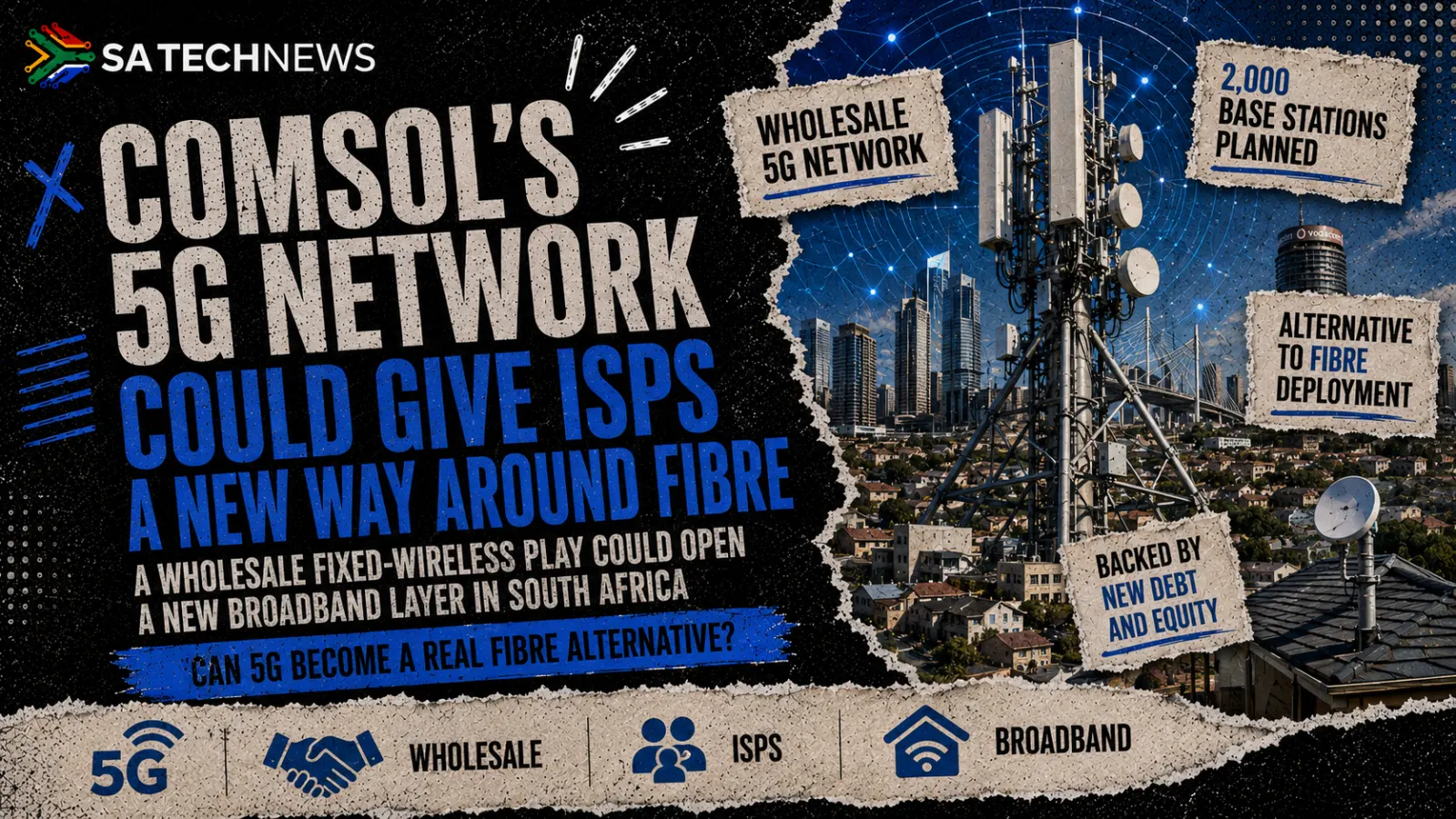
Comsol is building a wholesale standalone 5G-Advanced network for ISPs, with roughly one million Gauteng homes already in reach.
South Africa's next big broadband network will not have stores, consumer adverts or a familiar mobile brand on the bill.
Comsol is building it anyway.
The South African fixed-wireless operator is rolling out a standalone 5G-Advanced network that it plans to sell wholesale to internet service providers, MVNOs, banks, retailers and other companies that want to offer home broadband without building their own radio network.
The company says it already has around 450 sites live and can reach roughly one million Gauteng households. Its first ISP partner is expected to go commercial in September, with a broader national build targeting about 2,000 base stations by the end of 2028.
That makes the project more interesting than another 5G coverage announcement.
Comsol is effectively trying to create a new infrastructure layer between the big mobile operators and South Africa's consumer-facing ISPs, one that could give those ISPs an alternative in places where fibre is too slow, too expensive or simply not coming.
Comsol's model is deliberately invisible to the end customer.
The company owns and operates the network. Partners control the brand, pricing, billing, support and customer relationship.
That is closer to the open-access fibre model than a traditional mobile network.
An ISP could therefore sell a home-internet package on Comsol's infrastructure without becoming a mobile operator. A retailer or bank could potentially do the same. The network's API-driven architecture is designed so partners can create and change packages quickly rather than waiting for a full telecoms product cycle.
Comsol has spent years in enterprise connectivity, private networks and fixed wireless. Moving into mass-market home broadband is a much larger bet.
Founder and CEO Iain Stevenson says the company is completing a multi-billion-rand debt and equity raise to fund the expansion. RMB arranged financing for the transaction and capital programme, while Platform Investment Partners and Wimsey Capital have joined as new shareholders. Convergence Partners and other existing investors are also putting in additional growth capital.
The network runs on 60MHz of contiguous spectrum in the 3.7GHz band.
That detail matters.
Instead of stitching together fragmented blocks or relying on a 4G anchor, Comsol is building a standalone 5G network around one clean channel. It also holds significant millimetre-wave spectrum at 28GHz for higher-capacity use cases.
The result is a network designed from the start for fixed wireless access rather than a mobile network that happens to sell routers.
Comsol has also chosen not to build every physical layer itself. It leases tower space and fibre backhaul, allowing capital to go into radio equipment, core systems and coverage rather than duplicating infrastructure that already exists.
That should let it expand faster than a greenfield mobile operator.
The company wants full Gauteng coverage by March 2027, followed by the Western Cape, KwaZulu-Natal and major regional centres through 2027 and 2028.
Fibre remains the best fixed-broadband technology when the economics work.
It is stable, scalable and does not share radio capacity in the same way as wireless access. In dense suburbs with existing ducts and strong take-up, it is difficult to beat.
But South Africa's fibre market has a geography problem.
The easiest neighbourhoods have already been built. New deployment increasingly means townships, smaller towns, peri-urban areas and lower-density suburbs where trenching costs are harder to recover.
A 5G site can cover thousands of homes without digging past every gate.
That does not make wireless automatically cheaper or better. Spectrum capacity, tower load, signal conditions and customer-premises equipment all matter. But it can change the rollout equation dramatically.
Comsol is explicit that its footprint is not aimed only at wealthy suburbs. Stevenson has pointed to Diepsloot, Alexandra and Soweto as the kind of markets the network is intended to serve.
South African ISPs already compete fiercely on fibre networks they do not own.
Comsol wants to give them another wholesale pipe.
That matters because the largest mobile operators have a structural advantage in fixed wireless: they control both the radio network and the consumer brand. Smaller ISPs can resell mobile products, but they have less control over the underlying economics.
A neutral wholesale 5G network changes that balance.
An ISP could mix fibre and Comsol coverage under one brand, using fibre where it exists and 5G where it does not. MVNOs could add home broadband without negotiating the same arrangement as their mobile voice and data service. New entrants could launch broadband products without funding towers or spectrum.
The model will still live or die on wholesale pricing and network performance.
If Comsol's capacity is expensive, partners will struggle to compete with uncapped fibre and aggressive mobile deals. If too many customers are loaded onto a site, the experience will deteriorate. Fixed wireless also needs decent indoor signal or well-designed external equipment.
Those are execution questions, not small ones.
For now, Comsol's network is a large infrastructure project with a compelling model and no consumer track record.
That changes when the first ISP goes live.
The useful numbers will then be less glamorous than the R-billions raised or the 2,000-site target: installation times, average speeds at peak hours, customer churn, wholesale economics and whether partners can profitably serve areas fibre operators have skipped.
If those numbers work, Comsol could become one of the more important broadband networks in South Africa without most consumers ever knowing its name.
That is exactly the point.
Source: SA Tech News