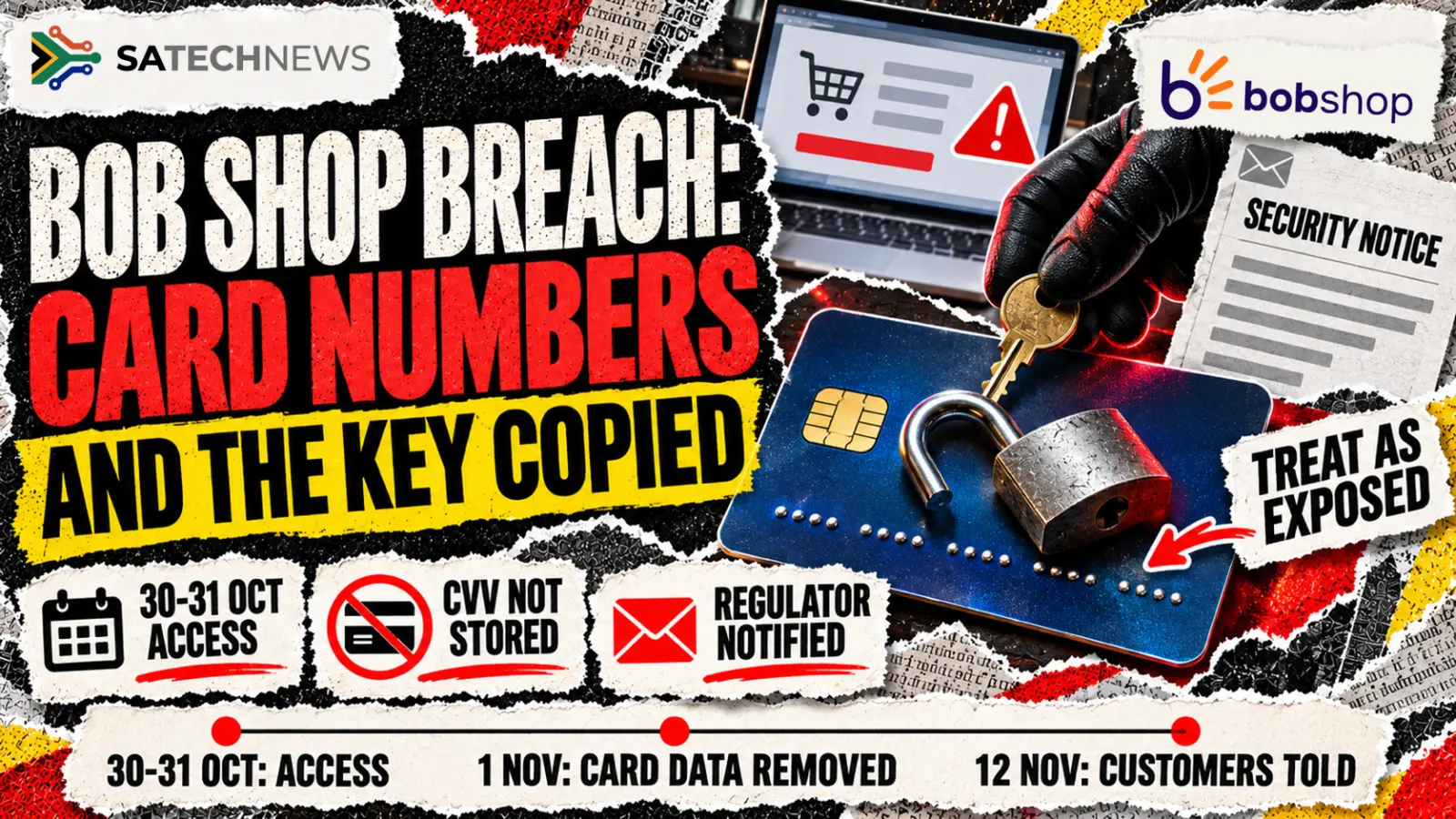
Bob Shop says attackers copied encrypted card numbers and the key that unlocks them on 30 and 31 October. CVVs were not stored. Here is what to do.
Bob Shop, the online marketplace that used to be Bidorbuy, has told customers who paid by card to treat their card numbers as exposed. An attacker got into the company's systems on 30 and 31 October and copied stored card records along with the key that decrypts them.
The warning went out by email on Thursday 12 November, signed by Bob Group chief executive Anita Erasmus in her role as information officer. If you have paid by card on Bob Shop, your name, card number and expiry date may be in someone else's hands. Encryption did not protect them, because the key travelled with the records.
That is the part that changes the usual advice. A stolen file of encrypted card numbers is a problem. A stolen file plus the key that unlocks it is a card number the company itself says you should treat as readable.
What the notice says was copied
An "unauthorised party" accessed parts of Bob Group's systems, including the Bob Shop database. That database holds customer and seller accounts and what the company calls "older partial payment records". The last recorded activity by the attacker was on 1 November.
The card records contain the cardholder's name, the card number and the expiry date. Erasmus wrote: "The card number was stored in encrypted form, but the encryption key was also copied, so the card number should be treated as exposed."
The three-digit security code on the back of the card, the CVV, was not in the records. That limits what a thief can do at a checkout that demands the code. It does not make the data harmless. Some online merchants accept payments without a CVV, and a caller who already knows your name, card number and expiry date sounds much closer to your bank than a stranger guessing.
Account details sat in the same database: names, email addresses, usernames and passwords. The passwords were stored in hashed form, which is not the same as storing them in the clear. The notice is still careful. "We have no evidence that your account details were read, but we cannot rule it out."
What Bob Group says it has already done
On 1 November the company removed historical card numbers, names and expiry dates from the live Bob Shop database and replaced the encryption key. It says it closed the routes the attacker used, ended all active sessions, and replaced exposed passwords, keys and system credentials.
Sellers get two extra controls. Payouts now go through stricter approval. Any change to a seller's payout bank details is held until it has been confirmed. The notice does not say whether any seller payout was actually changed. The email went to buyers who paid by card.
Bob Group has reported the breach to the Information Regulator, which the Protection of Personal Information Act requires. It has also told its acquiring bank. That bank was asked to notify the card schemes so that issuing banks can watch the affected cards for fraud. The company says it does not yet know who was behind the attack.
What a cardholder should do
The notice lists the steps, and they are ordinary because they work. Check card statements and report any transaction you do not recognise to your bank immediately. Change the Bob Shop password, and change it on every other site where you used the same one. Never give a CVV, a one-time PIN or a banking password to anyone who contacts you.
Bob Group says it will never ask for a password, card number, CVV, OTP or banking login, and will never ask a seller to change bank details by email. Treat any message that does as a scam, however much the sender seems to know about you. After a breach, the dangerous emails are the ones that quote a real order, a real username or a real expiry date.
The notice does not tell customers to replace the card. Whether to cancel and ask for a new number is a decision for each cardholder and their bank. Asking the bank costs nothing, and the bank can see attempted charges that a customer has not yet spotted.
The dates, in order
The notice puts the intrusion on 30 and 31 October. The last recorded attacker activity was on 1 November, and the company says it pulled the historical card numbers off the live database the same day and replaced the key. Customers were told on 12 November.
That is an 11-day gap between the last recorded activity and the customer email. The Protection of Personal Information Act requires notification as soon as reasonably possible after a compromise is discovered. Bob Group has not said when it first understood that the encryption key had been copied, so the notice does not show whether the gap was investigation time or delay. This account does not allege a breach of that duty. It records that the company has not explained the calendar.
What the notice still does not say
The notice does not say how many cardholders are affected. It does not say how far back the stored card records go. It does not explain why full card numbers were kept in a marketplace database, or how the attacker reached the encryption key.
Bob Group was formed in 2022 when Bidorbuy merged with the logistics software company uAfrica. Some of the "older" records may date from the Bidorbuy years. The notice does not say so in those words. Erasmus has run the group only since 1 September, when she took over from co-founder Andy Higgins. The intrusion, on the dates in the notice, happened in her second month.
How this sits next to the other notices
South African customers have had three breach notices in just over a week. NightsBridge disclosed that guest contact and booking details had been taken. The Courier Guy reported to the Information Regulator after a ransomware group dumped its files. Bob Shop's case is the one that involves payment card numbers, and the encryption failed because the lock and the key were taken together.
A hashed password can still be guessed if it was weak and reused. A card number that the company says should be treated as exposed is a different object: it is already in the form a fraudster can type into a checkout that does not ask for the CVV. That is why the practical step is the statement, not a password reset alone.
What remains open
Who copied the key is unknown. How many cards are in the file is unknown. Whether seller payouts were touched is unknown. Whether issuing banks have already flagged the cards is something only those banks can tell a customer who calls.
Until those answers exist, the usable instruction is the one in Erasmus's email. Treat the card number as exposed. Watch the statement. Do not hand a code to a caller who already knows your expiry date.