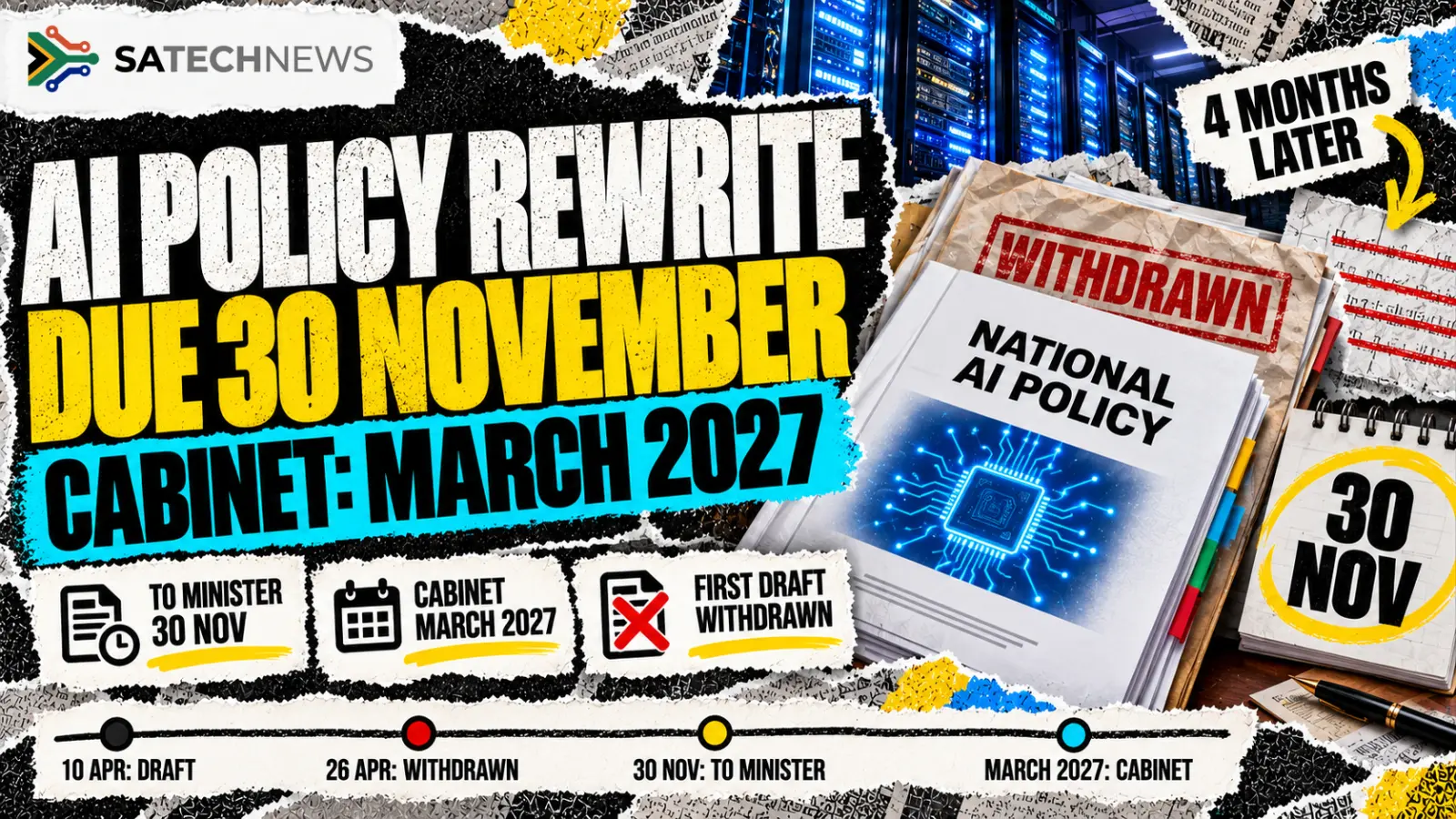
Officials must give Malatsi the rewritten national AI policy by 30 November. Cabinet is only due to see it in March 2027, four months later than promised.
South Africa's second attempt at a national AI policy now has a firm internal deadline. The government drafting team must hand the revised policy and a discussion document to Communications Minister Solly Malatsi by 30 November, according to Jeanette Morwane, the acting deputy director-general at the Department of Communications and Digital Technologies who manages the project.
Cabinet is due to approve it in March 2027, mainly so that it can be gazetted for public comment. That is the earliest point at which companies, universities and civil society will see what the state plans to do about AI, and it is about four months later than the department told Parliament in May.
For local businesses already deploying AI tools, that means at least another four months without a national policy to plan around. Until then, sector rules, POPIA and the courts continue to fill the gap.
The confirmed dates
Morwane set out the timetable at a South Africa–Finland AI dialogue hosted by the Finnish embassy at the National Research Foundation in Pretoria last week, as reported by TechCentral. "We have a deadline of 30 November to submit to the minister," she said.
Internal government consultations follow from December to February. Cabinet approval for public comment is pencilled in for March 2027. After the comment period, the department will consolidate submissions and take the policy back to cabinet for final approval. No date has been given for that last step.
The 30 November date is an internal handover, not a publication date. What the minister receives then is not what the public receives then. On the timetable Morwane described, the public text is the one cabinet is asked to release for comment in March 2027.
Why the timetable slipped
The first draft was gazetted for comment on 10 April 2026. Malatsi withdrew it on 26 April after its reference list was found to include fictitious sources, a failure he said was "not a mere technical issue". Reports at the time pointed to unverified AI-generated citations as the likely cause.
In May the minister appointed a seven-member independent expert panel chaired by Wits University AI researcher Benjamin Rosman. Its members have submitted advisory notes, which the drafting team is now analysing. The department leads that team, with the Presidency, the Department of Science, Technology and Innovation, the State Security Agency and the Department of Trade, Industry and Competition taking part.
The schedule has moved repeatedly since. In May, Parliament was told cabinet approval would come in November, with public comment in January 2027. In July, Morwane told TechCentral that cabinet would see the policy in November, with January as "the latest". In September, at GovTech, Malatsi said he aimed to have a draft before cabinet by the end of the financial year.
Set those three statements next to the new one. May: cabinet in November, public comment in January 2027. July: cabinet in November, January at the latest. September: a draft before cabinet by the end of the financial year. The Pretoria timetable now puts an internal submission to the minister on 30 November, and cabinet's look at a public draft in March 2027. That March date is the one Morwane described as about four months later than the May account to Parliament.
What the drafters are focusing on
Morwane said the discussions centre on compute and data sovereignty, and on what she called model sovereignty: making sure large language models work in South Africa's official languages. A separate implementation road map is being drawn up in parallel.
Compute is the most obvious gap. "What's missing for us is there is a huge need for investing in computing infrastructure," Morwane said at the Pretoria event. The Centre for High Performance Computing is due to have a 4-petaflop replacement for its Lengau system running by March. Finland's CSC, which operates the Lumi supercomputer, used the same dialogue to offer training, exchanges and help with access, although the science department said there is no formal collaboration agreement yet.
A presentation slide at the event said South Africa holds a regional lead in AI readiness, but that its peers are moving faster on implementation. It cited Egypt's national language model, Karnak, launched this year. The slide is a comparison the department's event used. It is not the policy text, and it does not say what South Africa will require of companies.
What is still unresolved
The policy's actual provisions remain unknown. Nothing published so far says whether it will propose new AI-specific rules, a dedicated regulator, or reliance on existing law such as POPIA. The 30 November submission is internal, so on the current plan the public will not see the text until cabinet releases it for comment in March 2027.
Between the withdrawn April draft and the March 2027 comment date, the public record is a sequence of later dates, not a sequence of rules. The fictitious citations are why the first text came down. The panel's notes are in. The policy they are meant to inform is not out.
What can be dated from the public record is the path, not the content. A draft went out on 10 April and was withdrawn on 26 April. A seven-member panel has sent notes the department is still reading. Five parts of the state are on the drafting team. The next dated step is 30 November, to the minister. The next dated step the public is told to expect is March 2027.