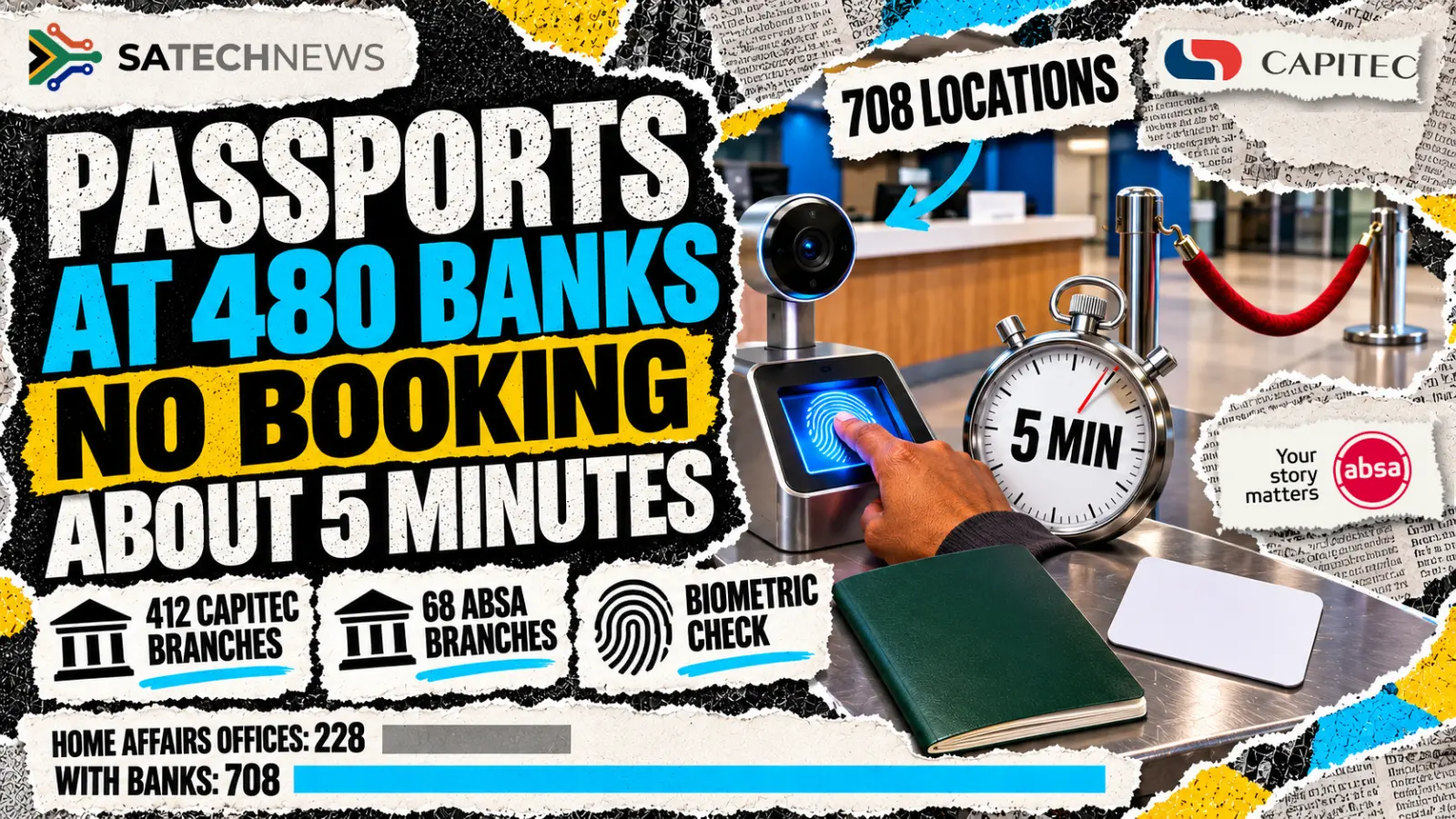
Adults can apply for passports at 412 Capitec and 68 Absa branches from 18 November, taking access from 228 Home Affairs offices to 708 locations.
South Africans aged 18 and over can now apply for a passport at 480 Absa and Capitec branches, with no booking. Home Affairs Minister Leon Schreiber switched the service on at the V&A Waterfront in Cape Town on Wednesday, 18 November, and called it the beginning of the end of standing in a queue to get a passport.
Capitec carries most of the load, with 412 branches. Absa has 68. Until this week, passports were issued through 228 Home Affairs offices, plus a few dozen bank branches that took appointments under the older eHomeAffairs model. The new branches take the network to 708 locations, which the department describes as a 208 percent increase in access.
The arithmetic is the department's. Two hundred and twenty-eight offices plus 480 bank branches is 708, and 480 is a large addition to a network that was built around Home Affairs counters. What it does not say is how many of those 480 branches are open for the full day, how many staff are trained to capture a passport application, or what happens when a branch's link to the population register drops. A location on a list is not the same thing as a passport in a hand.
The department says an application takes about five minutes, without forms or a queue. Participating branches are listed on the MyHomeAffairsOnline portal. Home Affairs' own fees still apply: R600 for an adult tourist passport and R1,200 for an adult maxi passport. Absa says it does not currently add a fee of its own. Capitec has not, in what has been published, said whether it will.
How the bank model works
This is the same digital partnership that has carried smart ID replacements since the first bank branch went live on 9 March. Capture is biometric and automated. If an applicant's photograph does not match the population register, the passport is not produced. That is the department's answer to photo-swapping fraud: the machine refuses the application rather than a clerk deciding later that the face looks wrong.
The smart ID side has grown faster than the department planned. Home Affairs set a target of 750 bank branches by 31 March 2027 and passed it more than four months early. Smart ID replacements are now offered at 833 branches of Absa, Capitec, FNB and Standard Bank, and those branches have processed more than 1.16 million applications in about eight months.
FNB and Standard Bank are not part of the passport launch. The smart ID network and the passport network are therefore not the same map. Someone who replaced a green ID book at an FNB branch cannot assume that the same counter will take a passport application this week. Absa says it plans to have more than 90 passport branches by the end of the year, up from the 68 that went live on Wednesday, and its customers can walk in or book a slot in the Absa Banking App. Capitec's 412 branches are walk-in. The department has not said what a person should do if they arrive and the branch has already reached its capture limit for the day.
The green ID book deadline
The passport launch also sits inside Home Affairs' plan to retire the green ID book, which it calls the most defrauded document on the continent. Production stops on 31 March 2027. The book stops being valid identification on 31 March 2028. About 14.7 million people still relied on it in October.
Anyone who has only a green ID book and applies for a passport at a participating branch will automatically apply for a smart ID card at the same time. That is a practical coupling. It is also a queue of a different kind. A person who wants a passport and still holds a green book is now applying for two documents, even if the department presents it as one visit. The department has not said how long the smart ID then takes to arrive, or whether a refused photograph blocks both documents or only the passport.
The 14.7 million figure is the size of the problem the bank channel is being asked to help clear before production of the green book stops. Eight hundred and thirty-three branches have already taken 1.16 million smart ID applications in about eight months. At that pace, the remaining green books are not a one-year job, and the passport service is only at 480 branches, not 833. The department has not published a monthly target for either.
What Schreiber said comes next
Schreiber listed three additions for the bank channel: first-time smart ID applications, passports for children, and home delivery of smart IDs and passports applied for at banks. "All of this work will be complete in a few months," he said, without giving dates. Until then, passports for children still go through Home Affairs offices.
A few months, with no date, is not a timetable a parent can plan around. The adult service that switched on this week still excludes anyone under 18, and it still excludes the two banks that already do smart IDs. First-time smart ID applications are a separate queue from replacements. The department has not said whether a person who has never held a South African ID can start at a bank, or whether "first-time" means something narrower.
A biometric e-passport is planned for the new year, which the department links to negotiating more visa-free access for South Africans. It still depends on a proposal going to cabinet, and the department has not said when cabinet will consider it. An e-passport that has not been to cabinet is not a chip in a booklet, and a hope of visa-free travel is not an agreement with any other country.
What is live, from Wednesday, is narrower than the speech. Adults can apply at 412 Capitec branches and 68 Absa branches, without a booking, at Home Affairs' own fees. The list of those branches is on the department's portal. Whether a given branch can actually capture an application on a given morning is something the department has not published, and neither bank has published how it will turn people away when it cannot.