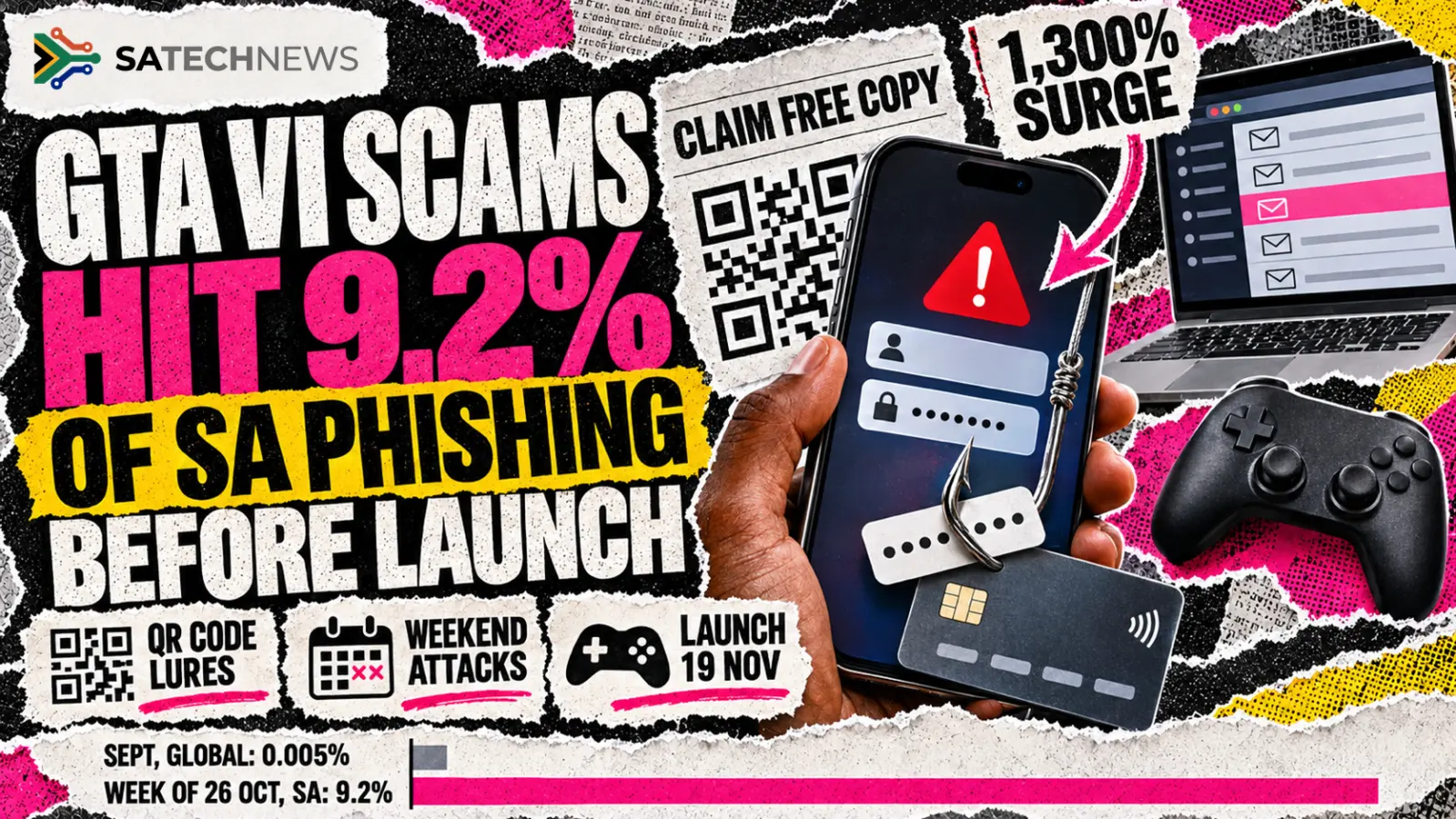
GTA-themed lures made up 9.2% of South Africa's phishing in late October, says KnowBe4, as attackers use the 19 November launch to target staff.
Grand Theft Auto VI goes on sale on PlayStation 5 and Xbox Series X|S on 19 November, and the phishing arrived first. Security awareness company KnowBe4 says GTA-themed lures made up 9.2% of South Africa's phishing volume in the week starting 26 October, the sixth-highest level of GTA-related phishing it recorded anywhere.
That is a sharp jump from a standing start. KnowBe4's Phishing Threat Trends Report Volume 8 put GTA-themed phishing at 0.005% of threats globally in September. Gaming-related phishing emails in general have since risen 1,300% against the monthly average for March to August. For South African players, the timing lines up with a launch many have been preparing for since pre-orders opened at R1,499 for the standard edition. For employers, KnowBe4's warning is that the same lures are being aimed at staff, not only at people trying to buy a game.
The 9.2% figure is a share of phishing volume, not a count of emails and not a count of companies. KnowBe4 has not said how many South African inboxes saw a GTA lure that week. A percentage that high, in a country that is not a launch market in any special sense, is still the local fact. The game's release date is doing the work the attackers need. People expect a message about it.
Two waves, and the second one is timed for the office
KnowBe4 describes two kinds of campaign. The first is mass-market: fake crypto casinos and giveaway sites built to collect passwords and card details. The company says the volume of these can also bury a security operations centre in alerts. The noise is part of the method. A desk that is clearing junk is a desk that is slower on the message that is not junk.
The second wave targets businesses and is timed for weekends, when security teams are short-staffed and still working through the first wave's reports. According to KnowBe4, attackers register lookalike supplier domains that pass SPF, DKIM and DMARC email checks, and send emails with blank bodies or QR codes. The codes are built from Unicode text or HTML tables so that image-scanning filters miss them. A filter looking for a picture of a QR code does not see a picture. It sees characters, or a table, that a phone camera will still read as a code.
The QR code is the step that takes the attack off the company network. An employee who scans it with a personal phone leaves the firewall, the web filtering and the endpoint protection behind, while the page that loads asks for work credentials. KnowBe4 has no data on how often these emails succeed once they reach an inbox. The published figures stop at volume. They do not say whether anyone typed a password.
Lucy Gee, senior cyber security threat researcher at KnowBe4, said the pattern is not unique to this launch. "Cyber security is no longer just a Monday-to-Friday, nine-to-five challenge," she said. The same shape shows up, on her account, around the FIFA World Cup, concert and festival ticket sales, Prime Day and holiday delivery notices. A date that a lot of people are waiting for is enough. The attackers do not need a South African office of the game publisher. They need a subject line people will open on a Saturday.
What the advice actually covers
KnowBe4's recommendations are aimed at this pattern, and they are ordinary because the pattern is ordinary. Staff should know that real perks appear on the company intranet or the HR portal, not in an unsolicited link. A work email that asks someone to scan a QR code with a personal phone should be treated as a reason to stop. Training simulations should include lures that arrive after hours and look like HR perks or vendor discounts, because that is the shape of the second wave, not a generic exercise run on a Tuesday morning.
For players, the safe route has not changed with the new numbers. Buy and download the game through the PlayStation Store, the Microsoft Store or a known retailer. Ignore a "free copy" or an early-access offer that asks for a login or a card number. A pre-order price of R1,499 is public. An offer that undercuts it by asking for a password is not a discount. It is the mass-market wave KnowBe4 described.
None of that advice answers the question an employer will ask first: did any of this land inside our company? KnowBe4 has not published how many South African organisations received these emails, which brands or suppliers were impersonated, or whether any credentials were taken.
What the percentages do not say
A separate figure published with the same data, that GTA lures reached 9.6% of all phishing volume in the same week, is not labelled by country. KnowBe4 has not said whether that 9.6% is global. It should not be read as a second South African number sitting next to the 9.2%.
The September baseline of 0.005% is global, and it is from a different month. The 1,300% rise is for gaming-related phishing emails in general, measured against the March-to-August average, not a rise in the South African GTA share alone. Putting those three figures in one sentence makes the launch look like a measured South African surge. Only the 9.2%, for the week of 26 October, is the local share KnowBe4 has actually labelled.
The launch is 19 November. The measured week ended well before it. KnowBe4 has not published a figure for the days closer to release, so it is not yet clear whether 9.2% was the peak or the start. What is clear is the method: a public date, a lookalike that passes ordinary email checks, and a QR code that walks the request onto a phone the company does not control. The missing piece is whether that method worked here, and KnowBe4 has said it does not have that number.