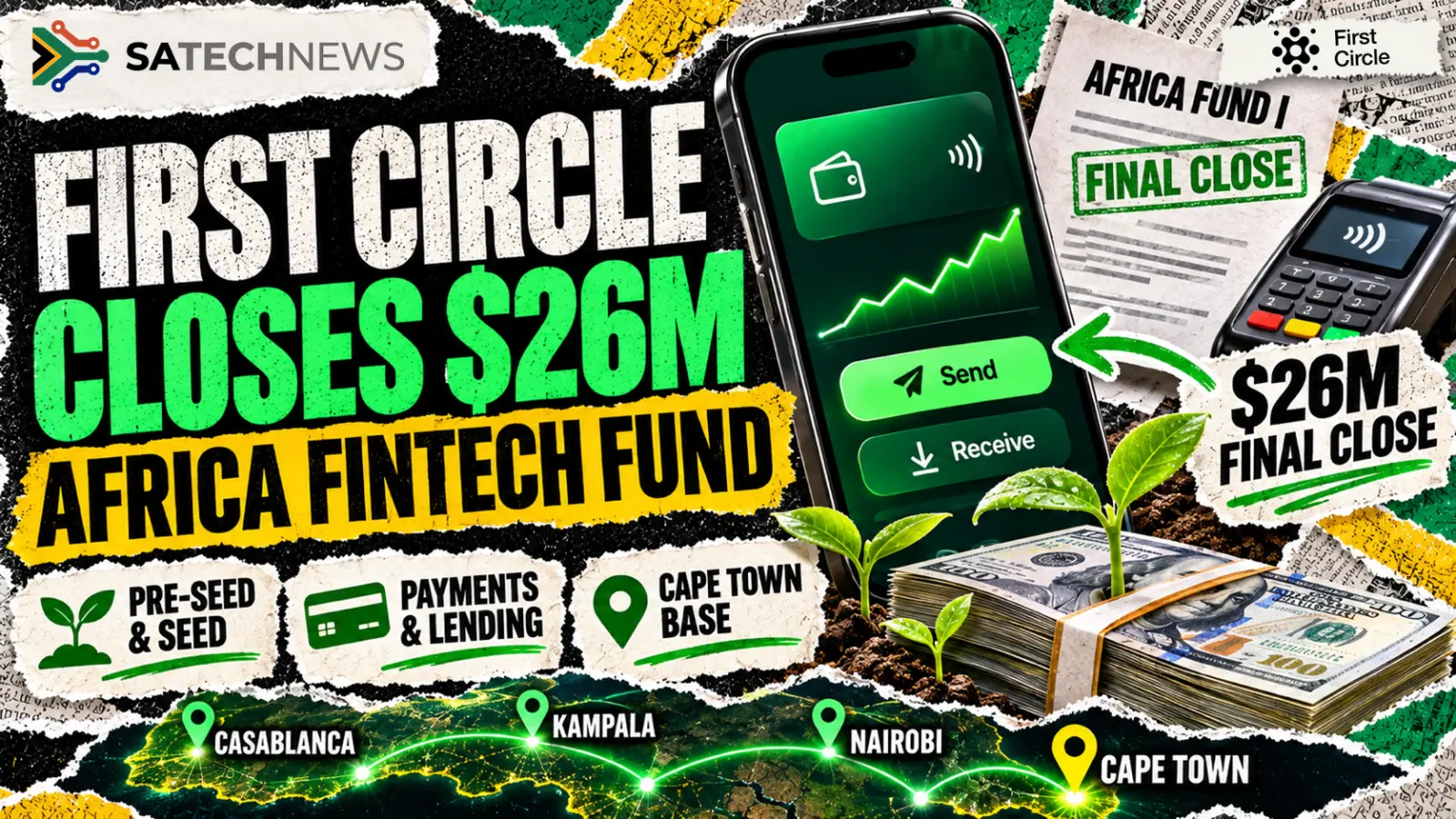
First Circle Capital has closed a $26m early-stage African fintech fund. Its Cape Town presence gives South African founders a relevant investor to watch.
First Circle Capital has completed the final close of its first Africa-focused fintech fund at $26 million. The close was reported on 19 November and dated to 18 November in Kampala. Cape Town is one of the firm's operating bases, which is the South African fact in an otherwise continental announcement.
A final close means the fund has finished raising the pool it set out to raise. It does not mean the money has been invested, and it does not name a single South African company. The vehicle, First Circle Africa Fund I, is aimed at pre-seed and seed investments, not later-stage growth capital.
What the fund says it will look at
The stated areas are insurance technology, alternative lending, payments interoperability and infrastructure, climate fintech, fintech software and regulatory technology. Those categories sit next to South Africa's banking and payments market. An investment mandate is not evidence of a local deal. No portfolio company, South African or otherwise, was named in the report of the close.
Cape Town is one of four reported operating locations, with Kampala, Nairobi and Casablanca. A local office can make it easier for a founder to get a meeting. It does not set aside any share of the $26 million for South African companies, and the firm has not said that it will.
The payments change it sits beside
The announcement lands as South Africa prepares to change who can reach the national payment system. The Reserve Bank plans to allow licensed non-bank players, including fintechs, retailers and telecoms, to connect to that infrastructure under a phased programme in 2027, Reuters reported in October.
That is a market possibility sitting next to the fund's thesis, not a strategy the firm has tied to the Reserve Bank's timetable. Payments infrastructure and compliance software are on the list of interests. A 2027 licensing window could raise demand for both. Nothing in the close says First Circle will wait for that window, invest ahead of it, or avoid it.
For a South African founder, the useful reading is narrower than the headline. A $26 million seed fund with a Cape Town base is a new name to know. It is not a cheque with the founder's name on it.
What a founder still cannot tell
The report of the close does not give a typical cheque size, eligibility rules, or a decision process. It also does not say how much of the $26 million is already committed and how much is still available. Those are the questions that decide whether the fund is relevant to a company raising now, or only to a company that will raise after this pool is spent.
Pre-seed and seed capital is the scarce end of the market, and it is also the end where a mandate can stay broad for years without a local investment. Until First Circle names a South African company, or says what share of the fund is reserved for the country, Cape Town on the office list is a presence, not a deployment.
The sectors themselves do not tell a founder whether they fit. Insurance technology covers a wide set of products, from claims software to underwriting tools. Alternative lending covers anything that is not a bank loan. Payments interoperability could mean a switch, a wallet, or a compliance layer. The report lists the words. It does not define them, and it does not say which of them First Circle will actually fund first.
What is still open
Business Tech Africa reported the close on 19 November. That report is the public account. A fund document has not been published alongside it. The final close confirms the size reported this week. It does not show how much of the capital will reach South African companies, which businesses will be backed, or how the portfolio will perform. The Reserve Bank's 2027 payments timetable is a separate decision. The fund has not said it is investing against that timetable, and the Reserve Bank has not named First Circle.
A founder reading the close as a South African fund would be ahead of the document. The raise is Africa-focused. Cape Town is listed with three other cities, and the close itself was reported from Kampala. Geography of the offices is not geography of the portfolio. Nairobi and Casablanca are payments and fintech markets in their own right. Nothing published with the close ranks the four cities, or says Cape Town will see the first cheque.
The $26 million figure is also easy to over-read. It is the size of the pool at final close, not an annual budget and not a sum per country. Spread across pre-seed and seed deals in several markets, it can be exhausted by a modest number of investments. The report does not say how many investments that would be, because it does not give a cheque size. That absence is the story. A fund that will not say what it writes, who can apply, or what is left uncommitted cannot yet be treated as available capital.
Until a cheque size, a process and a first local investment are public, the $26 million is a closed raise with a Cape Town address, not yet a change in who gets funded here. The Reserve Bank's phased opening of the payments system in 2027 remains a regulatory fact of its own, reported in October, and not a commitment by this fund.