Breaking
Latest tech news from South Africa and around the world•Stay updated with breaking technology developments•Innovation and digital transformation news•AI, gaming, and gadget updates daily•Crypto and fintech news from Africa•
 SA Tech News Desk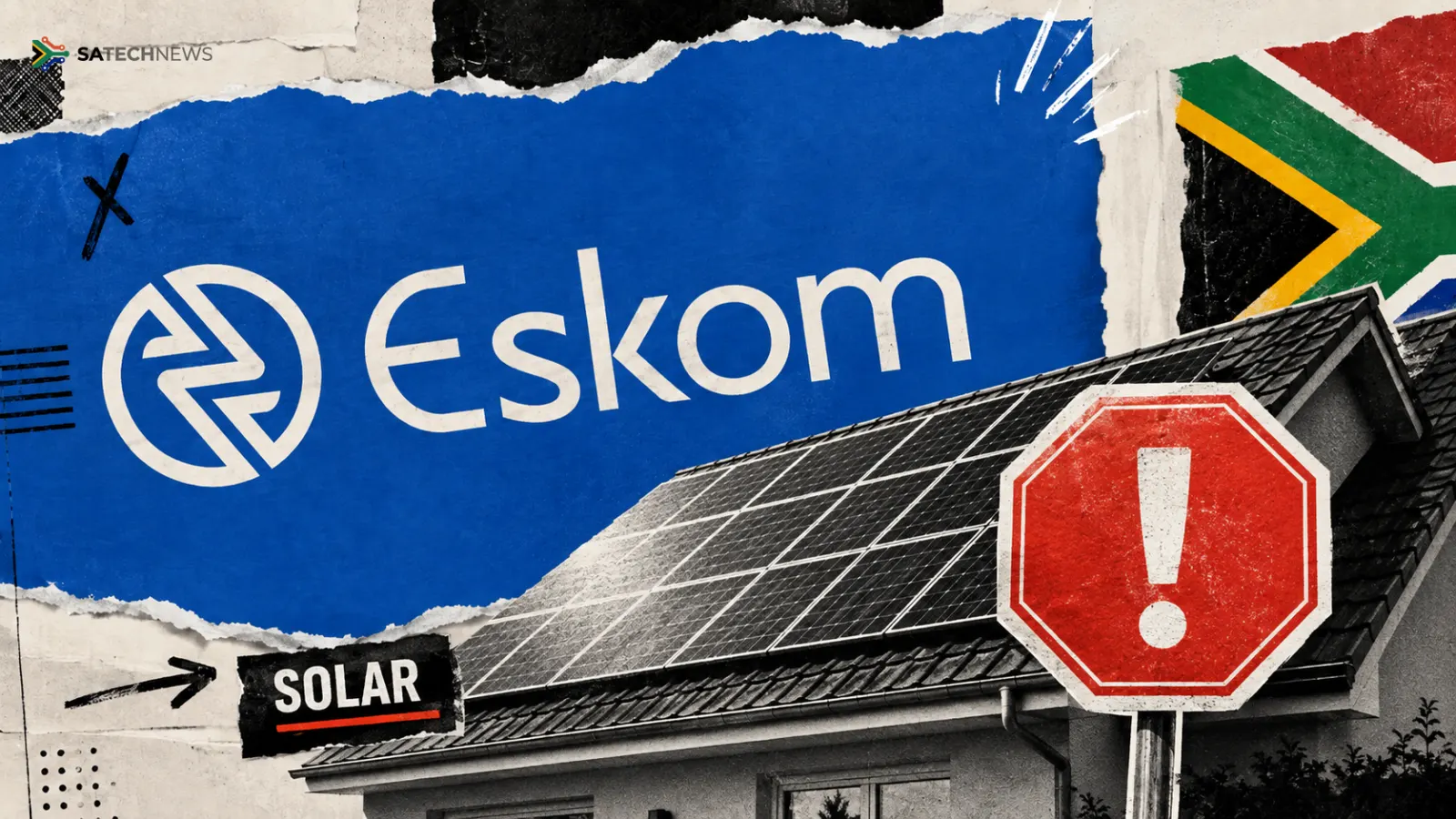
Eskom softened penalty talk on unregistered rooftop solar after backlash. Analysts say it lacks fining power, but tariff pressure remains.
Earlier this month, Eskom circulated notices to its direct customers urging them to register residential solar photovoltaic systems or face fines and possible disconnection. The messaging was blunt. A "legal compliance campaign" framed non-registration as a risk to safety and legality. Households with rooftop panels and batteries took note.
After criticism, the utility shifted tone. In a radio interview, Kevin Pillay, a distribution general manager, said there was no planned crackdown. Unregistered small-scale embedded generation systems, he said, were not currently being treated as illegal. Fines were not imminent. The push was framed as encouragement, with a temporary registration concession.
The walk-back did not settle the matter.
Energy analyst Chris Yelland argues the utility never had the authority it implied. As a company registered under the Companies Act, he says, it has no statutory power to levy fines on customers for failing to register rooftop solar systems. In his view, the threats were empty, confused, and damaging.
Yelland's advice to households with installed solar and battery systems is narrow. Use accredited installers. Ensure the system has a valid electrical Certificate of Compliance issued by a registered electrician. Beyond that, he says, homeowners who do not export power to the grid are entitled to ignore the registration demands.
He was speaking in a discussion with Wayne Duvenage, chief executive of OUTA. Both warned that aggressive compliance campaigns risk alienating paying customers who have invested privately to reduce strain on the grid.
The campaign has not been limited to the national utility's own network. Municipal distributors have echoed the message. City Power in Johannesburg has warned of disconnections and fines for unregistered systems. Some municipalities have already embedded fixed charges into residential electricity accounts. Others are still adapting billing systems.
The registration issue is tied to tariffs. Customers with grid-tied or hybrid systems are required to move to the Homeflex time-of-use tariff. Unlike flat-rate options, Homeflex charges different prices depending on when electricity is consumed. Peak hours cost more. Off-peak less.
Pillay defended the approach on The Money Show. Customers with self-generation, he said, may only draw from the grid occasionally but expect full availability at all times. The cost of maintaining infrastructure, he argued, cannot be shifted to neighbours who rely on the grid continuously.
The fairness claim is contested. In Johannesburg, customers with registered small-scale embedded generation must leave prepaid electricity for postpaid accounts. The fixed charges on those accounts are materially higher. Prepaid systems cannot currently support time-of-use billing. The workaround is billing migration, not system change.
Civil society groups including AfriForum have raised concerns that the registration database could be used to single out solar households for future fixed charges or tariff restructuring. The utility says fixed charges are the same across Homepower and Homeflex for now. The duration of "for now" is unclear.
OUTA has formally challenged the approach, arguing that customers should be allowed to choose tariff structures that reflect how they actually use electricity, rather than being forced into a category because they installed private generation.
The registration drive has already stalled once. Messaging changed. Threats softened. The compliance deadline blurred. Officials still insist registration is necessary for safety and planning. Enforcement without statutory backing remains unexplained. Estimates of how many systems are unregistered have shifted in briefings, and once questioned, were not revisited.
For now, households sit between warnings and reassurances. Legal certainty has not arrived. Tariff design remains unfinished. Municipal billing systems lag. Leverage depends on cooperation the utility has struggled to secure.
Source: SA Tech News