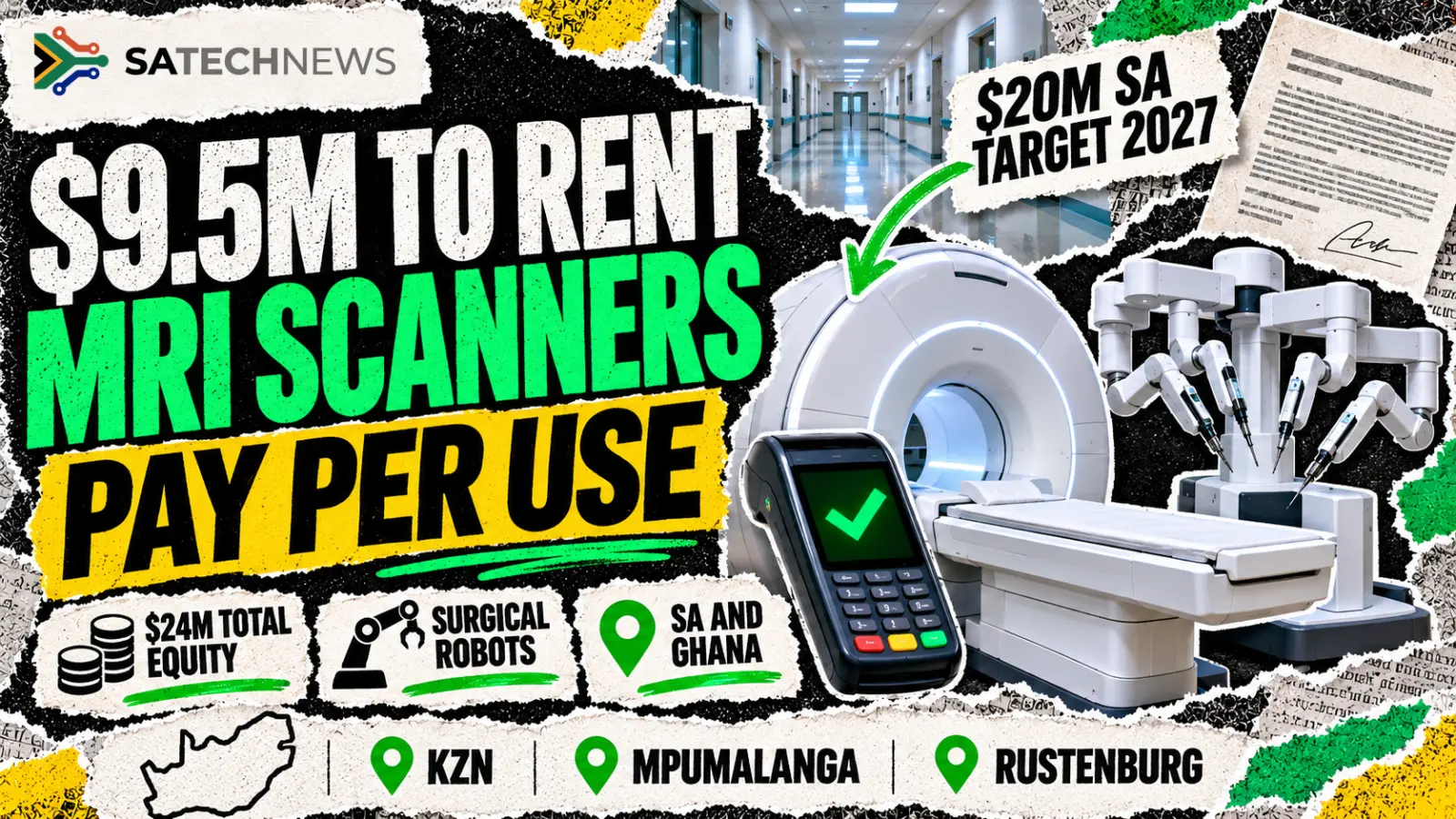
EASE has raised $9.5m from existing backer AAFC to rent MRI scanners and surgical robots to SA hospitals per use, targeting $20m of local installs in 2027.
EASE, a company that rents expensive medical machines to hospitals and charges them per use, has raised US$9.5m in new equity to grow in South Africa and Ghana. The money comes from AAFC Group, a US-based investor in emerging-market asset-backed finance, and takes EASE's total equity to US$24m, according to an announcement from Johannesburg on 2 November.
The model matters here because the equipment in question is the kind most South African hospitals struggle to buy outright: MRI, CT and PET-CT scanners, surgical robots and radiotherapy systems. EASE owns the machine, maintains and upgrades it, and the hospital or practice pays as it uses it, booking the cost as an operating expense rather than a capital purchase.
EASE says it expects at least US$20m of new installations in South Africa next year. That is a target, not an order book, and the company hasn't named a single local hospital customer.
Not quite outside money
The deal is less of an outside vote of confidence than the headline amount suggests, because AAFC is not new to EASE. In January 2024, AAFC, then described as African Asset Finance Company, opened EASE South Africa (Pty) Ltd in Johannesburg as an expansion of its own EASE Healthcare programme, which had started in Ghana and Nigeria the year before. Kanyinsola Oyeyinka, who was AAFC's vice-president of healthcare at that launch, is now EASE's chief executive. The new equity is an existing backer putting more money into a business it started, now held through EASE Holdings BV in the Netherlands.
That doesn't make the money less real, and EASE says it will combine the equity with debt facilities to fund more machines. But the round says more about AAFC's commitment than about demand from new investors.
"This investment marks an important step in expanding our healthcare infrastructure platform," Oyeyinka said. AAFC chief executive Frans van Schaik said: "EASE is addressing a structural constraint."
What is installed so far
The company lists surgical robots in KwaZulu-Natal and Mpumalanga and a PET-CT scanner in Rustenburg, alongside an MRI scanner in Akwatia and CT scanners in Accra in Ghana. It doesn't say how many machines it runs in total, which manufacturers supply them, or what a scan or a robotic procedure costs under its pricing.
EASE says it will work with "the country's largest banks and leading equipment manufacturers" on the South African expansion, without naming any. It is recruiting a managing director for EASE South Africa through Wynand du Plessis of executive search firm Mindcor-InterSearch, plans to add to the local board, and says it is looking at India, Morocco and Malaysia.
Why the model appeals, and its catch
For a private hospital group or a specialist practice, renting a scanner by use spreads a large cost over time and moves the maintenance risk to the supplier. For a public hospital tied to annual budgets, it could be a way to get equipment without a capital allocation, though EASE hasn't said whether it has any public-sector contracts.
The catch with any pay-per-use deal is the total price over the life of the machine, and whether the contract sets minimum volumes. None of that has been published.
What is still unknown
EASE has not disclosed the size of its debt facilities, its number of South African installations, its customers or its fees. The figure it has put on the table is US$20m of new South African installations in 2027. Whether that target turns into named hospitals and working machines is the measure to watch.
What the US$9.5 million actually is
The 2 November announcement from Johannesburg says AAFC Group, a US-based investor in emerging-market asset-backed finance, has put new equity into EASE, and that the new money takes EASE's total equity to US$24 million. The company rents machines and charges per use. It says it owns the equipment, maintains it and upgrades it, and that the hospital or practice books the cost as an operating expense rather than a capital purchase. The machines it names are MRI, CT and PET-CT scanners, surgical robots and radiotherapy systems, the equipment many South African hospitals struggle to buy outright.
The round is not a first meeting between the two. In January 2024, AAFC, then described as African Asset Finance Company, opened EASE South Africa (Pty) Ltd in Johannesburg as an expansion of its own EASE Healthcare programme, which had started in Ghana and Nigeria the year before. Kanyinsola Oyeyinka, AAFC's vice-president of healthcare at that launch, is now EASE's chief executive. The holding company named in the new round is EASE Holdings BV in the Netherlands. The equity is an existing backer putting more money into a business it started. EASE says it will combine that equity with debt facilities to fund more machines. The size of those facilities is not in the announcement.
Oyeyinka called the investment a step in expanding the healthcare infrastructure platform. AAFC chief executive Frans van Schaik said EASE is addressing a structural constraint. Those two sentences are the comments the announcement carries. They do not name a hospital, a fee or a delivery date.
Installed machines, and a target that is not an order
The company lists surgical robots in KwaZulu-Natal and Mpumalanga, a PET-CT scanner in Rustenburg, an MRI scanner in Akwatia and CT scanners in Accra. It does not say how many machines it runs in total, which manufacturers supply them, or what a scan or a robotic procedure costs. It says it expects at least US$20 million of new installations in South Africa next year. That is a target. It is not an order book, and no local hospital customer is named.
EASE says it will work with the country's largest banks and leading equipment manufacturers, without naming either. It is recruiting a managing director for EASE South Africa through Wynand du Plessis of Mindcor-InterSearch, plans to add to the local board, and says it is looking at India, Morocco and Malaysia. Looking at a country is not an announcement that it operates there.
For a private hospital or a specialist practice, paying per use spreads a large cost and leaves maintenance with the supplier. For a public hospital on an annual budget, it could be a route to equipment without a capital allocation. EASE has not said it holds any public-sector contract. The catch in a pay-per-use contract is the total paid over the life of the machine, and whether the contract sets a minimum volume. None of that has been published. What has been published is the equity, the total of US$24 million, the machines it lists, and the US$20 million South African installation target. Customers, fees and the debt facilities are still undisclosed.