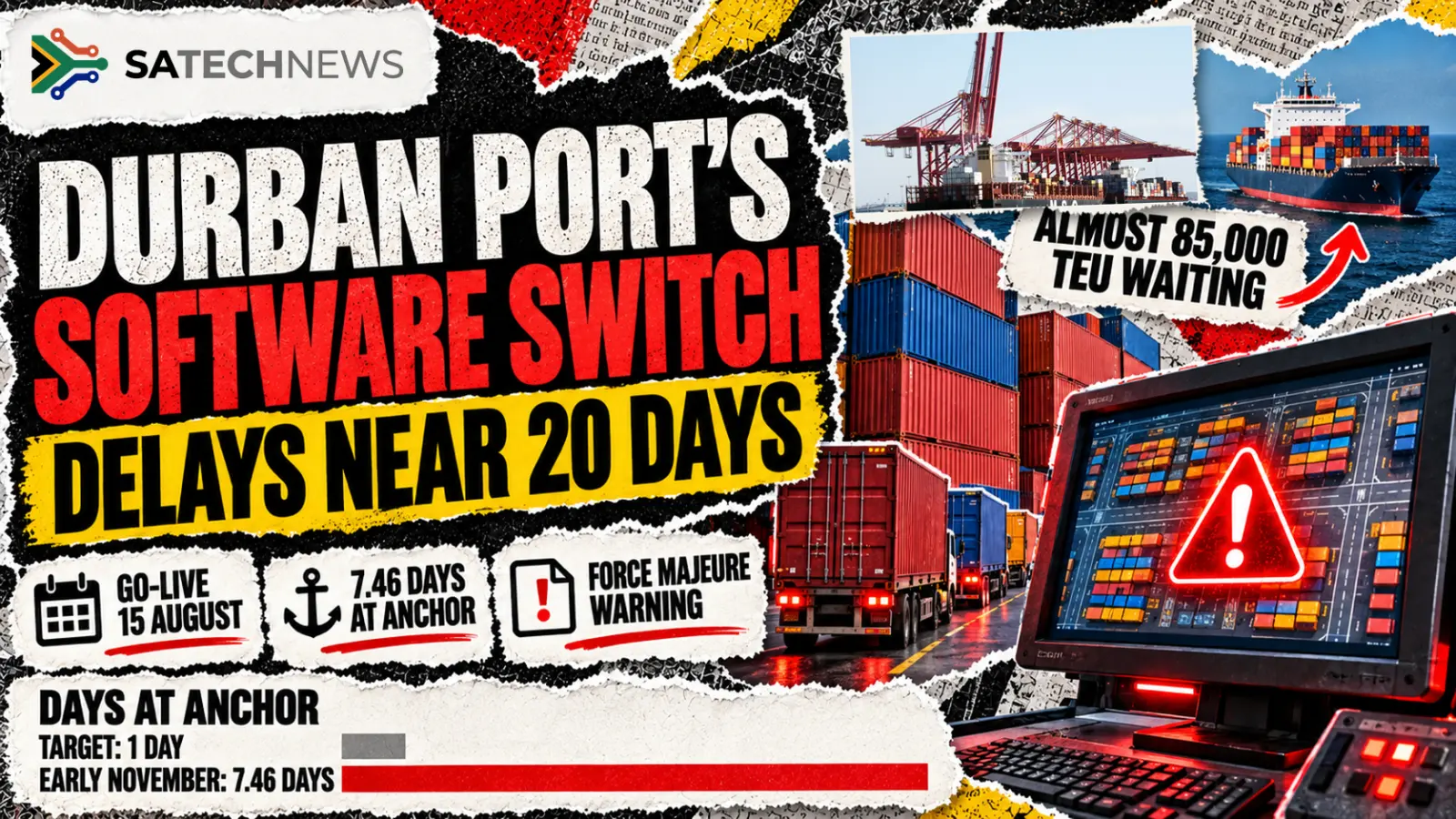
Three months after Durban Gateway Terminal moved to Navis N4, Metair says port delays nearly 20 days and it may have to invoke force majeure.
A terminal operating system that went live at the Port of Durban on 15 August has become a listed-company problem. Metair, the JSE-listed components maker that supplies Toyota, Ford, Volkswagen and Isuzu, told shareholders on Friday 13 November that delays at Durban Gateway Terminal are approaching 20 days and that it may have to invoke force majeure in its contracts if nothing changes.
Metair's shares fell more than 35% on the day, according to Moneyweb, which showed the stock at R2.95 at the close.
Durban Gateway Terminal handles roughly half of South Africa's container traffic. When its systems slow down, the effect reaches car plants, citrus exporters and anyone waiting on imported stock before Black Friday and Christmas.
How a software go-live became a port crisis
The terminal used to be Durban Container Terminal Pier 2. Philippine operator International Container Terminal Services Inc (ICTSI) took over its management on 1 January under a 25-year partnership with Transnet, which kept the majority stake.
In July the terminal told customers it was preparing to move to a new instance of the Navis N4 terminal operating system. The software runs yard planning, and it also handles truck appointment bookings and gate entry. Companies had until 12 August to send in a signed access form for every user, and the terminal warned that the company name on each form had to match its registered name exactly.
The cutover happened on 15 August. MyBroadband reported that container processing fell by as much as 30% within days, with trucking firms complaining of system downtime, registration problems and queues of up to 30 hours. Ships began skipping Durban, and the Cape Chamber of Commerce said the congestion spread to other ports.
Transport minister Barbara Creecy met ICTSI management in Durban at the start of October. She told Bloomberg the delays came mainly from the Navis implementation and from slow refurbishment or replacement of loading equipment, and said the operator needed to communicate better and produce a clear plan for the backlog. Average time at anchorage had roughly doubled to nearly six days since ICTSI took over, she said. The terminal's target is 24 hours.
What the numbers look like now
The terminal's own position, in a statement in early October, was that "the operational situation has stabilised and continues to improve" and that Navis N4 is stable. It also said it was working on a replacement for its truck appointment system, called Navigate.
Logistics firm Kuehne+Nagel's tracking tells a slower story. In the week to early November, container vessels waited an average of 7.46 days at anchorage before calling at Durban. On 2 November, six container ships sat in the anchorage and another 11 waited offshore, together carrying almost 85,000 TEU of capacity.
Moneyweb reports that freight forwarders' body SAAFF and Business Unity South Africa put total supply chain delays at up to 20 days, even though average anchorage times have improved from their worst, and that truckers describe 22-hour waits in loading bays with valid appointments.
What Metair told the market
Metair says the delays have interrupted production because vehicle parts and raw materials arrive late. It has been flying components in since August, which chief executive Paul O'Flaherty described as coming "at an exorbitant cost", and it is paying for extra trucking and overtime while more of its cash sits in stock that is still at sea.
The company estimates the extra costs could reach 20% to 25% of last year's earnings before interest, tax, depreciation and amortisation, and says it cannot recover them from customers. "This has reached crisis proportions," O'Flaherty said, calling for urgent intervention from government and the port operator.
Metair also does not expect quick relief. Meaningful improvement, it said, "might not occur before the end of the first quarter of 2027".
What is still unresolved
Nobody has published a technical account of what went wrong in the cutover. The minister points to the software and to equipment. The terminal says the software is stable. Whether the remaining delays come from Navis N4 itself, from the truck booking and access processes built around it, from cranes, or from all three has not been set out in public with data.
ICTSI and Transnet had not responded to Moneyweb's questions about Metair's statement by the time it published. The terminal is spending R737 million on equipment meant to lift capacity by 40% to 2.8 million TEU by 2030, but it has given no dated target for getting anchorage times back to 24 hours.
Metair has not said which contracts a force majeure notice would cover, or when it would decide.
The warning to shareholders is a commercial notice. It is not a diagnosis of the terminal software. If Metair does invoke force majeure, the company has not said which contracts that notice would cover, or when it would decide. Nothing in the statement restarts the terminal or sets a date for anchorage times to return to the 24-hour target.
The public accounts still do not line up. In early October Barbara Creecy told Bloomberg that time at anchorage had roughly doubled to nearly six days since ICTSI took over, and that the delays came from the Navis work and from equipment as well as from communication. The terminal's own statement from the same period said the situation had stabilised, that Navis N4 was stable, and that a replacement truck-appointment system called Navigate was in progress. Kuehne+Nagel's snapshot for the week to early November is the later figure: 7.46 days at anchorage, six ships in the anchorage and 11 offshore, almost 85,000 TEU.
For anyone waiting on imported stock before Black Friday and Christmas, that is the near-term problem. Metair's horizon is longer. It does not expect meaningful improvement before the end of the first quarter of 2027, it has been flying parts in since August, and it says the extra cost cannot be recovered from customers.