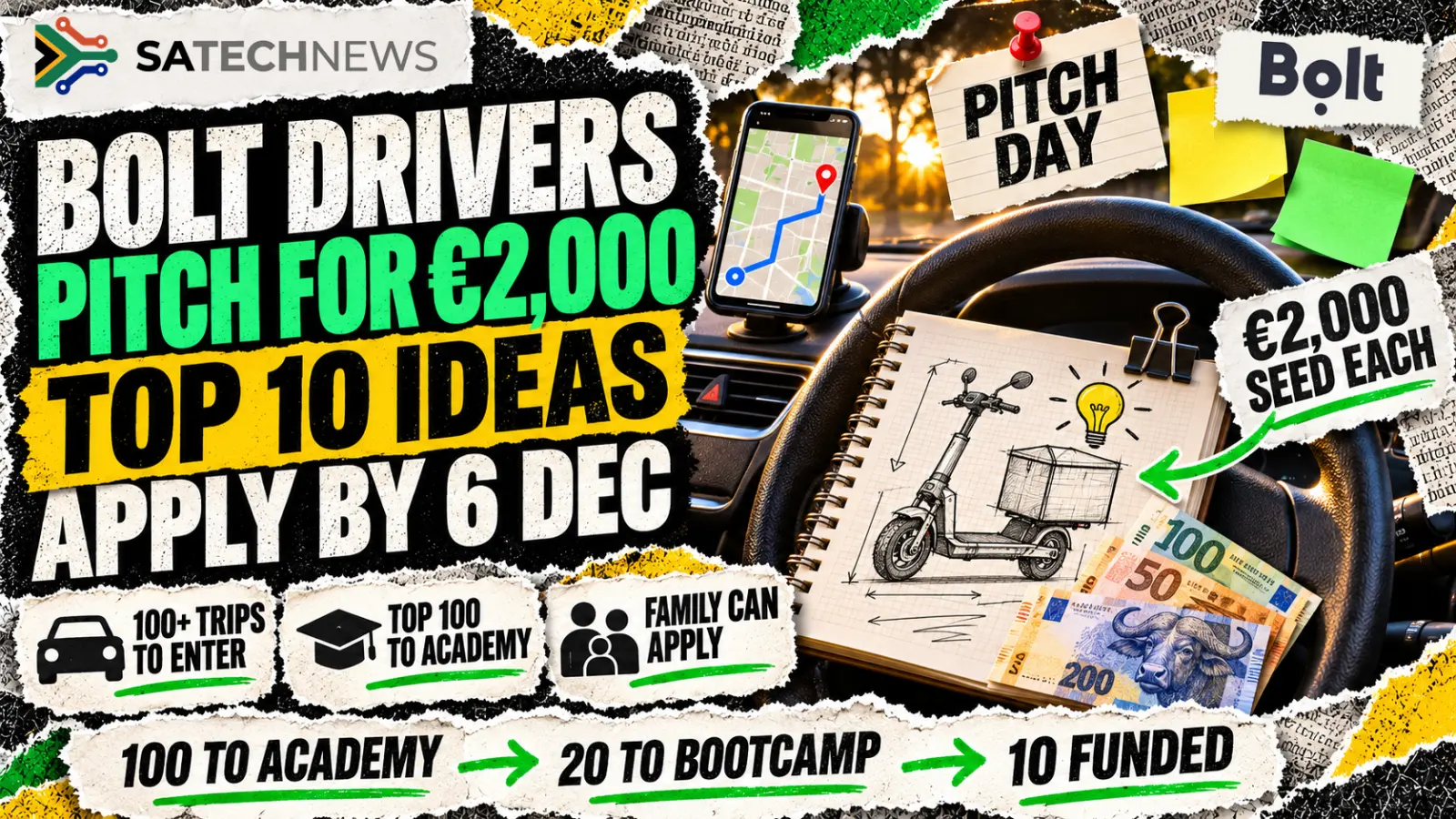
Bolt's second SA driver accelerator offers the top 10 ideas €2,000 each. Drivers or one family member can apply until 6 December. What the terms say.
Bolt has opened applications for the second South African edition of its driver accelerator. The money on offer is modest and specific: the ten best pitches will each get €2,000 in seed funding, about R37,300. Applications opened on Monday, 16 November, and close at midnight on Sunday, 6 December.
The programme is run with Pranary, a business school whose founder and chief executive is Sandras Phiri. It is aimed at people who already know ride-hailing and delivery from the driver's seat, and it wants them to turn that knowledge into technology-led businesses, particularly in e-mobility. The announcement is warmer than the terms. The terms are the part worth reading before anyone spends the four or five off-peak hours a week the programme expects.
Who is allowed to apply
Applicants must be South African residents. Drivers need at least 100 completed trips on Bolt. A spouse, or a child aged 18 or older, can apply instead, using the driver's account for verification. Only one person per family can enter. The trip count is the gate. A person with an idea and no Bolt history, and no family member who has the trips, is not the applicant this round is built for.
Pranary's application page lists eight areas it wants ideas in: mobility and fleet, logistics and delivery, EV and green mobility, food and retail, urban infrastructure, financial inclusion, women and youth empowerment, and future mobility. Ideas that compete directly with Bolt's ride-hailing or food delivery are excluded, along with gambling, alcohol, unlicensed financial services, and anything Bolt considers a reputational or regulatory risk.
The exclusion is the design. Bolt is asking drivers for businesses in the world they already work in, and it is telling them not to build another Bolt. A delivery idea can qualify. A delivery idea that is Bolt's delivery, done by someone else, cannot. The line between those two is not drawn in the public terms beyond the phrase "compete directly". An applicant has to guess where Bolt will draw it.
How the ten are chosen
The top 100 ideas get a place in a six-week Bolt Academy of hybrid training. The top 20 students move on to a two-week bootcamp, where they test their ideas with potential customers before pitching to judges. The top ten get the €2,000, paid in rand in two tranches, plus mentoring. Selected participants should expect to spend four to five off-peak hours a week on the programme. Free information webinars run on 19 November, 26 November and 3 December, from 11:00 to 12:00.
"Drivers experience first-hand how people and goods move through our cities and communities," Bolt said in its announcement. Weyinmi Aghadiuno, Bolt's head of regulatory and policy for Africa, said the company was "excited to welcome a new group of entrepreneurs". Phiri said an idea "becomes a business once it has been tested with real customers". The bootcamp is where that test is supposed to happen. The €2,000 comes after it, for ten people, not for the hundred in the Academy and not for the twenty in the room.
The first South African edition launched in December 2024 and drew about 578 applications. Ten entrepreneurs shared €20,000 for ideas including delivery services, accessible transport and vehicle technology. That is the only outcome the public record of the first round gives. It does not say which of those ten are still trading, whether the rand arrived in two tranches as the new terms describe, or what Bolt did with the ideas afterwards.
What the terms keep, and what they do not promise
The programme terms say intellectual property in the submitted ideas stays with the participants. They do not mention an equity stake for Bolt or for Pranary. That is the clause that stops this from being a venture round. Two thousand euros is a grant-sized sum, not a priced investment, and the terms do not take shares for it.
Bolt and its partners can, however, use participants' ideas for promotional or educational purposes, with attribution. The terms also give Bolt rights to use participants' photos, videos and likeness in marketing, with no end date. A driver who gets through the Academy and does not make the ten has still handed over a face and an idea for publicity. The €2,000 is not the consideration for that. Participation is.
The terms state that taking part "does not guarantee seed funding". They give no programme start date, no bootcamp dates and no pitch day, and no timing for the two payment tranches. The application page asks for a ten-week commitment. The six-week Academy and the two-week bootcamp add up to eight. Pranary has not explained the extra fortnight in public. Someone applying before 6 December is committing to a length the two named stages do not account for, on a calendar that has not been published.
What an applicant still cannot know
The funnel is clear: 100, then 20, then 10, from a field that last time was about 578. The money is clear: €2,000 each for the ten, in rand, in two tranches, with no promise that a place on the programme produces the payment. The ownership of the idea stays with the person who submitted it. The publicity rights do not expire.
What is missing is the calendar and the boundary. There is no start date, no date for the bootcamp, no date for the pitch, and no date for the money. There is a ten-week ask sitting on top of an eight-week description. There is a ban on competing directly with Bolt that the terms do not illustrate. Applications close at midnight on 6 December. The webinars on 19 November, 26 November and 3 December are the only dated events between now and that deadline, and they are information sessions, not the programme itself.