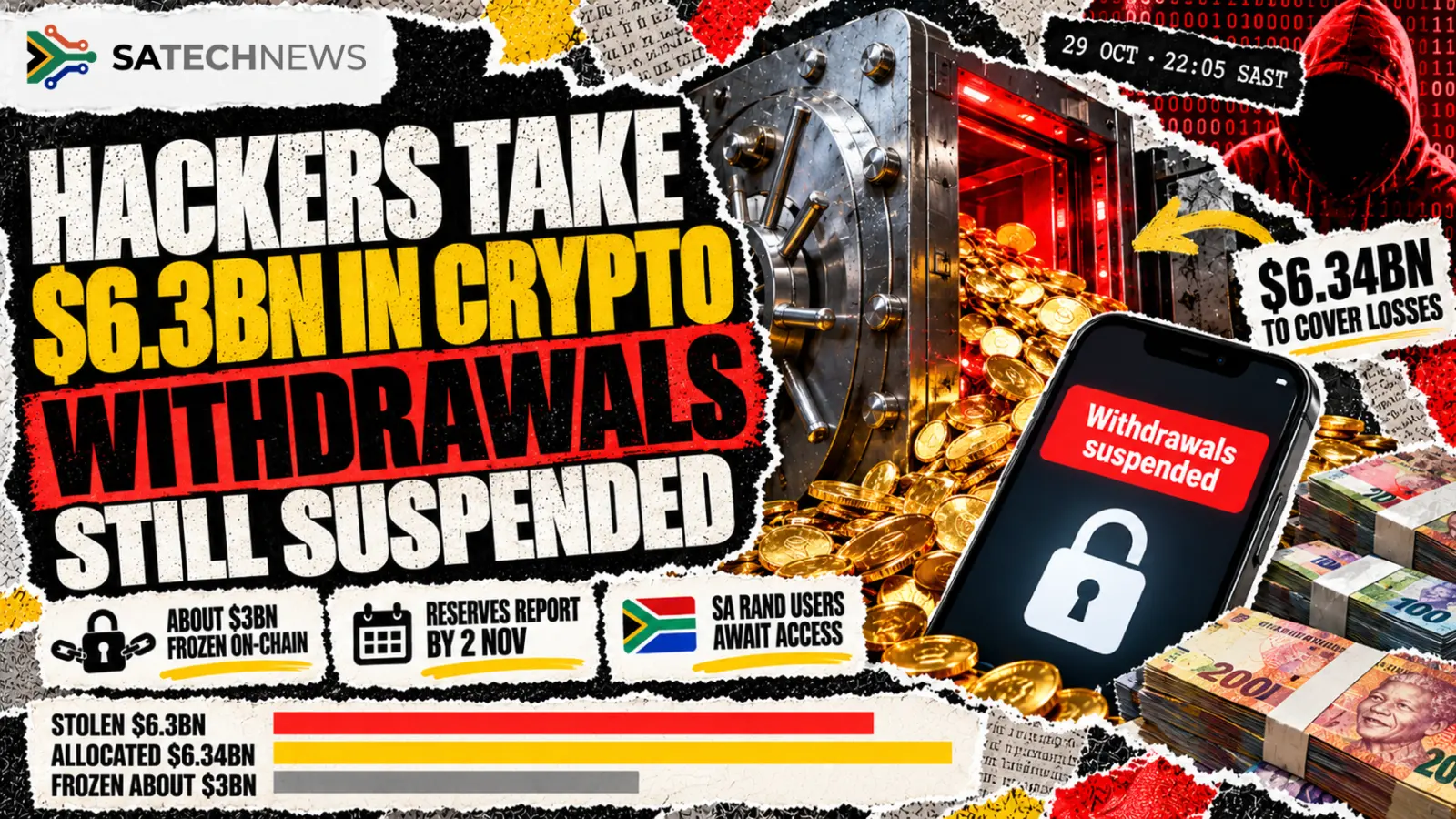
Binance says hackers stole $6.3bn from its hot wallets and withdrawals remain suspended. South African users await a verified restart and reserve report.
Binance has confirmed that hackers took approximately US$6.3 billion in crypto assets from its internet-connected wallets, and withdrawals remained suspended in its latest formal update on Friday, 30 October. The exchange says it will absorb the loss using its emergency fund and corporate treasury, rather than passing it on to customers.
For South Africans who use Binance to buy and trade crypto with rands, the immediate issue is access. Binance's South African service advertises ZAR deposits and trading, but the exchange has not published a separate South Africa-specific timetable for restoring withdrawals or disclosed how many local accounts have been affected.
The incident began at about 20:05 UTC on Thursday, 29 October, according to Binance. That is 22:05 in South Africa. In a follow-up notice published on Friday, the company said it had contained compromised infrastructure, revoked affected permissions and continued security checks before allowing withdrawals to resume.
What Binance has confirmed
The exchange puts the value of stolen assets at roughly US$6.3 billion. It says more than US$6.34 billion in company funds has been allocated to cover the incident, including US$5 billion already held in the same tokens that were taken. Binance describes that token-for-token coverage as approximately 80% complete and says it is purchasing the remaining assets through market and over-the-counter transactions.
The arithmetic is the company's, not an outside audit. About US$5 billion of the US$6.34 billion allocation is already held in the tokens that were taken. The rest is still being bought. "Approximately 80% complete" is Binance's description of that token match, not a statement that withdrawals are 80% restored.
Those are company statements, not independently audited proof that every customer balance is presently backed. Binance promised a new proof-of-reserves report, and on Friday said results would be ready on Monday, 2 November. A later notice moved that report to Tuesday, 3 November. Its announcement also says about US$3 billion in affected assets has been frozen on-chain through cooperation with token issuers, investigators and other partners.
A freeze prevents specified assets from moving, but it does not by itself establish that the exchange has recovered the money. The distinction matters when a company is simultaneously tracing stolen tokens, rebuilding withdrawal controls and pledging to cover the shortfall from its own balance sheet. Frozen tokens and a treasury pledge are two different claims. One says some assets cannot move. The other says Binance will make customers whole from its own funds if the stolen assets are not returned.
Binance initially suggested that a compromised employee laptop might have been involved. Its subsequent investigation identified additional points of compromise. The exchange says it has found no evidence that wallet private keys were leaked, but the complete attack path has not been established.
Blockchain intelligence firm TRM Labs has attributed the attack to North Korea-linked TraderTraitor with high confidence, according to Reuters. That remains an external attribution, not a confirmed finding from Binance or law enforcement.
What South African customers need to know
Binance markets its services directly to South African residents. Its local website describes ZAR deposits using Instant EFT or bank transfer, alongside crypto purchases and peer-to-peer trading in rands. A disruption to the global withdrawal system is therefore relevant to local account holders, even though Binance has not provided a South African customer count or quantified local exposure.
The exchange's South Africa page says it is engaged in the Financial Sector Conduct Authority's crypto-asset service provider licensing process. That statement does not establish that Binance itself currently holds an FSCA licence. The incident also does not establish a breach of South African banking infrastructure or that local bank deposits have been compromised.
Binance said deposits and other unaffected services were operating in its second update. Its target was to begin restoring withdrawals in phases within approximately 34 hours of that announcement, subject to security testing. A target is not confirmation that the service is available. Counted from Friday's notice, that window runs into the weekend. Users should check the exchange's official status notices before attempting time-sensitive transfers and should be wary of unsolicited recovery or compensation messages.
The next test is access, then evidence
The scale of the theft makes Binance's promise to cover losses unusually consequential. The company has not yet released the detailed technical post-mortem, an independently verifiable reconciliation of the affected assets, or a South Africa-specific service impact assessment.
Its next measurable commitments were the phased withdrawal restart and the proof-of-reserves update it had set for 2 November, later moved to 3 November. Until those appear and can be checked, the US$6.34 billion allocation, the frozen tokens and the reassurance that users will not bear the loss remain claims made during an active investigation. The figure South Africans can check today is the one Binance has published: about US$6.3 billion taken, withdrawals still suspended as of Friday, and no local timetable beside the global one.
South African readers have three dates and no local count. The theft was reported from about 22:05 on Thursday. The formal update that still had withdrawals suspended was Friday, 30 October. The proof-of-reserves result Binance first pointed to was Monday, 2 November, and a later notice moved it to Tuesday, 3 November. The second update is the one that still governs the public picture. Deposits were said to be operating. Withdrawals were not. The 34-hour target was attached to that Friday notice and was conditional on security testing. Binance has not said, in the notices this story uses, that the phased restart has begun, or how many rand accounts are waiting on it.