
Breaking
Latest tech news from South Africa and around the world•Stay updated with breaking technology developments•Innovation and digital transformation news•AI, gaming, and gadget updates daily•Crypto and fintech news from Africa•
 SA Tech News Desk
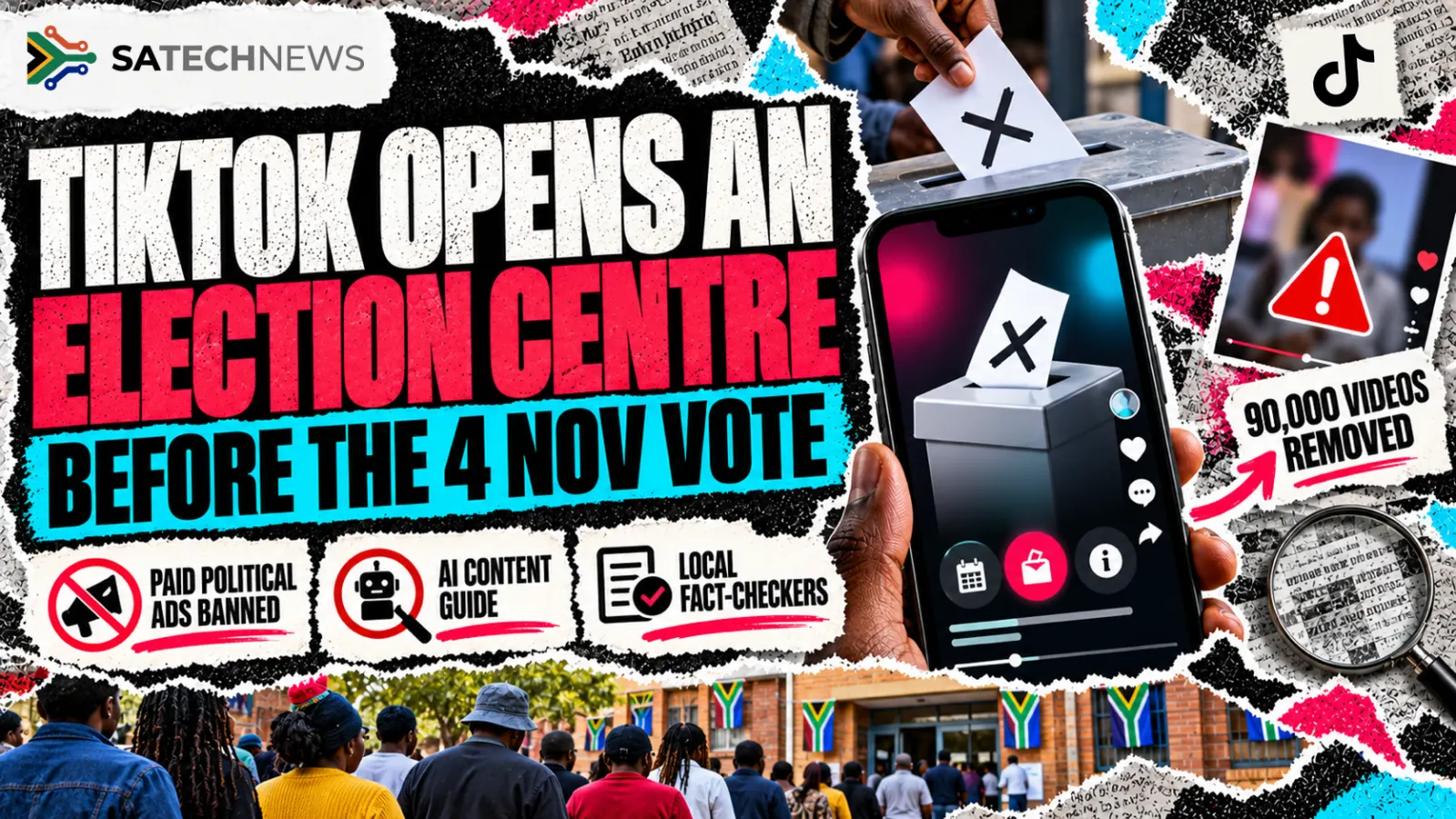
TikTok and the IEC have put an election centre in the app before the 4 November vote. TikTok says it removed about 90,000 SA election and AI videos in Q1.
TikTok has added an election centre to its app for South African users, built with the Electoral Commission of South Africa (IEC), two weeks before the local government elections on 4 November. It gives voting information and key dates, and links to a guide on spotting AI-generated content.
The platform says that in the first three months of 2026 it removed about 90,000 South African videos under its rules on civic and election integrity, misinformation and misleading AI-generated content. That figure, from TikTok's own enforcement report, gives a rough sense of how much false or manipulated election material was circulating on the platform before the campaign's final stretch.
For voters, the change is practical. Searches and posts about the election now carry labels and banners that send users to the centre in one tap, rather than leaving them to rely on whatever clips the feed serves up.
TikTok announced the partnership on 12 October, and ITWeb reported the launch on 20 October. The centre shows key election dates and information about voting and the electoral process. TikTok says it is available in local South African languages, including English, but has not published the full list.
It also links to a new AI media literacy hub. That hub explains how to recognise AI-generated content, how to use AI tools responsibly and how TikTok handles AI on its platform.
Chief electoral officer Sy Mamabolo said the centre "will help connect voters with official information about the electoral process." Tholoana Ncheke-Mahlaela, TikTok's government relations and public policy lead for southern Africa, said the labels and search banners would direct users to it "with a single tap".
TikTok does not allow paid political advertising. Politicians and political parties cannot advertise or earn money from their accounts, and election-related adverts from candidates, parties and other advertisers are banned. Official election bodies such as the IEC are the exception: they may run adverts with voter information such as registration guidance, polling details and how to take part.
The company says it has an elections taskforce with specialists in platform integrity, cybersecurity, deceptive behaviour and misinformation, working with local-language moderators. Its local fact-checking partner is Code for Africa, one of more than 20 fact-checking organisations it works with globally.
According to TikTok's community guidelines enforcement report for January to March 2026, it removed more than 1.1 million South African videos for breaking its rules. It says 99.6% were taken down before anyone reported them and 94.9% within 24 hours of being posted. Of the roughly 90,000 removed under the election, misinformation and AI-content rules, more than 99% were taken down before a report.
These are TikTok's own figures. They cover a period before campaigning picked up, and no independent audit of them has been published. The ban on paid political ads also does not cover ordinary posts by parties, candidates and their supporters, which are policed only by the same content rules.
The IEC has said no form of electronic voting will be used in these elections, so platforms matter for information, not for casting votes. Its own campaign, launched in May, runs across television, radio, digital and social media.
TikTok has not said how many South Africans have used the centre, which languages it covers beyond English, or whether it will publish enforcement figures for the campaign period itself. It has also not said how quickly it will act on manipulated videos in the final days before 4 November.
Source: SA Tech News


