
Breaking
Latest tech news from South Africa and around the world•Stay updated with breaking technology developments•Innovation and digital transformation news•AI, gaming, and gadget updates daily•Crypto and fintech news from Africa•
 SA Tech News Desk
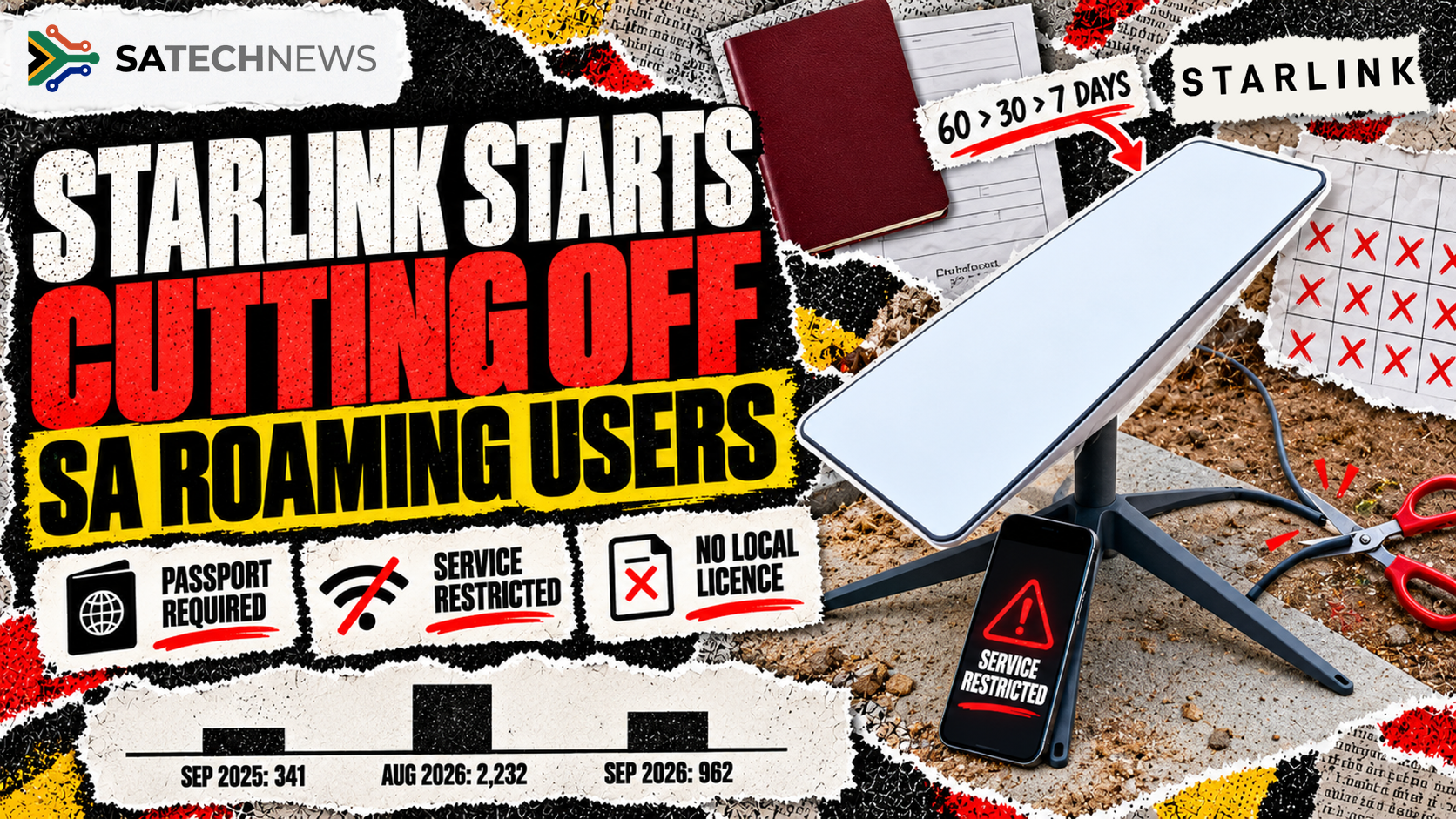
Starlink is restricting South Africans who roam at home, asking for passport-based travel registration while SpaceX still has no local licence.
Starlink has started switching off South Africans who use its roaming service in place of a local licence that SpaceX still does not have. On Friday, 23 October, some users still connected in South Africa received a notice that their service was restricted, MyBroadband reported. The notice read: "You're using your Starlink outside your account country. Complete travel registration to restore service."
The fix it offers is unlikely to help them. Starlink's travel registration asks for a full legal name, nationality, date of birth and a passport or government-issued photo ID, along with travel plans. A South African who answers honestly tells Starlink they are "travelling" in the country they live in, and Starlink's terms describe roaming as temporary use by people outside their home country.
Many of the users at risk live or work in remote areas, where they paid roaming's higher price because fixed lines and mobile coverage were poor. Their kits were often imported from neighbouring countries where Starlink is sold. Some have relied on the service since early 2023, and Starlink offers no legal local alternative.
Starlink never launched in South Africa, but its roaming service has worked here since early 2023. The company has generally switched roaming off in a country only after a government or regulator ordered it to, as happened in Namibia.
There has been no such order here. As of Friday there was no public sign that ICASA had sent Starlink a cease-and-desist letter or any other legal demand to block the service, according to MyBroadband.
The limits have instead tightened step by step. Roaming plans first came with a 60-day continuous-use limit, which was cut to 30 days in South Africa. In July a Starlink support agent told one user that South African roaming paused after seven days. Starlink stopped new sign-ups to its Global Roam plan on 15 July and ended it for existing users on 17 August, moving travellers to its more expensive Global Priority plan.
Travel registration itself is a global rule. Starlink began asking international users for passport details earlier this year, and its FAQ says registration is needed for use outside the home country on every account type except Enterprise. It bites harder in South Africa because so few of the people roaming here are travellers.
Nobody outside Starlink knows. MyBroadband's speed-test data gives a rough signal: South African Starlink users ran a record 2,232 MyBroadband Speed Tests in August 2026, up from 341 in September 2025. The count then fell to 962 in September.
Those figures count tests, not subscribers. Starlink has not said how many kits are active in South Africa, and it had not commented publicly on the notices by Friday.
The legal route into the market has not moved. In May, ICASA said it could not recognise equity-equivalent investment programmes as a substitute for the 30% ownership requirement for historically disadvantaged groups on network licences until Parliament amends the law. Communications minister Solly Malatsi had issued a policy direction allowing such programmes, and told Parliament in May that government would pursue the amendments.
Starlink has proposed spending about R500 million on an equity-equivalent programme to connect 5,000 schools. SpaceX still holds no South African licence.
Local operators are exploring satellite deals of their own. Cell C confirmed in August that it was in talks with Starlink and Amazon Leo about direct-to-cell service and reselling satellite broadband, but it has announced no agreement.
Starlink has not said whether South Africans who register honestly will be refused, or whether accounts that keep roaming locally will be closed. No ICASA statement on the notices had been published by Friday. The Electronic Communications Act amendment that ICASA says it needs before it can consider an equity-equivalent route has not been passed.
Source: SA Tech News


