
Breaking
Latest tech news from South Africa and around the world•Stay updated with breaking technology developments•Innovation and digital transformation news•AI, gaming, and gadget updates daily•Crypto and fintech news from Africa•
 SA Tech News Desk
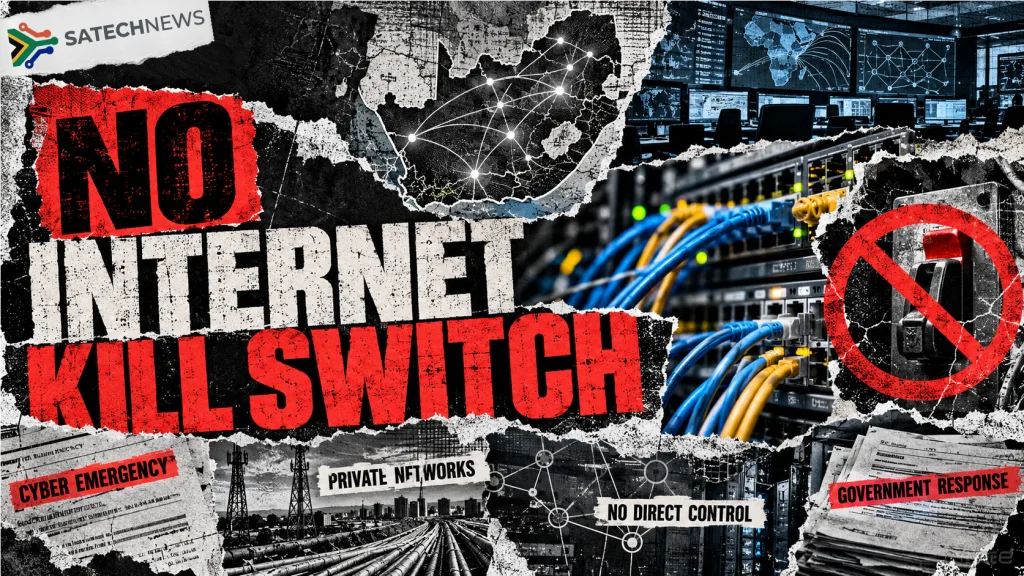
Minister Solly Malatsi told Parliament the state has no direct technical kill switch over privately owned networks that carry most of South Africa’s digital traffic.
South Africa does not have a government-controlled switch that can shut down the country’s Internet during a cyberattack, foreign interference or national emergency. Communications and Digital Technologies minister Solly Malatsi has also told Parliament that the state does not have direct technical control over the privately owned networks that carry most of the country’s digital traffic.
That matters because South Africa’s critical connectivity is spread across mobile operators, fibre networks, submarine cable landing stations, data centres and other infrastructure owned by a mix of private and public entities. A major cyber incident would therefore have to be managed through existing law, operators and regulators rather than a single state command that can simply take networks offline.
In a parliamentary response reported by MyBroadband on 20 September, Malatsi said the Department of Communications and Digital Technologies does not maintain direct technical access to all critical digital infrastructure in the country. He said the department instead exercises oversight through the applicable legislative and regulatory framework.
The distinction is important. A national Internet shutdown requires more than political authority: it would need technical control over networks or legal mechanisms compelling multiple operators to act in concert. South Africa’s communications infrastructure is decentralised across competing operators and infrastructure providers.
That does not mean government has no emergency powers or that operators can ignore lawful instructions. Electronic communications licences, cybersecurity obligations, disaster-management law and other legislation still shape how networks are operated. But the minister’s answer indicates there is no dedicated regulatory framework that gives government a universal technical kill switch over privately owned digital infrastructure.
Most South Africans reach the Internet through commercial mobile and fibre providers. Identity systems, content platforms and government services then sit on top of that private transport layer. When ransomware or a cable cut hits, recovery depends on those companies’ incident playbooks as much as on any cabinet instruction.
Recent supplier-side breaches and public-sector outages have already shown how quickly a failure outside a single operator can still interrupt banking, pensions or retail. The absence of a kill switch reduces the risk of a deliberate nationwide blackout. It does not remove the need for joint exercises, clear reporting lines and tested backup routes between private networks.
Submarine cables add another layer. South Africa depends on multiple international cable systems and landing stations for global connectivity. Mobile and fibre operators then carry that traffic inland. The distributed architecture can provide redundancy, but crisis coordination still crosses company and regulatory boundaries.
The Electronic Communications Amendment Bill has separately proposed changes to infrastructure access, wholesale pricing, roaming and spectrum sharing. Those proposals could reshape how operators share infrastructure. They do not create a national Internet shutdown mechanism.
What remains unresolved is whether South Africa’s existing coordination arrangements are sufficient for a large, simultaneous cyber or infrastructure emergency. The absence of a kill switch limits the risk of a single state-controlled shutdown. It also leaves the harder operational question: who coordinates private networks quickly enough when the failure is national in scale?
Source: SA Tech News Desk


