
Breaking
Latest tech news from South Africa and around the world•Stay updated with breaking technology developments•Innovation and digital transformation news•AI, gaming, and gadget updates daily•Crypto and fintech news from Africa•
 SA Tech News Desk
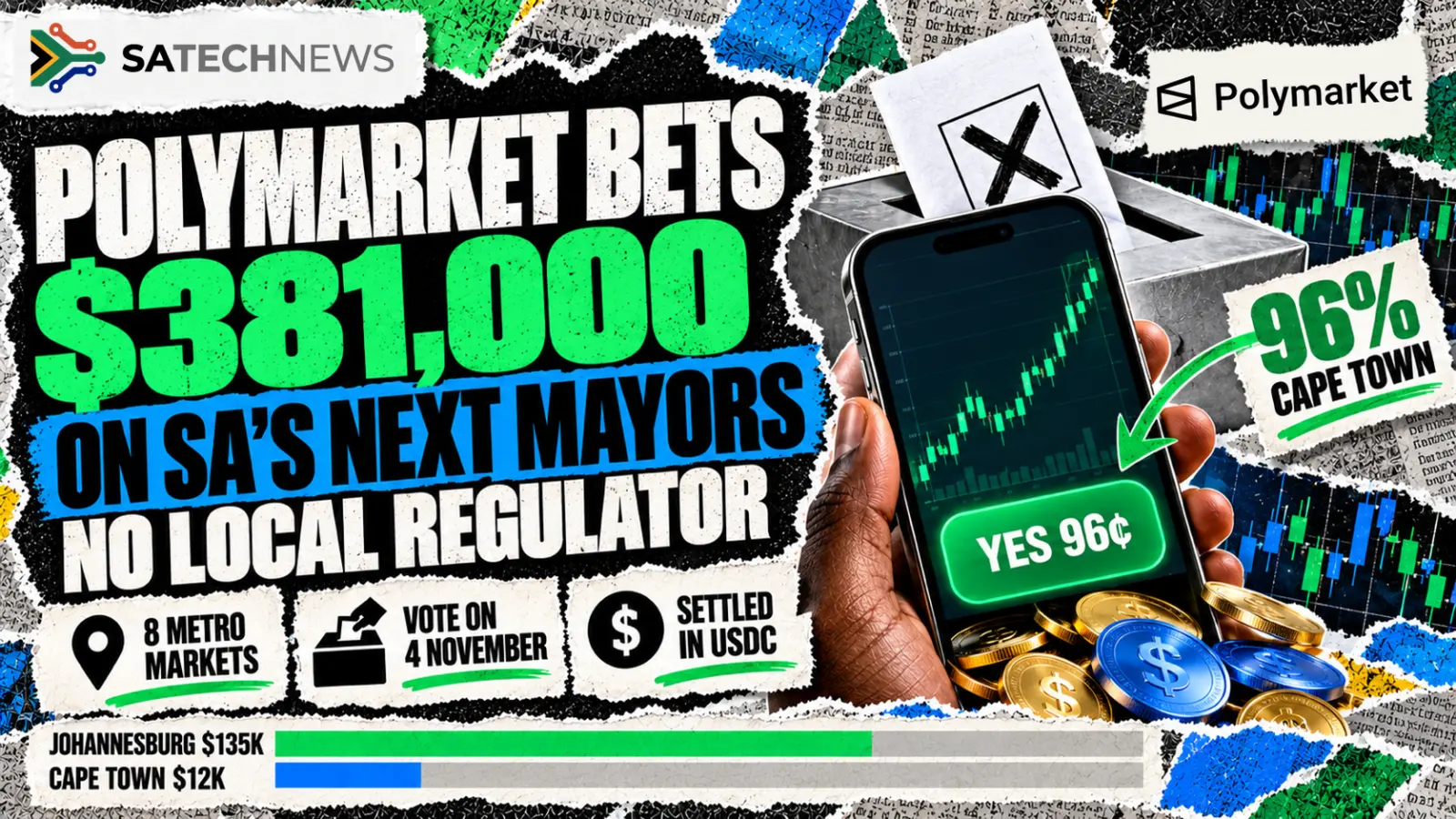
Polymarket's eight SA mayoral markets have traded about $381,000 before the 4 November vote, and no local gambling or financial regulator oversees them.
A week before South Africa's 4 November local government elections, Polymarket is running markets on who will become mayor of all eight metros, and no South African regulator oversees them. Polymarket's own market data, read on 28 October, shows about $381,000 traded across the eight markets, or roughly R6.3 million at October's average exchange rate of R16.55 to the dollar. These prices and volumes are a snapshot from that morning. They will move before the vote, and they are not a poll.
The prices are confident in some cities and close to a coin toss in others. Polymarket gives the DA's Geordin Hill-Lewis 96% to stay on as Cape Town mayor, Helen Zille 56% in Johannesburg, and Cilliers Brink 43% against Nasiphi Moya's 31% in Tshwane. TechCentral, which first reported the markets on 27 October, had Zille at 52% a day earlier. A four-point move in a day is a reminder that the figure on the screen is the last trade, not a forecast with a sample size.
For South African readers the question is less who wins than who is allowed to take the bet. Online betting here is legal only through bookmakers and totalisators licensed by provincial gambling boards, and the law makes no specific provision for prediction markets.
Polymarket is not a bookmaker that sets odds. It runs an order book where users trade contracts with one another. A contract is settled in a dollar token the company says is backed one-for-one by the USDC stablecoin and recorded on the Polygon blockchain. Users fund accounts with crypto or through intermediaries such as Coinbase and MoonPay. A taker fee applies on political markets, peaking at about 2% of the trade value when a contract trades near 50 cents. Disputed outcomes go to UMA, a separate blockchain-based resolution system.
That structure is why the prices can look like probabilities and still not be a regulated betting product. Nobody at a provincial board set Hill-Lewis at 96 cents. Traders did, by buying and selling. If the outcome is disputed, the resolution is not a gambling board's ruling. It is UMA's process, which is how the company describes disputed contracts.
South Africa does not appear on Polymarket's list of blocked or close-only countries. The United States, United Kingdom, France, Australia and Zimbabwe are among the jurisdictions where users can only close existing positions. A South African user, on the company's own list, can still open a new position on a South African election.
Johannesburg is by far the busiest market at about $135,000 traded. Cape Town, with the most lopsided price, has drawn only about $11,700. The city the market is surest about is the city with the least money on it. Thin trading matters. Bloomberg reported in July that election prices on Polymarket and Kalshi can be moved cheaply, citing a California race in which Polymarket briefly priced a candidate at 96% while polls had him near 4%.
Cape Town's 96% for Hill-Lewis is the number on a market that has traded about $11,700. That is not evidence the price is wrong. It is evidence that a small amount of money produced a very round-looking certainty. Johannesburg, with more than ten times the volume, is the market TechCentral watched move from 52% to 56% for Zille in a day. Tshwane is priced as a contest, Brink at 43% and Moya at 31%, which is what an order book looks like when traders disagree.
The contracts also turn on how South African mayors are chosen. Voters elect ward councillors and parties, not mayors. Each council elects its mayor at its first sitting, which must happen within 14 days of the council being declared elected. In hung councils, coalition talks will decide the outcome. A contract that pays out on "the next mayor" is a bet on that sitting, and on whatever deals are made before it, not on a name printed on a ballot.
The Johannesburg market stays open until the end of June 2027. That is months after the 4 November vote and months after the 14-day window for the first council sitting. A long-dated contract can stay tradeable through a coalition that collapses and a mayor who is replaced. Anyone reading 56% as a call on the 4 November vote is reading a market that does not have to resolve that day.
The South African Bookmakers' Association published a position paper on 27 July, after News24 reported that more than R700,000 had been wagered on Polymarket's Johannesburg market. The volume on that market is now about $135,000, so the book has grown since the figure SABA was answering. The association wants prediction markets brought under gambling law and, until a dedicated framework exists, treated as part of the illegal offshore market.
"Prediction markets are, in substance, exchange betting products operating under a different label."
That is SABA chief executive Sean Coleman. The association also argues that offshore operators avoid the responsible-gambling, self-exclusion and tax rules that apply to licensed local bookmakers. SABA is an industry body for the firms that would compete with these markets if the markets were onshore. Its interest is plain. The description of the product matches how Polymarket says it works: users trade contracts with one another, rather than betting against a book the operator sets.
SA Tech News found no public statement from a provincial gambling board, the National Gambling Board or the FSCA on whether Polymarket's South African election markets fall under their rules. The FSCA's silence matters because the contracts are settled in a stablecoin on a blockchain, which is the part of the product that can look like a financial instrument. The gambling boards' silence matters because the subject is an election result, which is the part that can look like a bet. Neither silence is a ruling that the markets are allowed.
Until one of them acts, South Africans can keep trading on the outcome of their own elections on a platform no local regulator supervises. The Johannesburg contract stays open until the end of June 2027. The prices in this article were read on 28 October and should be treated as that morning's book, not as the book on election day.
Sources: Polymarket public market data read on 28 October 2026; TechCentral, 27 October 2026; Polymarket's geoblock list; South African Bookmakers' Association position paper, 27 July 2026; News24 on the earlier Johannesburg volume; Bloomberg, July 2026, on thin election markets.
Source: SA Tech News


