
Breaking
Latest tech news from South Africa and around the world•Stay updated with breaking technology developments•Innovation and digital transformation news•AI, gaming, and gadget updates daily•Crypto and fintech news from Africa•
 Tech Team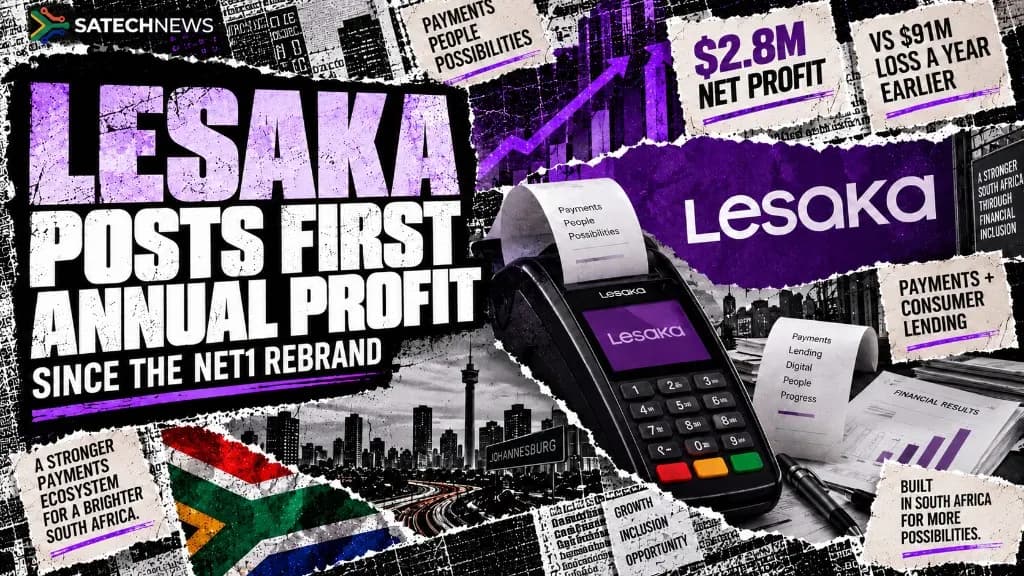
Lesaka Technologies has reported its first full-year net profit since the former Net1 business was rebranded in 2022, marking a major turnaround milestone.
Lesaka Technologies has crossed an important line in its turnaround, reporting its first full-year net profit since the South African fintech group emerged from the former Net1 UEPS Technologies in 2022.
For the year to June 2026, Lesaka reported group-level net profit of $2.8 million, roughly R47 million at the exchange rate cited in local reporting. A year earlier, the group recorded a $91 million loss.
The swing does not mean every part of the business is suddenly simple. Lesaka has spent several years buying, integrating and reshaping businesses across merchant payments and consumer financial services. What the latest result does provide is evidence that the combined operation can produce a bottom-line profit after that restructuring.
The company has also completed a brand refresh built around a “One Lesaka” strategy. The objective is to reduce the complexity created by multiple acquired businesses and present a more integrated financial-services and payments platform to merchants and consumers.
Lesaka operates across a broad set of services, including merchant acquiring, cash management, transactional accounts, lending, insurance and software. Its customer base is concentrated in Southern Africa, with a particular focus on merchants and consumers that are underserved by conventional financial institutions.
That mix puts the company in a different position from a pure digital bank or a single-product payments startup. Its opportunity is to make the various pieces reinforce one another; its risk is that integration costs and operational complexity can erode those benefits.
The first annual net profit since the rebrand is therefore more significant than the headline number alone. It gives investors a cleaner way to judge whether the strategy is moving from acquisition-led scale to sustainable earnings.
South African payments has become increasingly competitive. Banks, fintech startups, mobile operators and large retail groups are all building products around digital payments, merchant services and lower-cost financial access.
Lesaka’s advantage is the physical and digital footprint it has assembled, particularly in merchant payments and cash-heavy parts of the economy. The company has also been simplifying its identity at a time when customers increasingly expect financial products to work as one service rather than as a collection of separate brands.
Profitability will now raise the bar. A single profitable year establishes a milestone, but the next test is whether Lesaka can repeat it while continuing to invest in its platforms and integrate the businesses it has acquired.
For South Africa’s fintech sector, the result is another sign that the market is moving beyond a simple contest between incumbent banks and venture-backed apps. Large technology-enabled financial groups are increasingly competing across the same merchant and consumer relationships.
Source: SA Tech News


