
Breaking
Latest tech news from South Africa and around the world•Stay updated with breaking technology developments•Innovation and digital transformation news•AI, gaming, and gadget updates daily•Crypto and fintech news from Africa•
 SA Tech News Desk
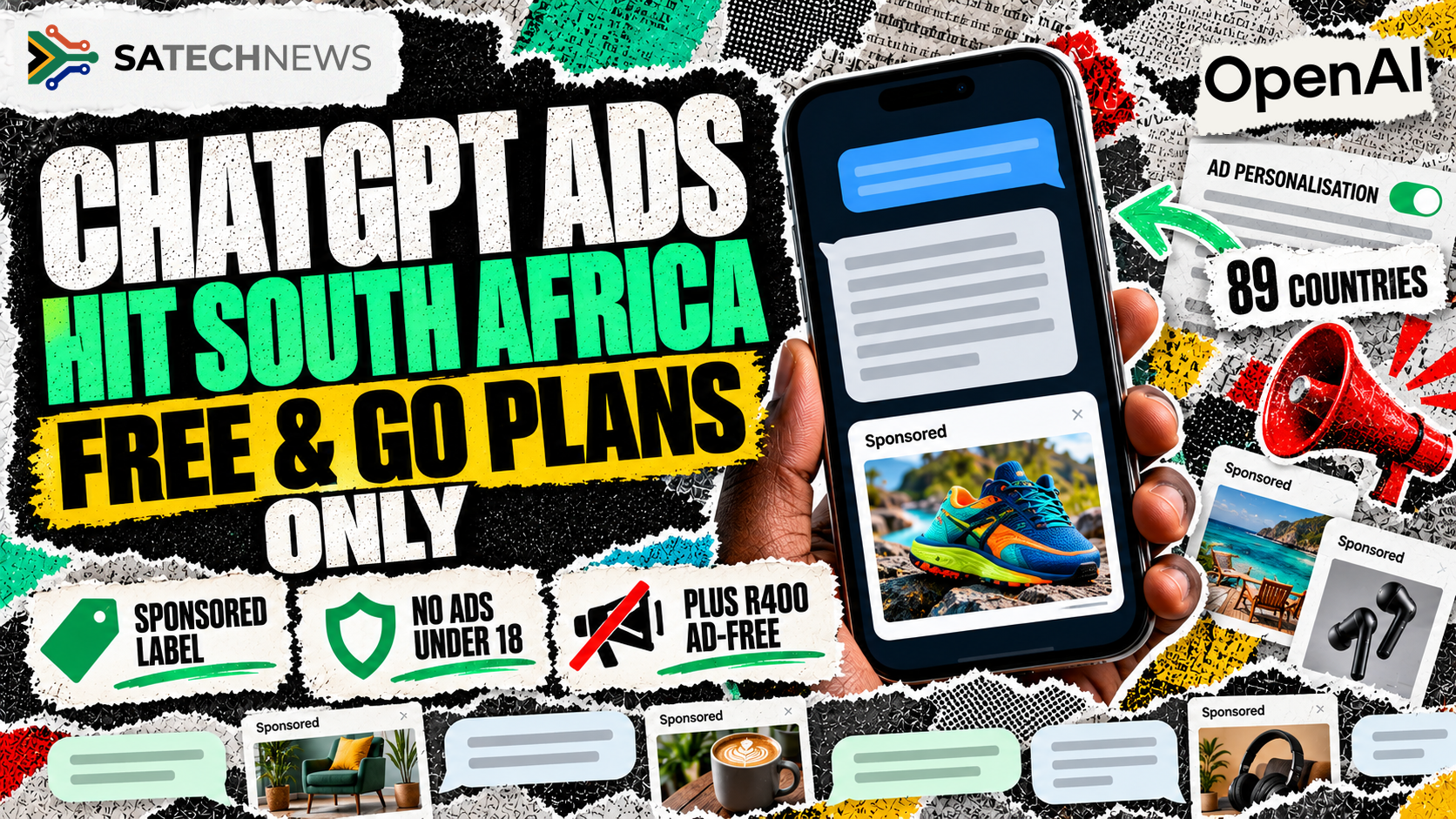
OpenAI is bringing ads to ChatGPT's Free and Go plans in South Africa. What users will see, what advertisers get, and the POPIA questions still open.
South Africans who use ChatGPT without paying, or on the low-cost Go plan, will now see adverts in the chatbot. OpenAI said on 21 October that ChatGPT Ads are expanding to 26 more countries, taking the total to 89, and South Africa is one of the 11 it named.
Local users started receiving emails about the change and an updated privacy policy earlier this week, according to MyBroadband and Stuff. Paying more removes the ads: Plus, Pro, Business, Enterprise and Education accounts stay ad-free. Stuff lists Plus at R400 a month in South Africa.
The change puts sponsored products inside a tool people use for homework, job applications, health questions and business planning. How those ads are targeted, and what South African privacy law says about that targeting, now matters to every free user here.
OpenAI says ads are labelled as sponsored and shown separately from ChatGPT's answer. The company says ads do not influence what ChatGPT tells users. That separation is the claim a reader has to hold onto: the answer and the advert are supposed to be different things on the screen, and the advert is supposed to be marked.
Users under 18 are not shown ads, based on the age on their account and OpenAI's age prediction. The exclusion is therefore only as good as the age on the account and the prediction. OpenAI has not published, in the material we checked, how that prediction works for South African accounts or what happens when an adult and a child share a login.
Targeting uses information that stays inside ChatGPT, including the context of the conversation and how a user has interacted with earlier ads. A person who asks about laptops, bank accounts, schools or clinics is handing the ad system the subject of that conversation. Users can manage ad personalisation in their settings. OpenAI's own guidance, quoted by MyBroadband, says "advertisers do not have access to your chats, chat history, memories, or personal details", and that advertisers receive only aggregate figures such as views and clicks.
Those two sentences do different jobs. The first says the advertiser does not get the chat. The second says the advertiser still gets counts: how many people saw the ad and how many clicked. Aggregate figures are not a transcript. They are still a measurement of the audience OpenAI assembled from conversation context.
OpenAI began testing ads in the US in February and opened its self-serve Ads Manager in April with no minimum spend. It says more than 100,000 advertisers have run campaigns. In the expansion announcement, OpenAI said advertisers can reach the new countries through technology partners or self-service access through Ads Manager.
It has not said whether South African-registered businesses can buy through Ads Manager themselves. When OpenAI expanded into South-East Asia, self-serve access was limited to advertisers whose legal entity was based in a listed country. That earlier limit is why the South African question is still open. A local company should not assume that a tool which is live for users is also live for buyers.
MyBroadband reported that the ads South African users may see so far are not from local companies. If that pattern holds, the first adverts in a South African chat may be for products and brands that are not priced, stocked or regulated here. The reader still sees them next to an answer about a local decision.
For local marketers, this is a new channel competing with Google search and Meta's apps for the same budgets. A person asking ChatGPT which laptop to buy or which bank account suits them is close to a purchase, and that is the audience advertisers will pay for. The channel only becomes a South African media buy if local advertisers can actually place the campaign, which OpenAI has not confirmed.
Advertising is now a large business for OpenAI. In August, the ads product was reported to have passed a $1 billion annualised revenue run rate, less than 200 days after testing began. That figure is a run rate, not a South African revenue number, and it is not a promise about what Free or Go will cost here.
OpenAI says ChatGPT has more than a billion weekly users, and it describes advertising as one part of a wider business model alongside subscriptions. The South African split of that user base has not been published. The local price that has been published is the one Stuff lists for Plus: R400 a month, which is the tier that stays ad-free along with Pro, Business, Enterprise and Education.
Free and Go are the plans that carry the ads. Plus is the cheapest named way off them. Anyone deciding whether R400 is worth it is deciding whether they want the sponsored slot gone, not whether the underlying model has changed. OpenAI says the ads do not change the answer. It has not said the subscription price will stay at R400, or what Go costs in rand, now that free users are an advertising audience.
South Africa's Protection of Personal Information Act requires companies to tell people how their data is used and to limit processing to a defined purpose. OpenAI has updated its privacy policy, but we could find no public comment from the Information Regulator on ChatGPT ads. Whether conversation-based targeting fits local rules on processing personal information has not been tested.
The practical questions for a South African user are narrower than the global launch. Which plan they are on. Whether the account is treated as under 18. Where in settings ad personalisation can be turned down. Whether the advertiser is a company they can actually buy from here. None of those is answered by the headline that South Africa is one of 89 countries.
OpenAI also hasn't published how many South Africans use ChatGPT, or whether rand prices for Go and Plus will change now that free users bring in advertising revenue. Until it does, the local story is the one in the email and the privacy update: ads are on for Free and Go, they are off if you pay for Plus or above, and the regulator has not yet said whether the targeting is acceptable here.
Source: SA Tech News


