
Breaking
Latest tech news from South Africa and around the world•Stay updated with breaking technology developments•Innovation and digital transformation news•AI, gaming, and gadget updates daily•Crypto and fintech news from Africa•
 SA Tech News Desk
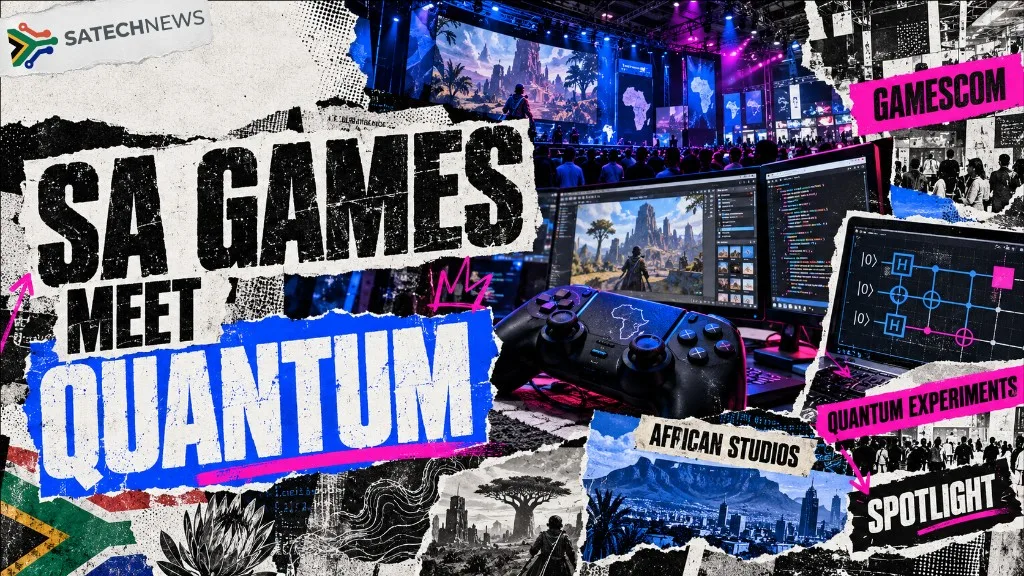
African studios, including South African developers, shared a Gamescom showcase with experimental quantum-computing game projects — useful exposure, not proof that quantum gaming has arrived.
South African and other African game developers shared space at Gamescom 2026 with an unusual neighbour: experimental game projects using quantum-computing techniques.
The link-up matters less as a claim that quantum gaming has arrived and more as a sign that African studios are appearing in the same indie-development spaces where new tools get tested. South African developers were part of the Games From Africa showcase inside the W Love Games booth in Germany.
MiTale showed Clay – The Last Redemption, a post-apocalyptic role-playing project that uses simulated quantum circuits to influence narrative dynamics, procedural environments and selected visual effects. The current build does not require a quantum computer to run.
Moth, a quantum-technology company working across games and creative media, showed a more direct hardware connection. Its Quantum Backrooms project uses jobs run on real quantum computers to shape changing maze structures, and the company invited developers to apply for early access to its platform.
That distinction is the whole story for readers who only see “quantum” on a Gamescom banner. Much of the work remains experimental. A conventional PC or console is still doing the work players see. The research question is whether quantum processes can eventually become useful creative inputs rather than a marketing label stuck on a normal game.
Games From Africa featured projects from Ghana, Kenya and South Africa alongside the quantum work. The line-up included Africanfuturist and mythology-inspired titles, putting African studios in front of the international developer and publishing audience that gathers around Gamescom’s Indie Arena.
For South African developers, the practical opportunity is not a sudden need to learn quantum programming. It is exposure to a broader toolchain and to research groups trying to make unfamiliar computing resources accessible to game creators — plus the ordinary Gamescom value of meetings, press and publisher traffic that are hard to assemble from Johannesburg or Cape Town alone.
Sharing a booth with experimental tech also changes how African games are framed. They are not only regional curiosities on a cultural stage; they sit next to people stress-testing new development ideas. That does not guarantee investment. It does widen the conversation beyond “local flavour” as the only pitch.
Gamescom rewards novelty. Quantum circuits on a booth screen get attention that a competent mid-tier mobile title may not. The Wire Room test is whether any of that novelty becomes a library, an API, or a workflow South African studios can afford to use after the show floor closes.
Until then, the African showcase remains the more durable story: presence in Indie Arena conversations, peer contact with experimental teams, and another year of South African games being visible without needing a separate “Africa pavilion” caveat.
Whether any of these experiments will produce development tools that are cheaper, faster or creatively useful enough to survive outside research showcases remains unanswered. Quantum labels travel easily at trade shows. Durable tooling does not.
For now, the more concrete signal is simpler: African studios, including South African teams, are increasingly present where those experiments happen. That presence is useful. Treating it as a finished quantum-gaming breakthrough would oversell what Gamescom actually showed.
Source: SA Tech News Desk


